
From March 11 to 13, 2026, the National Exhibition and Convention Center in Shanghai hosted the spring edition of the China International Clothing & Accessories Fair (中国国际服装服饰博览会) under the theme “Finding Spring”. More than 1,291 exhibitors from over 10 countries and regions presented 1,335 brands across 12 zones covering fashion trends, menswear, womenswear, outdoor sports, Chinese-style clothing, and design power. One phenomenon stood out on the fairgrounds widely treated as a barometer of China’s apparel industry: the newly created “Chinese-style clothing” zone and the “design power” zone, both newly and explicitly dedicated to Chinese aesthetics, drew the heaviest foot traffic of the entire show. Industry data puts the current Chinese-style apparel market at 200 to 300 billion yuan, with room still expanding. From wholesale stalls to brand counters in high-end malls, from the traditional crafts of Lingnan to the weaving heritage of Suzhou, a transformation of Eastern aesthetics is running through the warp and weft of China’s garment industry.
What Counts as Neo-Chinese: A Definitional Contest
Chinese-style apparel (Guofeng, 国风) is rooted in the traditional dress systems of China — Hanfu, Qipao, Tang suit, Song-style garments — and fuses traditional aesthetic elements with modern design thinking. Unlike retro or restorationist Chinese clothing, the goal is to keep the core of Eastern culture while fitting contemporary life and taste; the category is deliberately broad, taking in any garment that carries Chinese elements. The country’s “kingdom of clothing” past left an exceptionally rich wardrobe heritage, and that archive is the bottomless source pool for Chinese-style design and production.
Chen Dapeng (陈大鹏), vice president of the China National Textile and Apparel Council and president of the China National Garment Association, pointed at the deeper social shift behind the boom: “The post-60s and post-70s generations — people with taste, cultural aspiration, and spending power — are becoming the mainstream, and their changing sense of fashion is reshaping the clothing market.” In his view the most important question of the next decade for China’s apparel industry is the move from an industrial-manufacturing model to a cultural-creative one: “Cultural attributes are becoming the most important attribute of clothing.” The shift is already visible in small places: last year, in an otherwise difficult season for the industry, one embroidery artisan who makes purely handmade buttonholes on custom order — just that single narrow specialty — earned USD 2 million in a year for his team. “The clothing industry is no longer an era of chasing scale and expansion; the market is more segmented, the tracks more focused, and success belongs to those who go deep in one specific field.”
Chen argues that for Chinese style to become a true fashion current, the key is “creative transformation,” not replication. “We cannot go back to a retro past of separate upper and lower garments. The goal is to dissolve China’s excellent clothing culture into contemporary design — open-ended fusion rather than simple symbol grafting — so that one glance reads as Eastern, yet the garment truly fits contemporary life and contemporary aesthetics.” Exposure through young people wearing Hanfu and period-drama costume restoration has taught the public about Chinese dress, he acknowledged, but Chinese style cannot be confined to niche occasions: “What matters more is dissolving the spirit of Eastern culture into contemporary garment design. Cultural revival is never a return to the past; it is creation again. It must be contemporary and international. You wear it out, people find it beautiful — it is the beauty of the East — and yet it does not look strange. That is successful creative transformation.”
Fabric Narratives: Song Brocade, Xiangyunsha and Old Silk
In the Chinese-style landscape, fabric is the most basic narrative language. At the fair, Song brocade and Xiangyunsha (香云纱) were the two most visible materials.
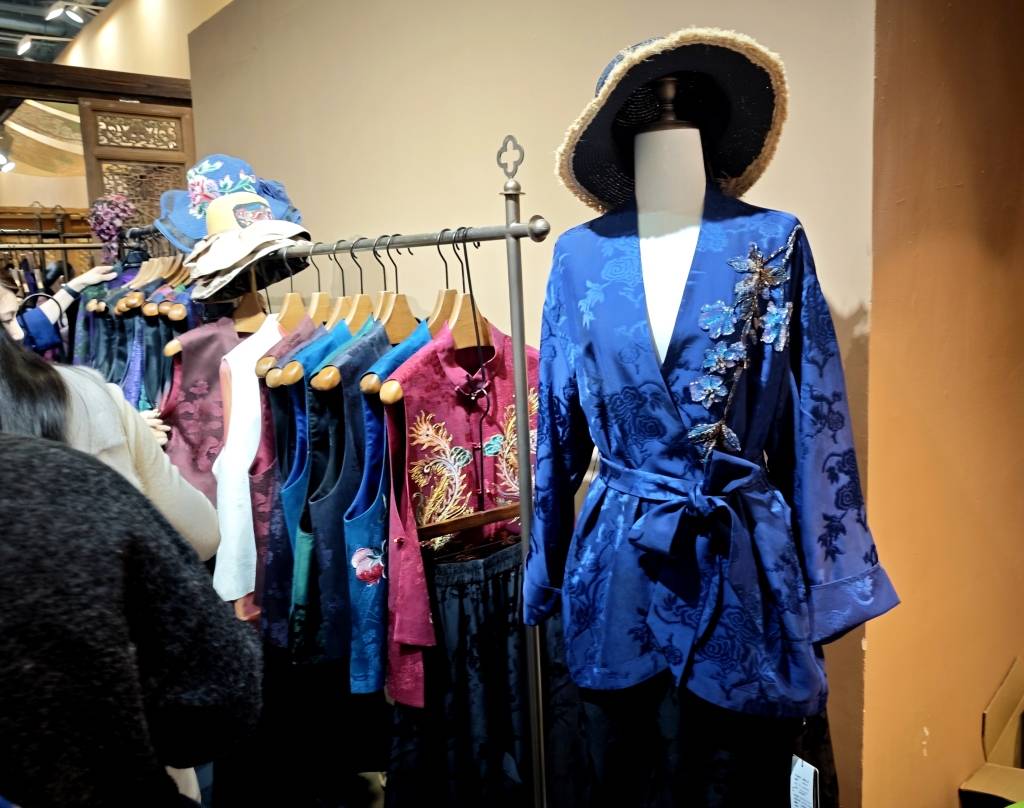
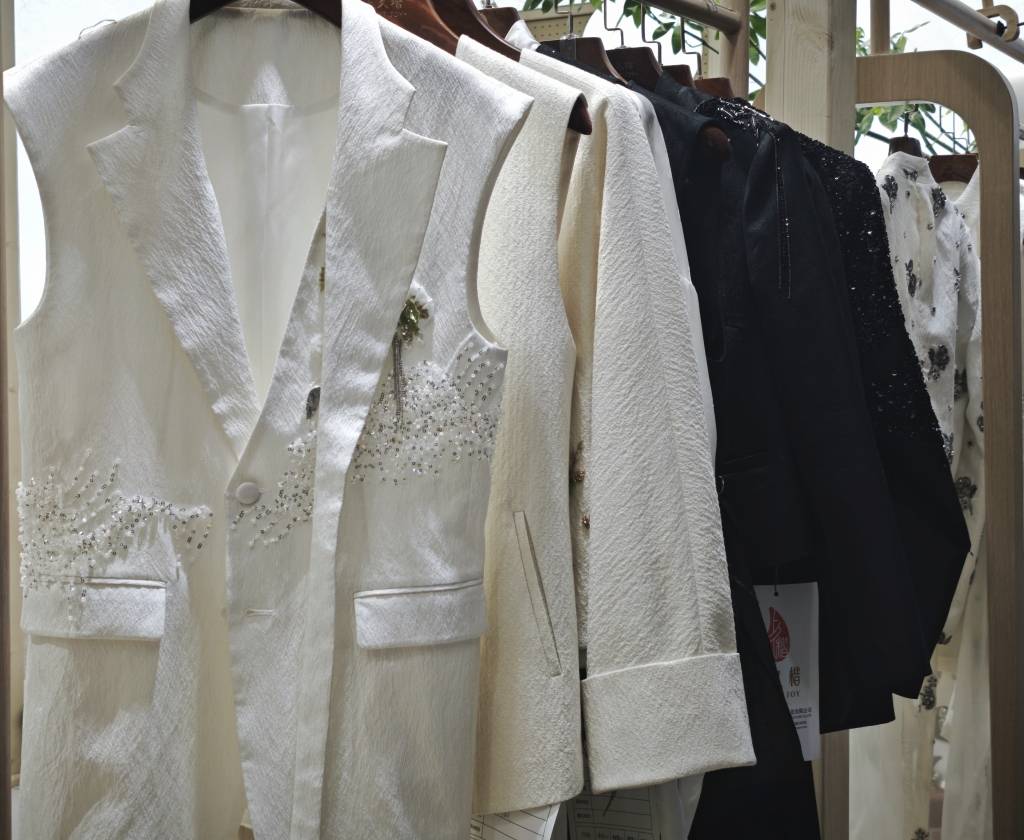
Wu Zhenfei (吴振飞) of the Shangjiukai (上久楷) booth explained that the sophisticated technology of Song brocade matured as early as the mid-to-late Tang, but the name “Song brocade” itself was born centuries later, in the Ming: in the early Ming, during the wave of restoring Han culture, weaving craftsmen copied a surviving Song album of patterns and produced more than twenty designs, then called “brocades woven in imitation of Song gold brocade.” The name dates from the Ming onward. Functionally, ancient Song brocade was not primarily clothing material — what museums hold is more often used for scroll mounting and home décor, such as the seat cushions of the Qianlong emperor’s Three Rare Treasures Studio (三希堂), reflecting the fabric’s firm texture and durable construction. Song brocade is woven on jacquard looms, with warp threads divided into face warp and ground warp; weft threads alternate in multiple colors to create color gradients, and the result is smooth on both faces, tough yet supple. “Compared with fragile silk, Song brocade is dense and resistant to snagging, and with fine patterns even light soiling is barely visible — that is the deep reason for its recent popularity,” Wu said. “In 2017, Song brocade appeared on leaders’ garments at the APEC meeting, which boosted its rise.” Against the long-standing homogenization of the Chinese-style market — “look at the market three years ago, and it was almost all Song-brocade waistcoats and Neo-Chinese jackets” — Shangjiukai has spent two years on fusion experiments: adding Pankou (盘扣) knots to Western garment silhouettes, or treating dense Song-brocade patterns as subtle tonal textures presented through Western cutting. “Most people are really chasing ‘one bright spot’ in everyday dress — a spot that comes from Chinese elements but does not make the wearer look out of place in work or social settings.”
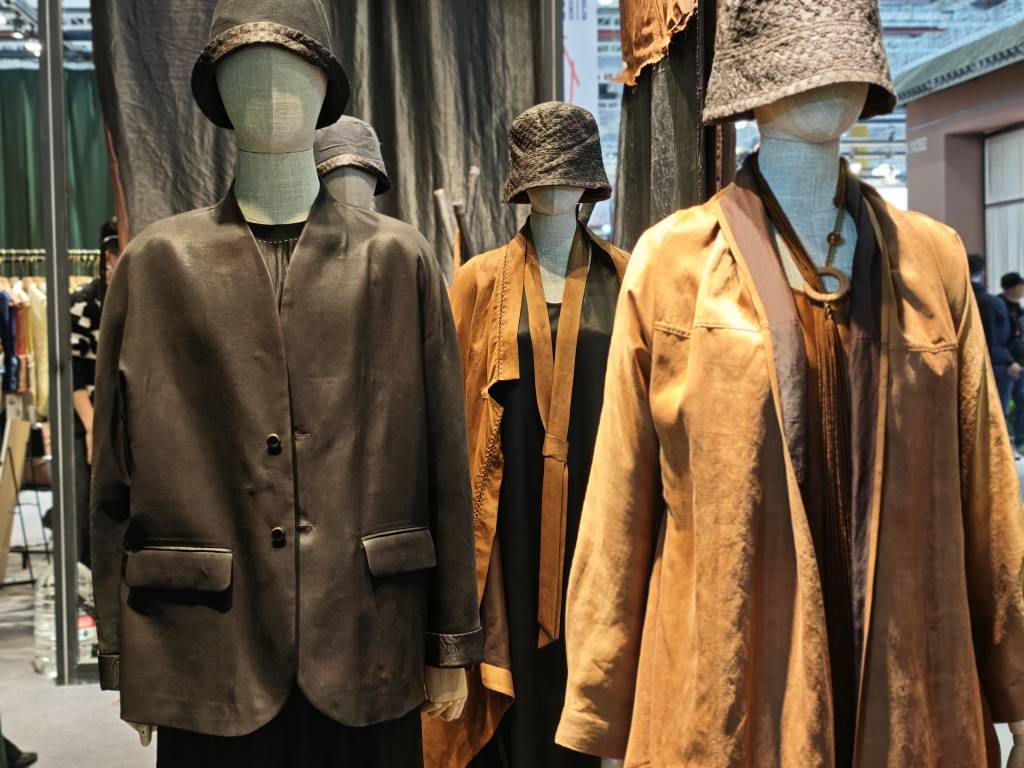
Xiangyunsha is an ancient hand-woven, plant-dyed fabric of the Lingnan region: raw silk ground cloth soaked in the juice of the shuliang vine, a plant native to Guangdong, then covered with mineral-rich river-mud and sun-cured — muted in color, tough in texture, long nicknamed “soft gold.” Ms. Wang, founder of the Baishanv (白沙女) brand and a wholesaler doing business in Hangzhou for fifteen years, said the current strategy is to “add” to mature techniques: laying Panjin embroidery (盘金绣), Miao embroidery (苗绣), and French embroidery onto Xiangyunsha. Miao embroidery — the hereditary needlework of Miao women, brilliantly colored, boldly patterned, and sharply original — sets off Xiangyunsha’s quiet depth; French embroidery, with its strong three-dimensional relief, strikes a different kind of collision with the warmth of Chinese ground fabrics. She also introduced a rare product line: garments cut from old satin. “These old satins are bridal quilt covers from village weddings of the 1970s-80s, some even from the 1950s-60s — mulberry silk, well preserved, many never used. We recover them and make them into clothes.” After fifty or sixty years, old satin has mellowed in color, far gentler than new satin’s glare. Against rampant copying, her countermeasure is to “raise the difficulty of copying”: Xiangyunsha alone has a production cycle of over half a year, and stacking complex Panjin and French embroidery on top means a competitor needs at least six months to a year to imitate — a product moat built by time.
Lipstick Economics: Lowering the Threshold of Eastern Beauty
Some players in the Chinese-style chain are finding other paths. Zhang Bo (张博), founder of Yipin Huashang (一品华裳), said the traditional agency and store networks of the apparel industry are under siege — “the jars and pots of the old era have already been smashed.” His experiment is to make products a “plug-in” for other brands: partnering with established women’s-wear stores to supply Chinese-style accessories within the same space, and linking with fabric brands to provide gifts and show merchandise. On the craft side, embroidery applications keep widening: embroidery on sheer silk gauze (真丝绡), whose transparency suits round fans and room screens as soft furnishing; embroidery on wool, which solves the wrinkling that wool’s softness and elasticity create and wins its own niche. The price ladder runs from embroidered trinkets at a hundred yuan to scarves at several thousand and screens above ten thousand — the logic being to “keep the threshold of Eastern aesthetics from getting too high”: a several-thousand-yuan Song-brocade garment daunts many buyers, but cheap embroidered ornaments and cushions draw far more people into contact with and acceptance of Chinese-style products. It fits the lipstick-economy pattern: in volatile economic stretches, small self-pleasing purchases tend to show the most resilience.
Design Power: From 1-Millimeter Ceramics to Nushu Brooches
Emerging accessory designer Zeng Wenyuan (曾文渊) proposes a three-layer theory. First, material deconstruction — in his own brand’s practice, firing traditional ceramic down to a thickness of one millimeter through technical innovation to create a category of miniature ceramic jewelry: “We look for the roots of heritage in material expression; clay, lacquer, wood, handcraft — these are the skeleton that carries tradition.” Second, aesthetic deconstruction — young designers must use contemporary taste and cultural understanding to unpack the overly heavy historical burden of heritage crafts and convert it into new forms that follow modern visual logic. Third, reconstruction of cultural structure — “Heritage cannot stay on paper and in museums as untouchable exhibits; through our expression it must enter the use-scenarios of real life.” Yan Hongyu (阎红玉), curator of the “Sanshengwan” (三生万) heritage digital art exhibition, agrees, citing the Nushu brooch she wears: Nushu (女书), the world’s only female-only script, is a national-level intangible cultural heritage item. “Design can turn Nushu into a brooch, plant dyeing into ceremonial dress, lacquerware into everyday tea sets.” Design is a light and powerful translator that converts millennia of weight into aesthetic symbols a contemporary audience can readily accept.

Market Data: A Trillion-Yuan Imagination
Seen from the macro level, the Neo-Chinese and Chinese-style apparel market is still expanding fast. According to People’s Daily, the market for Neo-Chinese-driven trendy apparel exceeded 220 billion yuan in 2024 and was projected to pass 250 billion yuan in 2025. In the first quarter of this year, Kuaishou e-commerce data showed orders for “Neo-Chinese” style products up 700 percent year on year, and Hanfu category orders up nearly 300 percent. Technical fabrics are becoming a new variable: machine-washable, sun-protective silk frees real silk from delicate care; the Hangzhou brand Yimingge (邑铭歌) uses “butterfly satin” ground cloth combined with Xiangyunsha technique and AI-assisted weaving to produce 55 million three-dimensional weave points per square meter on silk, rendering fine gradients or complex patterns — the company’s Neo-Chinese clothing sales grew nearly 20 percent last year. Between the 200-to-300-billion-yuan market and deep specialization in sub-tracks, between the craft revival of Song brocade and Xiangyunsha and the lipstick economics of embroidery and accessories, the Neo-Chinese wave is weaving itself — softly but steadily — into how Chinese people dress and live.