
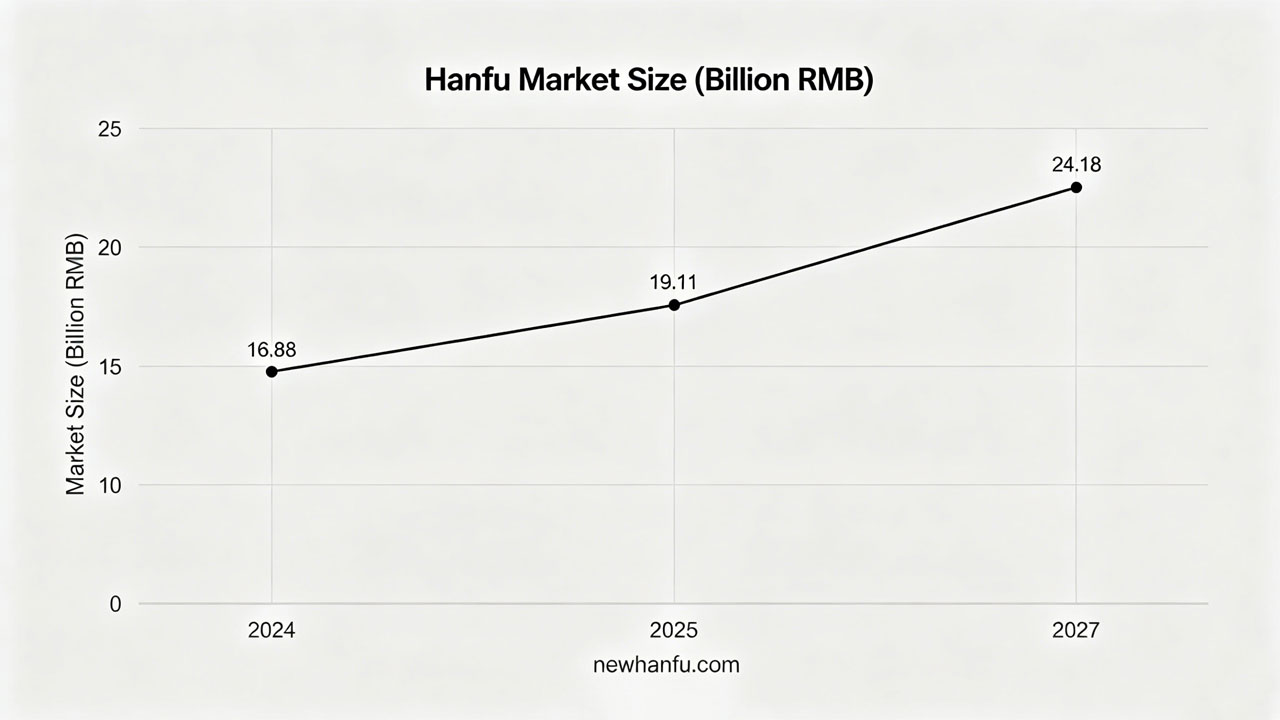
Executive Summary: 2025 was the year Hanfu stopped being a “costume” and started becoming a wardrobe staple. As the market crossed 19 billion yuan (approx. US$2.64 billion) and daily wear adoption surged past 34%, the industry faced a new set of challenges: how to scale without losing authenticity, how to export without cultural dilution, and how to turn a social media spectacle into a sustainable business.
This report does not repeat a standard market breakdown. Instead, it analyzes five seismic shifts that defined Hanfu in 2025 — from the “mamianqun explosion” to the rise of AI-aided design, from cross-border supply chains to the quiet tension between purists and everyday wearers. All figures are sourced from iiMedia Research, Alibaba International, public government data (Caoxian County), and platform reports (Douyin, JD.com).

1. The “De-Ceremonialization” of Hanfu: Daily Wear Beats Festival Wear
For years, Hanfu was synonymous with garden parties, photography sets, and traditional holidays. In 2025, that narrative flipped. Surveys indicate that 34.56% of Hanfu consumers now wear the garments in daily life — commuting, shopping, meeting friends — overtaking “festival wear” (40%) as the second most common scenario and closing in on “photo shoots” (45%). The single biggest driver? The mamianqun (horse-face skirt).
What made the mamianqun different from earlier Hanfu pieces? Designers stripped away heavy ornaments, introduced lighter wool-blend and cotton fabrics, and created versions that pair with sneakers and plain sweaters. On Douyin, the hashtag #mamianqun daily wear generated over 9 billion views in the first half of 2025 alone. One Caoxian manufacturer told a local reporter: “Two years ago, 80% of our orders were for full-set costumes. Today, 70% are for mix-and-match mamianqun skirts.” This shift is not minor — it signals that Hanfu is joining fast fashion as a daily category.
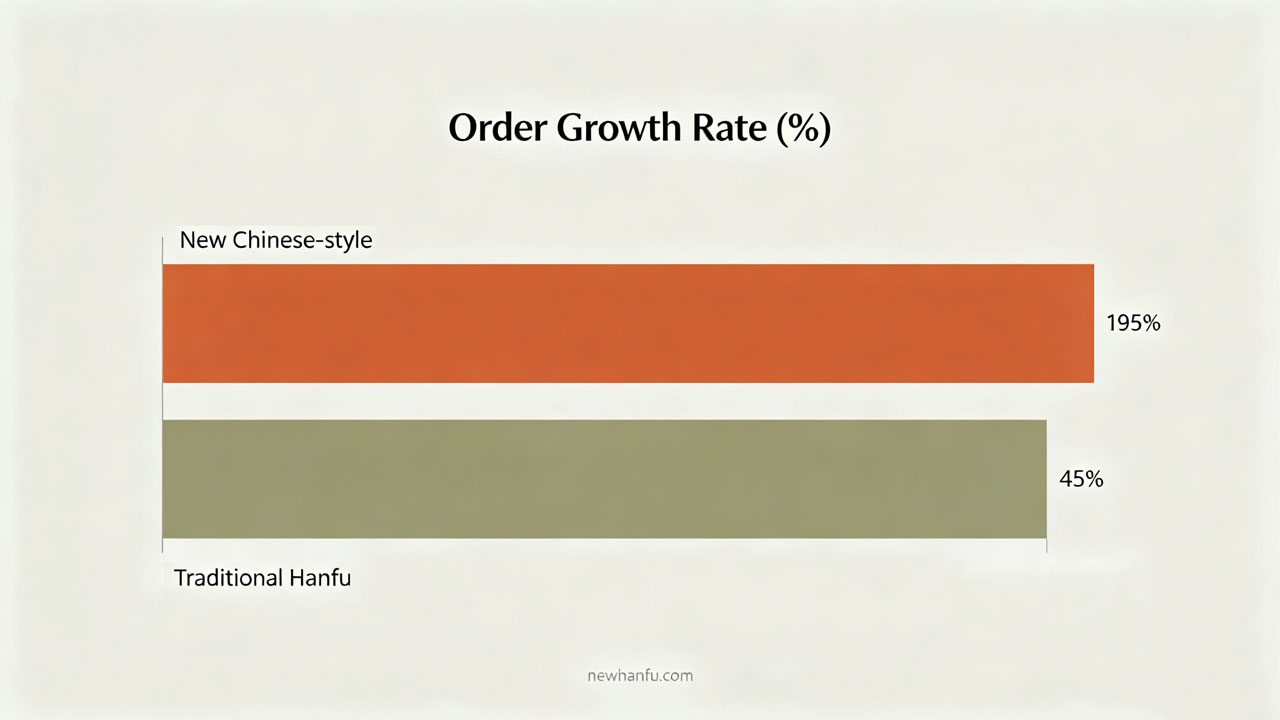
Yet friction remains. A consumer survey found that 30% of potential buyers still feel Hanfu is “too conspicuous,” and 25% find it impractical. The industry’s answer in 2025 was “Han-element” (New Chinese-style) clothing — a bridge category that retains traditional cuts but uses modern zippers, shorter hemlines, and machine-washable fabrics. Orders for such items on Douyin grew 195% year-on-year, far outpacing traditional authentic Hanfu (45% of products but slower growth).
2. From Volume Play to Value Play
Caoxian, Shandong — the village cluster that produced half of China’s Hanfu — entered a new phase in 2025. With 2,822 enterprises, over 15,000 online stores, and 100,000 workers, it grew sales to 13+ billion yuan (up from 12 billion in 2024). But the more interesting story is qualitative: Caoxian is no longer just a cheap reproduction hub.
Local authorities pushed a “three transitions” policy: from copycat designs to original IP, from unbranded to brand-led, and from low-price competition to mid-to-high-end quality. The result? The average selling price of a Caoxian mamianqun rose from 180 yuan in 2023 to 320 yuan in 2025. The number of design patents filed by Caoxian firms surged by 140% year-on-year. One workshop that used to replicate museum pieces now employs in-house illustrators who blend Song dynasty motifs with cyberpunk aesthetics.
But scale brings new risks. Overcapacity is a real threat. A Caoxian industry insider told a finance outlet: “Everyone saw the mamianqun frenzy and bought jacquard machines. By mid-2025, fabric supply exceeded demand by 30%. Prices are dropping again.” This signals a coming consolidation: weaker copycat vendors will be squeezed, while original brands with loyal following will survive. 2025 may be remembered as the year Caoxian learned to say “no” to race-to-the-bottom pricing.
3. The Cross-Border Leap
International expansion in 2025 was not a gentle rise — it was a rocket. Chinese traditional apparel exports grew 33% year-on-year in Q1 2025. Europe took 42% of the market, but the real fireworks were in unexpected places: Middle East +80%, Latin America +80% (with Chile surpassing +70%). On Alibaba International Station, Hanfu orders from France jumped 125%; from Saudi Arabia, 40%.
Why? Three drivers converged. First, sustainable fashion — European buyers saw natural-dyed, linen-based Hanfu as an eco-friendly alternative to fast fashion. Searches for “organic cotton Hanfu” rose 140%. Second, the Middle Eastern appetite for luxury custom robes — UAE buyers spent an average US$500+ per transaction on high-end embroidery. Third, Latin America’s folk revival — Mexican wholesalers ordered embroidered shawls (inspired by Hanfu pibo) in batches of 100,000+.
However, cultural friction surfaced. Some Western influencers wore mamianqun as “aesthetic exotic wear” without context, prompting online debates about respect vs. appropriation. In response, Caoxian’s government launched “Hanfu Culture Export Guidelines” in mid-2025, requiring merchants to include a short cultural card with each overseas shipment — explaining the skirt’s Song Dynasty origins and the meaning of each pattern. A small step, but a recognition that export is not just logistics but storytelling.
Another interesting twist: reverse adaptation. To fit Western body types, manufacturers added larger sizes and raised waistlines. To fit Middle Eastern modesty norms, they designed longer-sleeve, higher-neck Hanfu variants. Some purists complained about “distortion.” But as one brand owner argued: “If we don’t adapt, Hanfu stays a museum piece. Adapting is how it lives.” The debate will likely continue into 2026.
4. Social Commerce Over Search
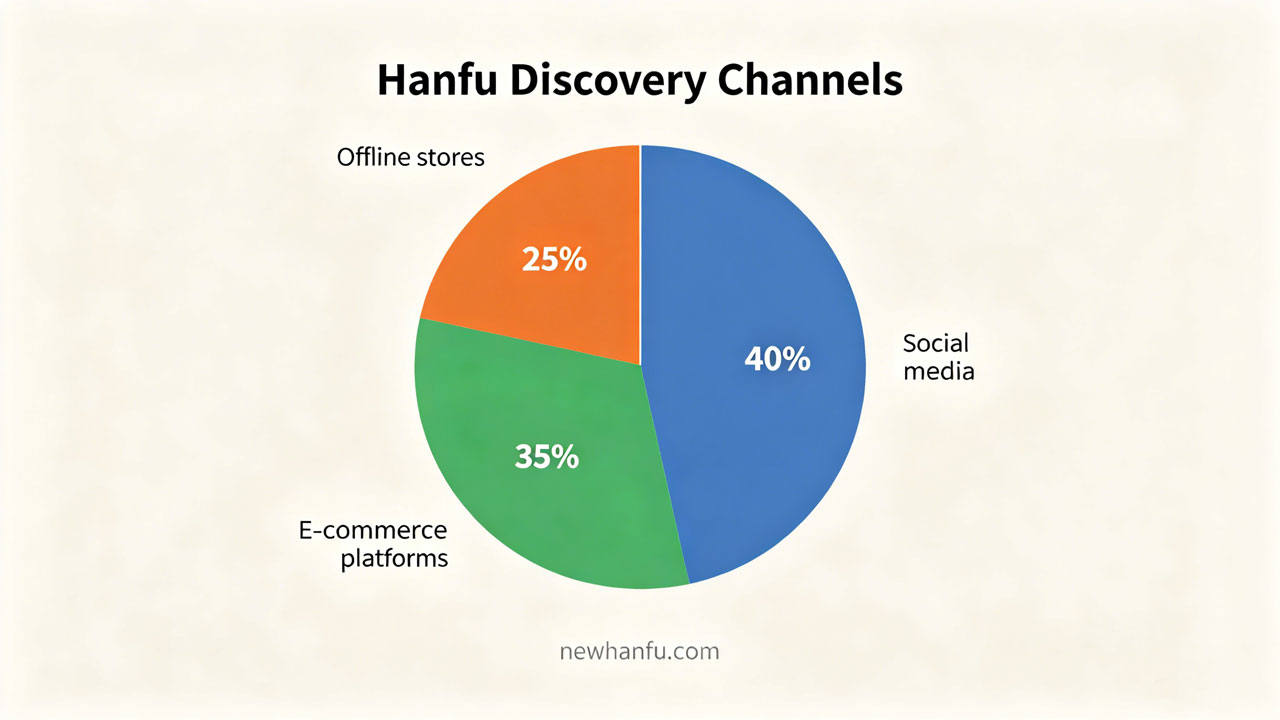
In 2025, over 40% of consumers discovered Hanfu through social media — not through search engines or shopping platforms’ internal browse. Douyin (TikTok) and Xiaohongshu (Little Red Book) drove the majority of new customer acquisition. This changes everything: design cycles now follow TikTok trend cycles.
One case study: a small designer from Hangzhou posted a 15-second video of a “reversible mamianqun — floral on one side, solid on the other.” It got 3 million views in a day. Within two weeks, she sold 50,000 units. The traditional product development cycle of 6 months compressed to 2 weeks. This speed benefits nimble makers but also fuels copycat culture — a design that goes viral on Tuesday will appear on budget stores by Thursday.
Platforms responded with tighter IP protection. Douyin launched a “Hanfu Originality Verification” badge in May 2025, requiring sellers to upload design registrations. By year end, over 8,000 designs had been verified, and the platform removed 32,000 knock-off listings. But the battle is far from won.
5. AI Jacquard and Smart Fabrics
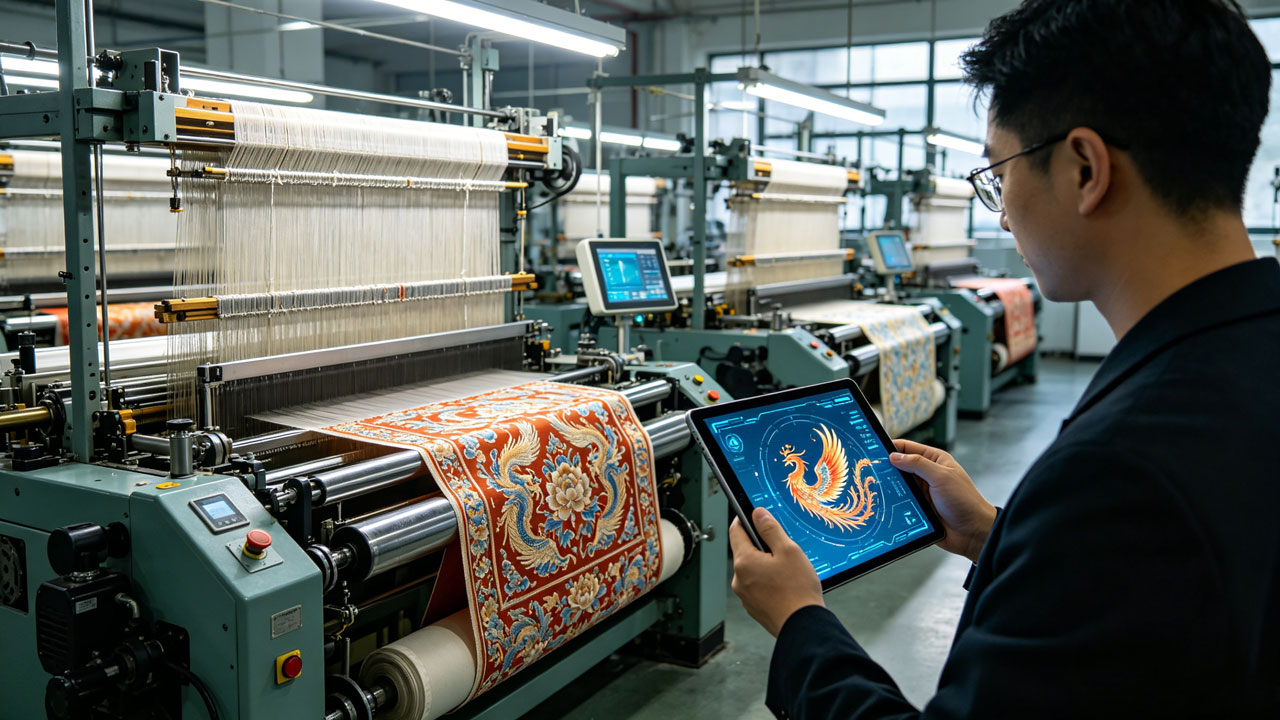
2025 was also the year Hanfu production quietly digitized. The most visible sign: AI-aided pattern generation. The brand “Luoruyan” launched an “AI + Hanfu” intelligent design system that generates a thousand novel brocade patterns from a single historical motif — and then ranks them by predicted popularity based on social media sentiment analysis. It sounds futuristic, but it’s already in use: their AI-designed “digital phoenix” series became a top seller in Q3.
On the manufacturing floor, jacquard machines in Caoxian now run 24/7, each producing 600 meters of fabric daily. One manufacturer received a single order for 10,000 meters of mamianqun brocade — to be delivered within two months. This would have been impossible without computer-aided weaving.
Even materials are evolving. “Fragrant Hanfu” — woven with peony, rose, or lotus fibers — appeared on the market, offering natural scent retention. While still niche, it signals a direction: Hanfu competing on sensorial experience, not just visual spectacle.
6. Challenges Not Talked About Enough
No annual report is honest without a “dark side” section. Here are three uncomfortable truths for Hanfu in 2025:
- Inventory pile-up: Because of the viral-driven demand, many small brands over-ordered fabric before a trend fades. When the “Song dynasty thin-hemp” trend cooled after three months, dozens of workshops were left with tons of unsold grey fabric.
- Gender imbalance: Women remain ~70% of buyers. Men’s Hanfu — especially the elegant “daopao” and “yuanlingpao” — is growing slowly (roughly 15% year-on-year), but the market is still heavily skewed. Efforts to design masculine, less theatrical men’s Hanfu for daily wear have yet to break through.
- Rental market cannibalization: With many consumers still unwilling to buy (30% say “too conspicuous”, 25% say “inconvenient”), 60.71% opt for rental at scenic spots and experience centers. That’s a thriving business for tourism operators, but it means actual garment sales don’t reflect true interest. One expert estimated that only about half of Hanfu wearers in public own their outfit — the rest rent by the hour.
7. Looking Ahead to 2026–2027
iiMedia Research projects the total Hanfu market to reach 24.18 billion yuan by 2027, with the number of enthusiasts topping 14.3 million. But the real shift will be from “enthusiasts” to “general consumers.” The industry must solve the practicality problem: lighter fabrics, easier fastenings (instead of traditional ties), and machine-washable embroideries. Early movers in this direction are already gaining share.
Also watch for Hanfu as service — subscription boxes, styling apps, and virtual try-on using AR filters. In 2025, the Xitang Hanfu Culture Week already introduced a “Hanfu + music” hybrid concept, hinting that the garment is becoming a lifestyle platform, not just a product.
Finally, international expansion will shift from B2B bulk orders to B2C brand building. Chinese Hanfu brands are quietly opening flagship stores on Amazon Japan and Zalando in Europe. The next two years will tell whether “made in Caoxian” can become a recognized brand like “Made in Italy.”
Conclusion: 2025 was not a year of revolutionary breakthroughs but of quiet maturing. Hanfu moved from costume to clothing, from Caoxian to Colombia, from hand-drawn to AI-generated. The challenges are real — overcapacity, cultural friction, male market gap — but so are the solutions. For an industry that was almost invisible a decade ago, this level of self-reflection is itself a sign of health.
Data sources: iiMedia Research (2025 China Hanfu Industry Development Report), Caoxian County Government Statistics (2025), Alibaba International Station Q1 2025 Cross-border Apparel Report, Douyin E-commerce Annual Trends 2025, JD.com 618 and Double 11 Battle Reports, Huaxinren Consulting. All numerical conversions from yuan to USD use approximate average 2025 exchange rate of 1 USD = 7.24 yuan.