
From niche obsession to mainstream cultural phenomenon, 2022 marked another landmark year for Hanfu. With the market surpassing 12.5 billion yuan and China-chic cementing its position, the traditional Chinese clothing industry continued its remarkable trajectory. From scenic spots to office commutes, Hanfu became an increasingly common sight across China. Meanwhile, major events such as the viral Mamian Qun plagiarism controversy and the ongoing rise of production hubs like Caoxian captured national attention. This report analyzes the 2022 Hanfu market from multiple perspectives: market scale, consumer demographics, regional distribution, product trends, industry channels, major events, and future challenges.
1. Overall Market Situation in 2022
Market Size Surpasses 12.5 Billion Yuan
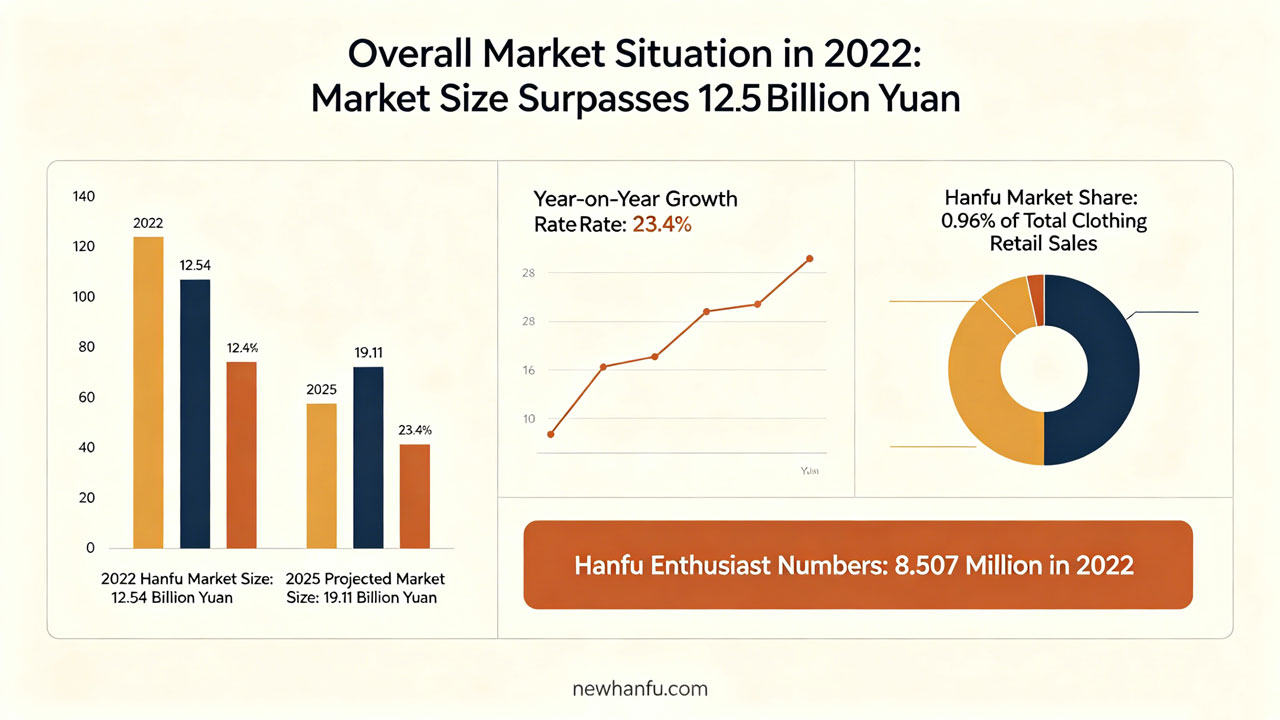
The Hanfu market maintained steady growth in 2022 despite continued pandemic-related disruptions. According to iiMedia Research’s “2022-2023 China Hanfu Industry Status and Consumer Behavior Data Research Report,” China’s Hanfu market size was estimated to reach 12.54 billion yuan in 2022, representing a year-on-year increase of 23.4 percent. This market is projected to reach 19.11 billion yuan by 2025, highlighting significant growth potential ahead.
In terms of enthusiast numbers, iiMedia Research data shows that the scale of Hanfu enthusiasts in China reached approximately 8.507 million people in 2022, with the market sales scale reaching 12.54 billion yuan. The Hanfu market currently accounts for only about 0.96% of China’s total clothing retail sales of unit-stores above designated size (1,300.3 billion yuan). However, as the post-95s and post-00s generations gradually assume central roles in the economy, they are expected to become the main force of China-chic consumption, further releasing market potential and accelerating the vitality of the Hanfu market.
New Hanfu: The Path to Mainstream Adoption
According to the “2022 China New Hanfu Industry Development White Paper” jointly released by the China National Garment Association and iResearch, the concept of “New Hanfu” (modern Hanfu) continued to gain traction. New Hanfu is defined as garments that originate from traditional Han ethnic classic clothing styles while retaining their typical formal characteristics, combined with contemporary multi-scenario wearing contexts and fashion aesthetics. Its core features are avant-garde innovation, popular openness, and contextual diversity.
Currently, New Hanfu accounts for only 0.8% of the overall apparel market. However, as design styles and wearing habits become better aligned with modern needs and aesthetics, the entire industry is expected to break through and enter the “hundreds of billions era,” at which point market penetration could reach approximately 5.0%, truly making Hanfu a mainstream daily apparel category.
2. Core Data: Consumer Demographics & Behavior
Aggregated data from iiMedia Research, iResearch, and other third-party institutions reveals the following portrait of the 2022 Hanfu consumer:
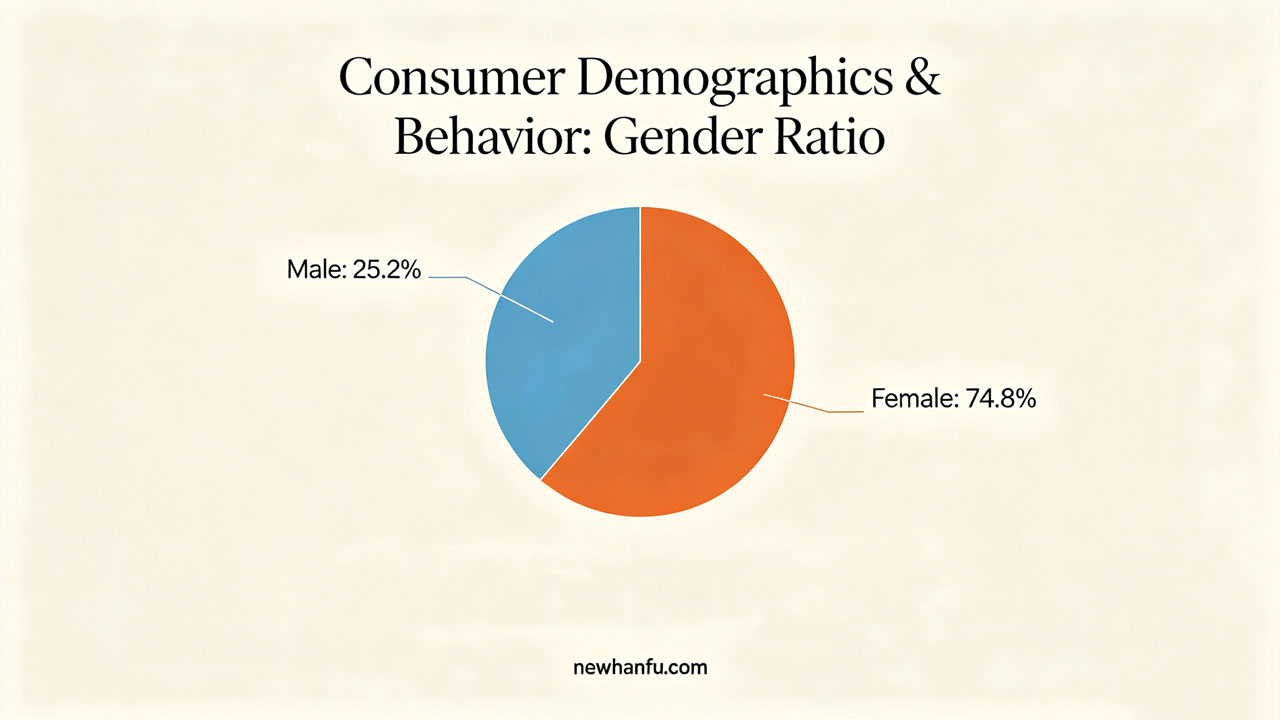
- Gender Ratio: In New Hanfu target consumers, male users accounted for 25.2% and female users accounted for 74.8%, with female users having an obvious advantage and being the absolute core group. Among all Hanfu consumers surveyed, the female share was reported at 69.9%, with over 80% of consumers having a monthly disposable income exceeding 5,000 yuan.
- Age Distribution: The consumer group under 35 years old accounted for 71.4% of New Hanfu consumers, of which 18 to 25 year olds accounted for nearly 30%. This indicates that young people under 35 are the main consumer group of New Hanfu, with huge potential for future consumption increment.
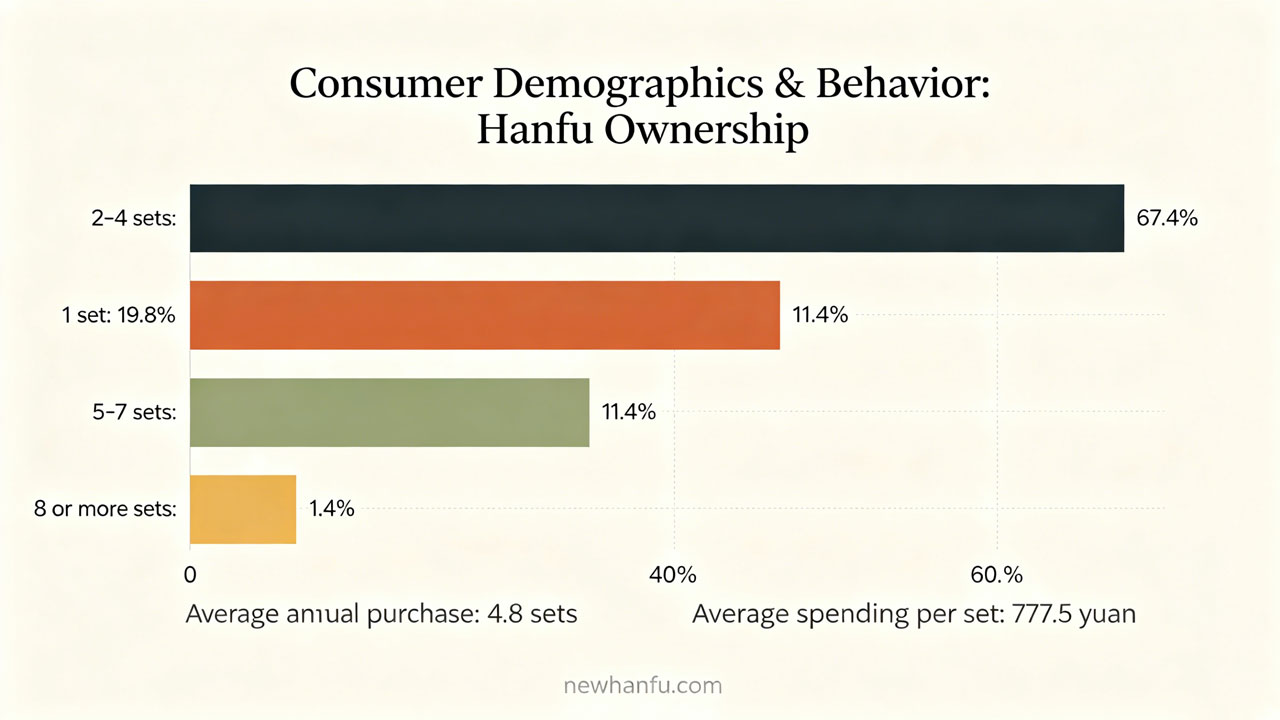
- Hanfu Ownership: Among Chinese consumers in 2022, 67.4% owned 2-4 sets of Hanfu, 19.8% owned 1 set, 11.4% owned 5-7 sets, and 1.4% owned 8 or more sets. Hanfu enthusiasts purchase an average of 4.8 sets per year, spending an average of 777.5 yuan per set—a relatively “luxurious” expense compared to everyday clothing.
- Purchase Channels: Nearly 70% of consumers purchase Hanfu through online shopping platforms such as Taobao and Xianyu, while 49.8% of consumers purchase from offline Hanfu physical stores.
- Motivation: The main reasons for “entering the pit” (becoming a Hanfu enthusiast) are “love of traditional culture” and “sense of ethnic identity,” consistent with the rise of China-chic. Additionally, “beautiful clothing” remains a key factor, as Hanfu has withstood historical tests and conforms to the aesthetic sensibilities of most Chinese people.
Purchase Scenarios and Expenditure
More than 50% of surveyed consumers wear Hanfu during Hanfu activities, artistic photo shoots, special occasions, and traditional festivals, while 19.6% wear Hanfu in daily life. This suggests that Hanfu brands can improve the practicality of Hanfu and promote daily-use improvements to make Hanfu a part of everyday clothing, thereby enhancing their products’ market competitiveness. According to KuRun Data research, Hanfu enthusiasts’ ages are concentrated between 20 and 30 years old, with the post-90s generation providing significant momentum for the rise of Hanfu. Among enthusiasts, many have experience with other niche costumes such as COSPLAY and JK uniforms, indicating that costume enthusiasts are more likely to “enter the pit.” Seven out of ten enthusiasts bought their first Hanfu within the last five years.
3. Regional Distribution and Industry Hubs
In 2022, the geographic landscape of Hanfu production solidified around several major hubs, with new players continuing to emerge.
Cao County, Shandong: The Unmatched Production Champion
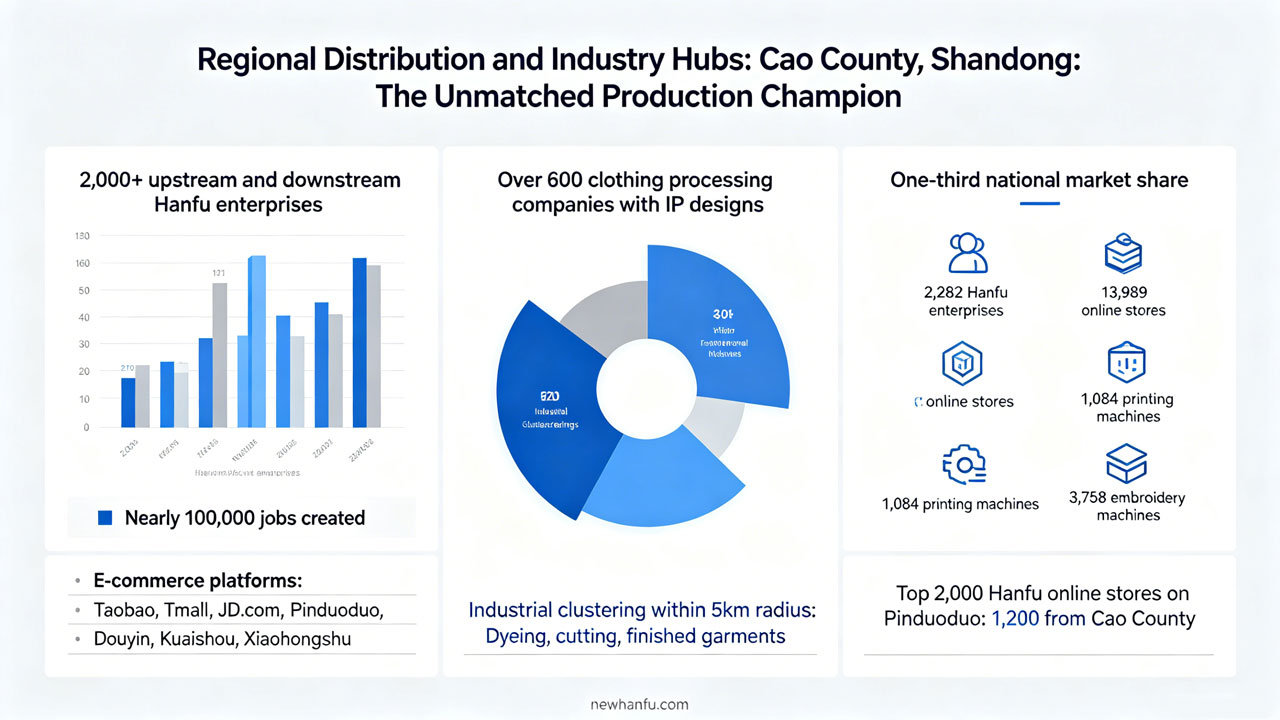
Cao County in Heze City, Shandong Province, became the undisputed champion of Hanfu production in 2022. Leveraging its existing expertise from years as a performance costume manufacturing base, Cao County pivoted massively into Hanfu production starting in 2020. By 2022, the county boasted over 2,000 upstream and downstream Hanfu enterprises, creating jobs for nearly 100,000 people. Over 600 clothing processing companies have their own designs with intellectual property rights.
Cao County’s Hanfu production accounts for one-third of the national market share. According to China Garment Association’s white paper, Cao County was cited three times as having the earliest industrialization, strongest production capacity, and greatest development potential, laying the foundation for the county’s position in the national Hanfu industry. The county is home to 2,282 Hanfu upstream and downstream enterprises, 13,989 online stores, 1,084 printing machines, and 3,758 embroidery machines, achieving industrial clustering within a 5-kilometer radius (from dyeing and cutting to finished garments can be completed within 5 kilometers), forming a complete industrial chain and brand incubation system. Cao County Hanfu stores cover all e-commerce platforms including Taobao, Tmall, JD.com, Pinduoduo, Douyin, Kuaishou, and Xiaohongshu—among the top 2,000 Hanfu online stores on Pinduoduo nationwide, 1,200 come from Cao County.
Guangzhou and Chengdu: Established Centers
In Hanfu circles, there is a saying “one capital and two prefectures”—referring to Chengdu, Guangzhou, and Hangzhou as the three main cities for Hanfu industry development. Leveraging its mature clothing industrial chain, Guangzhou has seen the Hanfu industry take root and flourish. Currently, Guangzhou has a total of 154 Hanfu enterprises, including leading brands such as Minghuatang, Rufangfang, Han Shang Hua Lian, and Zhizao Si. Guangzhou’s Hanfu merchants rank first nationwide in both sales volume and number of stores.
Chengdu maintained its reputation as a city brand for Hanfu consumption, hosting China’s first Hanfu physical store and a vibrant enthusiast community, while Hangzhou excelled as an e-commerce and influencer center.
4. Product and Style Popularity Trends
The Mamian Qun Phenomenon
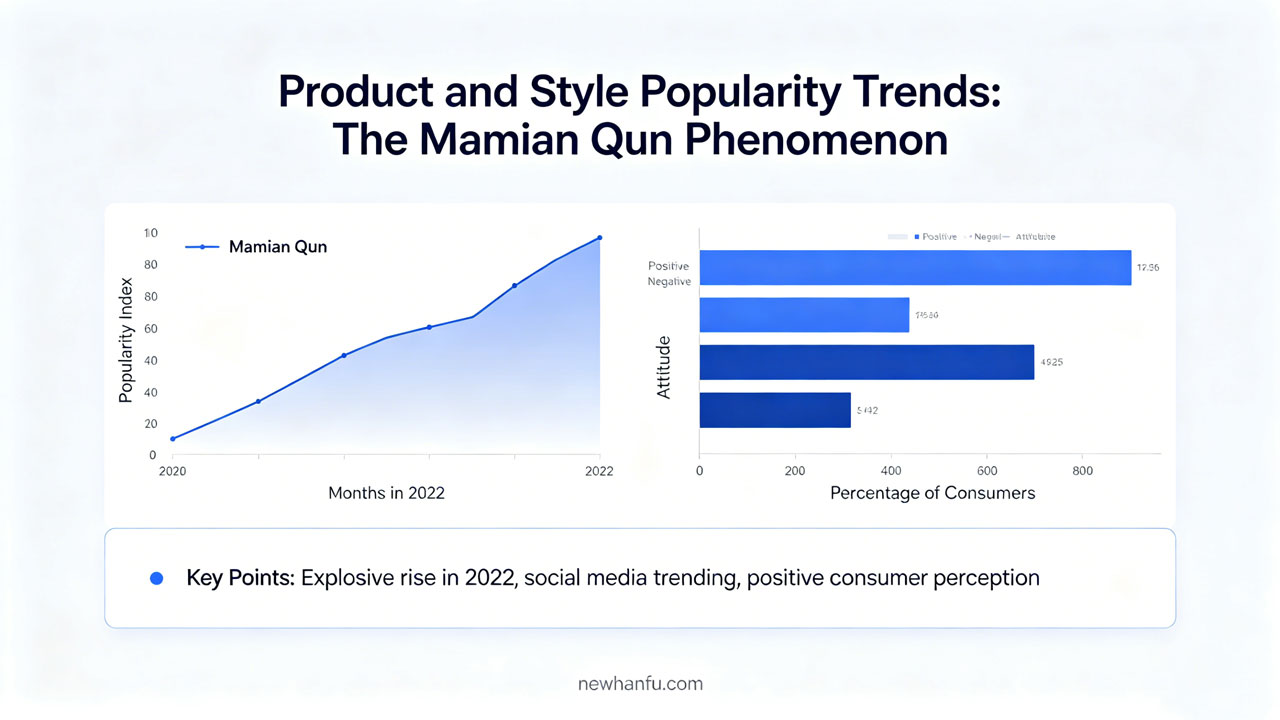
2022 witnessed the explosive rise of the Mamian Qun (horse-face skirt)—a Ming Dynasty skirt characterized by stacked box pleats on both sides and smooth panels at the front and back. Originating in the Song Dynasty and flourishing in the Ming and Qing Dynasties, the Mamian Qun captured widespread attention among young people in 2022. This traditional garment unexpectedly became a hot topic on Chinese social media, with related discussions topping Weibo’s trending charts.
According to a survey by iResearch, the vast majority of consumers held a positive attitude toward the Mamian Qun incident, viewing it as an example of traditional culture being recognized internationally, albeit through controversial means.
Song Dynasty Styles Surge
The hit TV drama “A Dream of Splendor” (Meng Hua Lu) in the summer of 2022 sparked a major fashion wave around “Song-style Hanfu.” Many brands launched co-branded Hanfu products tied to the drama, propelling Song Dynasty-inspired designs to popularity. Leading brand Shisanyu collaborated with “A Dream of Splendor” to launch four co-branded styles, including the Song-style cape “Lingbo Pan Yue” and the large-sleeved robe “Fuguang Yi Meng”—these sold over one million yuan in the first hour of release.
Hezi Qun and Other Styles
The Hezi Qun (waistband skirt from Tang Dynasty) remained a strong seller throughout 2022, offering a flattering and regal look that resonated with both newcomers and seasoned collectors. In terms of e-commerce performance, sales data from September 2022 showed that Shisanyu captured five spots on the top-selling Hanfu items list, while Zhonglingji held two spots, demonstrating their dominance in the popular styles market.
Functional and Multi-Scene Innovations
To attract younger consumers and make Hanfu practical for daily wear, brands continued to innovate with functional designs and “commuting Hanfu” elements. iResearch’s white paper highlighted that consumers’ habitually purchased channels top three were e-commerce platforms, and consumers showed a preference for Hanfu styles suitable for multiple scenarios such as work and casual outings. Co-branded products spanning museums, games, and film/TV became increasingly popular as a marketing strategy.
5. Brands and E-commerce Performance
Top 10 Hanfu Brands of 2022
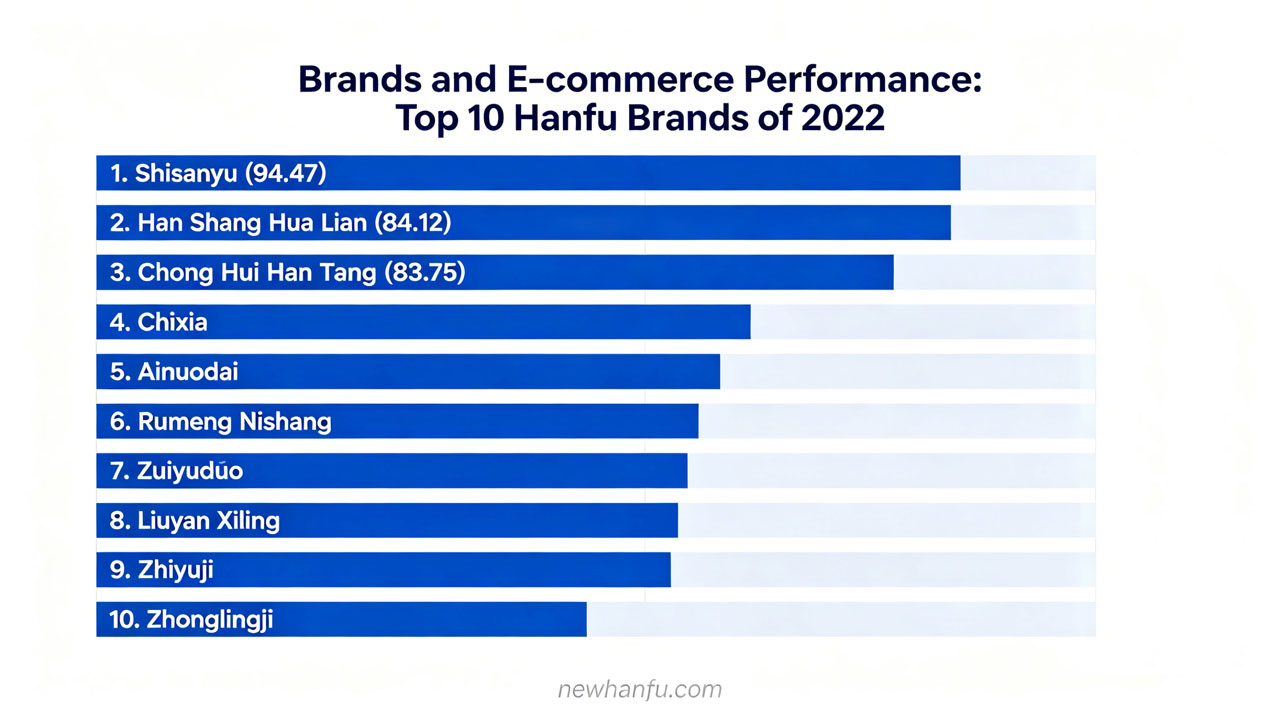
iiMedia Ranking released the “2022 China Hanfu Brand Top 10 List,” which evaluates based on comprehensive strength, platform sales, online media communication trends, and analyst team evaluations, focusing on e-commerce platform sales volume, online popularity, and consumer word-of-mouth. The top 10 brands were:
1. Shisanyu (94.47) · 2. Han Shang Hua Lian (84.12) · 3. Chong Hui Han Tang (83.75) · 4. Chixia · 5. Ainuodai · 6. Rumeng Nishang · 7. Zuiyuduo · 8. Liuyan Xiling · 9. Zhiyuji · 10. Zhonglingji
Shisanyu Leads the Pack
Shisanyu solidified its position as the undisputed leader in 2022. During the “Double Eleven” shopping festival, Shisanyu’s omnichannel GMV exceeded 45 million yuan, ranking first in the Hanfu category on Taobao and Tmall for four consecutive years (data source: Alibaba official data platform), with Tmall channel GMV growing 55% year-on-year. Shisanyu currently has product lines in Hanfu, Chinese-style clothing, wedding wear, children’s wear, accessories, and co-branded products, with distribution across e-commerce channels including Tmall, Taobao, and Douyin. To date, Shisanyu has co-developed over 100 co-branded products with 20 well-known IPs, including collaborations with the Chinese Kunqu Museum, Suzhou Museum, Dunhuang Museum, the TV drama “A Dream of Splendor,” and the game IP Honor of Kings.
In terms of financing, Shisanyu received a Pre-A round investment from well-known angel investor Wang Gang Jue(JUE) Capital, followed by a Series A financing round of over 100 million yuan co-led by Bilibili and Zhenxin Capital, with Pop Mart (9992.HK) as a participating investor.
6. Industry Channels and Business Models
Live-Streaming E-commerce Gains Ground
2022 saw live-streaming e-commerce become a significant sales channel for Hanfu. Cao County exemplified this transformation, with many traditional e-commerce enterprises transitioning to live-streaming sales. One Cao County company, Tiandi Bang Clothing, which started with performance costumes and pivoted to Hanfu in 2019, began live-streaming sales in 2021. After one year of development, its live-streaming annual output value reached 10 million yuan, successfully being selected as one of the “100 Shandong Internet Celebrity Products” during the 2022 Golden Autumn Double Festival Live Season.
The company operates two livestream studios, broadcasting daily from 10:00 AM for 2-3 hours, with 3-4 staff members per studio. This business model transformation represents a microcosm of how Cao County’s Hanfu enterprises evolved from traditional e-commerce toward live-streaming e-commerce in 2022.
Cross-Border Expansion Continues
International sales of Hanfu continued to grow in 2022. A number of companies in Cao County reported a surge in foreign orders this year. In addition to domestic clients, foreign demand for Hanfu increased notably.
7. Landmark Events of 2022
Dior’s Mamian Qun Plagiarism Controversy
One of the most talked-about events in the Hanfu world in 2022 was the controversy surrounding French luxury brand Dior. In July 2022, Dior released a mid-length skirt as part of its early fall collection. Chinese netizens—particularly Hanfu enthusiasts—quickly noticed that the skirt, from its single-piece cut to its distinctive skirt door design and waist pleating, was an exact replica of the traditional Chinese Mamian Qun, a style worn by Han Chinese women during the Ming and Qing Dynasties for over 600 years.
What made the controversy particularly infuriating was that Dior’s product description called the skirt a “Dior signature silhouette,” with no mention of its Chinese origins. While similar plain, unembroidered Mamian Qun are typically sold for 60-100 yuan on Taobao, Dior’s version was priced at 29,000 yuan—and quickly sold out. Chinese netizens accused Dior of “cultural appropriation,” demanding acknowledgment of the traditional Chinese source of the design. The topic topped Weibo’s trending charts, although Dior never issued an official response and merely removed the skirt from its Chinese website while continuing to sell it overseas.
This incident galvanized the Hanfu community to take action, with enthusiasts writing English introductions to “educate” foreigners about Mamian Qun on Twitter, emailing and calling Dior’s offices to demand a stop to the “plagiarism,” and reporting the issue to relevant authorities. iResearch’s white paper devoted a section to this incident, reflecting its significance as a major industry milestone.
Olympics and China-chic Integration
Hanfu culture also found representation in major international events during 2022. The Beijing Winter Olympics saw Chinese athletes wearing garments incorporating traditional Chinese elements—Wu Dajing’s Sun Wukong helmet, Gu Ailing’s dragon robe, and the Chinese ice hockey goalie’s “Dragon and Tiger Leaping Over the Bright Wall” shield. These powerful visual representations of Chinese culture, amplified by global media coverage, contributed to cultural confidence and indirectly benefited Hanfu’s recognition internationally.
8. Challenges Facing the Industry in 2022
IP Infringement and Counterfeiting
The persistent issue of counterfeiting continued to plague the Hanfu industry in 2022. For small original design studios, the cycle from concept to finished product takes six to eight months, yet knockoffs can appear on the market within weeks, undercutting the original on price and eroding consumer trust. Malicious trademark squatting remained a serious issue, with counterfeiters registering the names and logos of legitimate independent designers. According to iiMedia Research data, 31.2% of Hanfu consumers had unknowingly purchased counterfeit Hanfu.
Supply Chain Bottlenecks
Embroidery and printing/dyeing processes remain very complex in the Hanfu industry. The embroidery process is crucial, and achieving precision and large quantities of complex embroidery over large areas is especially challenging. The production chain still relies heavily on highly skilled masters, resulting in long production cycles and high costs for modern Hanfu. Design capabilities remain lacking, with limited new products appearing each season. Leading brands such as Shisanyu actively explored solutions, making positive contributions to advancing key areas including embroidery, material innovation, mass production, and standard setting. However, the gap between supply and demand continued to widen, leading to customer dissatisfaction over shipping delays.
Slowing Growth Rate
While the overall Hanfu market continued to grow, the growth rate slowed in 2022 compared to the explosive expansion of previous years. This was attributed to several factors: the ongoing impact of the COVID-19 pandemic on offline activities and tourism; the need for Hanfu designs to further adapt to modern consumer preferences; and increasing competition among brands, which squeezed profit margins. In 2021, the total output value of the top 30 Hanfu sellers on Taobao saw a decline of 17.32% compared to 2020—a sign of intensifying market competition.
9. Future Outlook Beyond 2022
Looking beyond 2022, the Hanfu industry is poised for continued expansion with projected market size reaching 19.11 billion yuan by 2025. Several key trends will shape this future:
- New Hanfu standardization: Professionalization and standardization will be core trends for the further development of the New Hanfu industry. Mature and professional supply chains, along with comprehensive and clear industry standards, will drive the industry to the next level. More diverse designs and categories will be key to meeting consumers’ full-scene wearing needs and habits.
- Deepening IP collaborations: Leading brands like Shisanyu plan to collaborate with 2-3 national costume TV dramas annually while exploring more diverse IP collaboration categories and long-term co-creation approaches. The goal is to integrate New Hanfu into more people’s daily lives, explore different scenario needs such as children’s traditional cultural activities, new Chinese-style weddings for young people, and college Hanfu club activities.
- Technological innovation in production: Addressing supply chain bottlenecks through digital manufacturing and improved production standards is expected to accelerate, with leading brands continuing to explore innovations in embroidery, materials, mass production, and standard setting.
- International recognition: As Chinese cultural confidence grows, Hanfu is increasingly positioned for global reach, as evidenced by export growth and major brands’ successful international expansion strategies.
China’s Hanfu industry has achieved substantial growth from a niche subculture to a multi-billion-yuan market sector. 2022 proved that Hanfu is not just a trend—it is a sustainable, culturally significant segment of the Chinese fashion economy. However, as the industry matures, the balance between commercialization and cultural authenticity, the resolution of intellectual property disputes, and the continued innovation for everyday wearability will determine whether Hanfu can truly transition from a flourishing subculture to a universally accepted mainstream apparel category.