Caoxian County (曹县) in Shandong sold 4.775 billion yuan worth of Hanfu online in the first half of 2026, up 9.2 percent year on year, holding more than half of the national Hanfu market, according to the county’s e-commerce figures. Its total online retail in the same period reached 23.618 billion yuan, a 12.3 percent increase. The price logic behind the share is blunt: a Mamianqun (马面裙) made of the same fabric with the same embroidery sells for 400 to 500 yuan under an outside brand, while a comparable Caoxian skirt costs just over 100 yuan.
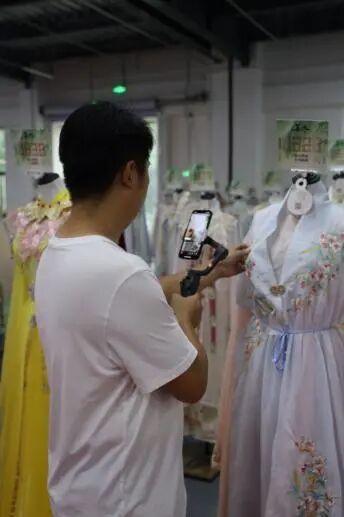
At the Jizhi Youai (极智有爱) cloud warehouse showroom in the county, four anchors livestream at once, split between selling, picking styles and promotion. One, holding a skirt from the racks, ran through the arithmetic on air: the fabric comes from Keqiao (柯桥), the weaving is done in Xucun (许村), and the embroidery is finished locally, “so nowhere else can touch this price.” The county also drew the attention of People’s Daily’s online program “The Unexpected Chinese Economy”, whose crew brought young actor Xu Ruohan (徐若晗) to report from the workshops; the report repeated the industry’s standard line that one of every two Hanfu sold in China ships from Caoxian, and put the county’s 2025 Hanfu sales at more than 13 billion yuan.
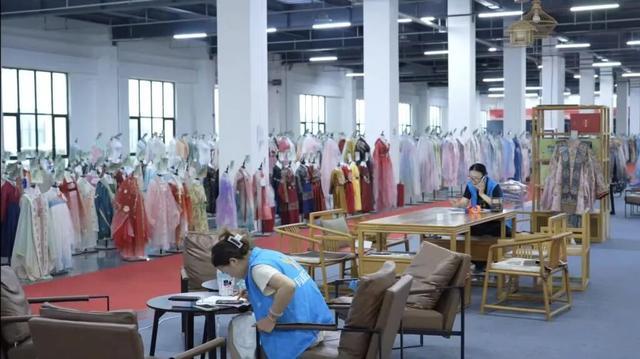
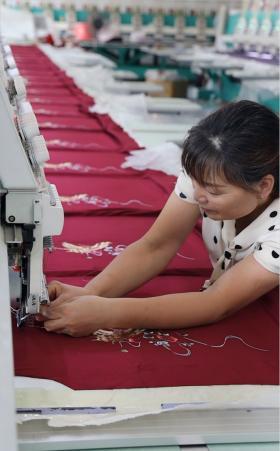
The cheapness rests on a supply chain packed into five kilometers. Around Ancailou Town (安蔡楼镇) and Daji Town (大集镇), pattern-making, cutting, embroidery, sewing, ironing and packing all sit within a short drive, so a design can become a finished sample without leaving the district. “Bring in your design drawing and we can make the sample before you leave this street,” said Meng Xiaoxia (孟晓霞), design director of Chenfei Apparel. That model of local design, local sourcing and direct online sales turned Hanfu from a collector’s piece into what the industry calls “a young person’s first Hanfu.”
No single event built the cluster. In the 1990s, villagers around Ancailou and Daji painted studio backdrops and sewed costumes for photo studios; over the next two decades, as e-commerce and the performance-costume trade grew, workshops for pattern-cutting, embroidery and sewing filled in the missing links. Caoxian began selling stage costumes online around 2008. When the Guochao (国潮) wave crested near 2018, garment workers pivoted almost without changing equipment, staff or suppliers, swapping only patterns and design, and by 2020 the county had converted to Hanfu almost wholesale. County officials and business owners cite that near-zero-friction pivot as the reason Caoxian seized the lead so fast.
Attention arrived before sales could keep up. On March 19, 2020, then-county magistrate Liang Huimin (梁惠民) went on a livestream in a red Duijin (对襟) Daxiushan (大袖衫) to explain the craft, drew more than 1.6 million viewers and sold over 3,000 pieces; Hanfu sales doubled that day, with some merchants up seven to eight times. A short-video catchphrase in 2021 made the county a national meme, and netizens joked about “Beijing, Shanghai, Guangzhou and Caoxian” and called the county “the center of the universe.” “When traffic comes, someone has to catch it,” said Li Zilei (李字雷), founder of Youai Hanfu and chairman of the county’s e-commerce livestream association. “You cannot buy a second chance at any price.” In 2022 his team organized donations from more than 100 Hanfu firms totaling over 4,800 outfits, and the recipients’ own photos and clips drew nearly 300 million views; the Caoxian Hanfu Association was set up the same year with Hu Chunqing (胡春青), general manager of Chenfei, as its first chairman. “We wore Hanfu and went straight to officials to introduce ourselves,” Meng recalled, setting a goal that people should think of Caoxian Hanfu as easily as they think of Aksu pears and Yantai apples. Buyers eventually came in person: Xie Qian (谢倩), head of the Youai base in Ancailou, says customers have driven down from Liaoning, and in peak season the base receives dozens of procurement buyers a day, mostly scenic-area operators and costume-rental shops. More than 90 percent of the Hanfu used in scenic districts of Xi’an, Luoyang and Kaifeng comes from Caoxian.
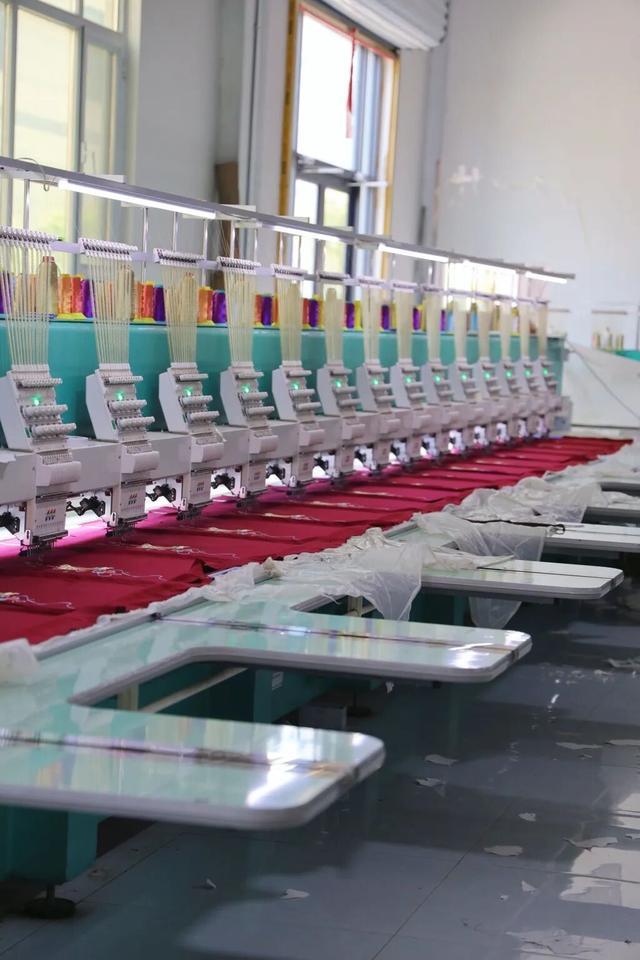
Tourism’s 2023 surge turned the county’s products into a fixture of China’s ancient-city craze. When Luoyi Ancient City (洛邑古城) in Luoyang took off, Meng said, shops that had sold cold noodles and tires simply changed their signs into Hanfu stores without even removing the old boards; more than 200 such experience shops opened in Caoxian within two months, and Li’s showroom took 600,000 to 700,000 yuan a day in cash. When the Mamianqun trend hit at the end of 2023, one loom could turn out only about 20 skirts a day and local capacity ran out, so Caoxian orders flowed to Haining’s Xucun, a former curtain-fabric town with idle looms, and sales of the skirt passed 300 million yuan within months. “Construction workers made Mamianqun, sweet-potato sellers made Mamianqun, packaging makers made Mamianqun,” Meng said. In October 2023 she wore one into the Great Hall of the People for the 13th National Women’s Congress of China; when delegates asked which ethnic group she belonged to, she answered, “I am Han Chinese, and this is Hanfu.”
The boom cooled as quickly as it came. From late 2024 the Mamianqun market contracted and a wave of late entrants washed out, leaving fewer operators but still-rising sales. Li Zilei had kept his own hand in through the 2020 lull by running a livestream training base that produced more than 1,000 graduates between late 2020 and 2022, “ready to start the moment they are needed.” Wang Fengyin (王凤银), who left factory embroidery jobs in Guangdong and Zhejiang to open her own workshop in 2013, says her machines have barely stopped since, because long embroidery lead times are met by finishing goods early and shipping in batches.
Government support runs alongside the private clusters. Drawing on the national policy for e-commerce demonstration counties, Caoxian set up a dedicated e-commerce fund, runs a “thousand villages, ten thousand people” training program and, with local banks, offers “e-commerce loans” and “Qilu Fumin” loans that disburse in about one minute with no manual review. To protect original designs, the county works with the Beijing Institute of Fashion Technology, has 42 industry experts on call, and established an intellectual-property fast-track center that cut design-patent examination from 180 days to 10; a second county-level fast-track center for design patents in Shandong now works with a judicial coordination team of courts, market regulators and publicity departments to shorten enforcement from six to twelve months down to 7 to 15 days.
Pain points remain. Meng described the “refund only” practice that lets buyers return used goods: her firm sews “void if removed” labels to fight it, but such labels do not stop abuse, and no single company can change platform rules. Inside the industry, debate continues over what counts as authentic Hanfu. Li divides Caoxian’s output into travel-photo styles, museum-grade reproductions and everyday adapted versions; strict reproductions demand finer fabric, pattern and color work and cost far more. The county’s chosen lane is Hanfu the majority can afford, and Jizhi Youai has launched the higher-end Mamianqun brand Luoruyan (洛如嫣) while investing in flexible digital production lines for small-batch customization.
Adaptation is the industry’s answer to daily wear. “A Mamianqun once had to cover the feet; now we cut it to eight-tenths or half length for cooler wear, and we replace traditional ties with zippers for modern pace of life,” said Liu Xia (刘霞) of the county’s Hanfu sector. Asked about resilience, merchants return the same answer: Hanfu carries Chinese traditional dress culture, and what buyers really accept is cultural confidence, “and that does not collapse.” Li put it as a long run: “We will do this for a hundred years; I will run it like a marathon, slowly.” Wei Pengju, dean of the Institute of Cultural Economy at the Central University of Finance and Economics, compares Caoxian to Yiwu: the secret is cultural depth converted through creative innovation. With more than 100,000 people now working in the trade at or near home, the county’s bet is that young buyers are purchasing not only cloth but a sense of cultural identity, belonging and emotional value.