
SS2027 Beijing Fashion Week opened on the evening of September 7 in the Golden Hall of the Beijing Hotel under the banner “Opening a New Chapter, Boundless Symbiosis” (序启新章·无界共生). The curtain-raising assignment went to a collaboration that pairs a haute couture house with a state museum: designer Laurence Xu presented his new collection Qi (祈, “prayer”) together with the Nanjing Yunjin Museum (南京云锦博物馆), the custodian of a brocade woven for Chinese courts since the Eastern Jin dynasty.
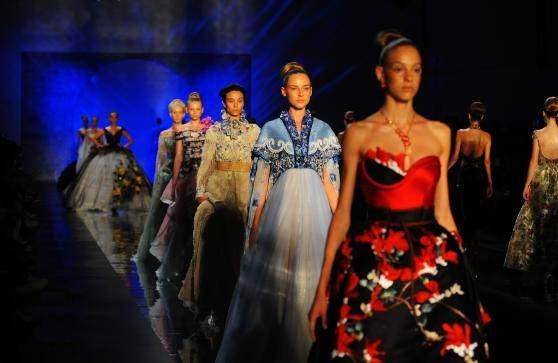
The collection’s centerpieces are two couture gowns whose fabric is the story. Neither dress is trimmed with Yunjin as ornament; the cloth of each was woven start to finish on a Dahualou drawloom (大花楼木织机), a machine of more than a thousand parts that needs two operators, a draw-boy aloft pulling the pattern cords and a weaver below at the shuttles, and that yields five to six centimeters of fabric in a full day’s work, the reason the old saying values an inch of it like an inch of gold. The gown named Dayanghua (大洋花) is worked in piled silk so the flower rises off the surface in layers of light and shade, while Pudianhua (铺殿花) draws its composition from a Northern Song painting of palace flowers, remaking a court mural as something a body can wear.
Central to the craft story is the Zhuanghua (妆花) method, the Tongjing Duanwei tapestry technique (通经断纬) in which colored wefts are packed in to build each motif so that pattern and ground are one cloth. Laurence Xu’s own contribution is the house technique Liulu embroidery (鎏络绣): its stitches stand up from the ground weave in low relief that reads like cast bronze, giving the shoulders and hems of the gowns a metallic weight. The exclusive fabrics were made with the Nanjing Yunjin Museum and mix real gold thread, lapis-toned metal thread and multicolored silk, the palette carrying the festive calm of the Northern Song New Year painting Suichao Tu (岁朝图) into contemporary couture.
For the museum, the runway is policy as much as spectacle. Curator Jian Mingwei (简名伟) laid out three reasons the institution accepted an opening-slot invitation: the craft’s royal depth, since the Eastern Jin court created an imperial brocade bureau in 417 CE and a millennium of palace taste gives a gala its ceremony; the fact that hand Zhuanghua weaving still cannot be replicated by machines, so its scarcity is a genuine asset for domestic couture; and a conviction that the craft should be translated by living designers rather than preserved in storage. “Intangible heritage should not be left to grow old behind a glass case,” he said. “Yunjin should be worn, walked onto a runway, lit by stage lights, seen by people.”
The partnership itself is thirteen years old. Laurence Xu carried Yunjin onto the official Paris haute couture calendar in 2013, the first Chinese designer to reach the schedule three times, and the 2026 Beijing show reads as the pair’s homecoming after that international debut.
Wider still, the season runs September 7 to 17 with its main hub on Wangfujing Pedestrian Street, gathering more than 160 brands and 135 events across the city. China Arts and Crafts Master Zhu Bingren (朱炳仁) brings his molten copper art into the shows, Zhang Zhaoda (张肇达) and Mark Fairwhale stage a cross-generational relay, and Hu Sheguang (胡社光) and Zhang Kejia (张珂嘉) hold themed presentations. A companion “Fashion Enjoyment Festival” links nearly 100 malls across Beijing, Tianjin and Hebei on a ticket-stub economy that turns show tickets into shopping vouchers, while Taobao and Douyin carry the catwalks live with instant purchase, so a look seen on stage can be bought before the show ends. Organizers present the edition as the opening season of the event’s next decade.
The point of the evening, in the museum’s telling, was that an imperial textile earns its keep by entering the fashion system: brocade made for emperors now meets buyers, cameras and the market, and the craft stays alive by being worn rather than archived.