
The Aoqun (袄裙) is the rare Hanfu form you can date by silhouette alone: a jacket that ends above the hem of the skirt beneath it. The cut appears in Spring and Autumn and Warring States tombs, became common in the Wei, Jin and Northern and Southern dynasties, and reached Asuka-period Japan along with the spread of that “jacket-over-skirt” habit. By the Ming dynasty it had settled into the standard women’s two-piece outfit, the last “upper garment, lower skirt” combination to mature in Chinese dress history. For autumn 2026 it is also one of the most practical choices in the Hanfu wardrobe, because the two-piece set layers better than any one-piece robe, and its structure rewards a clear understanding of collars, sleeves, pleats and panels.
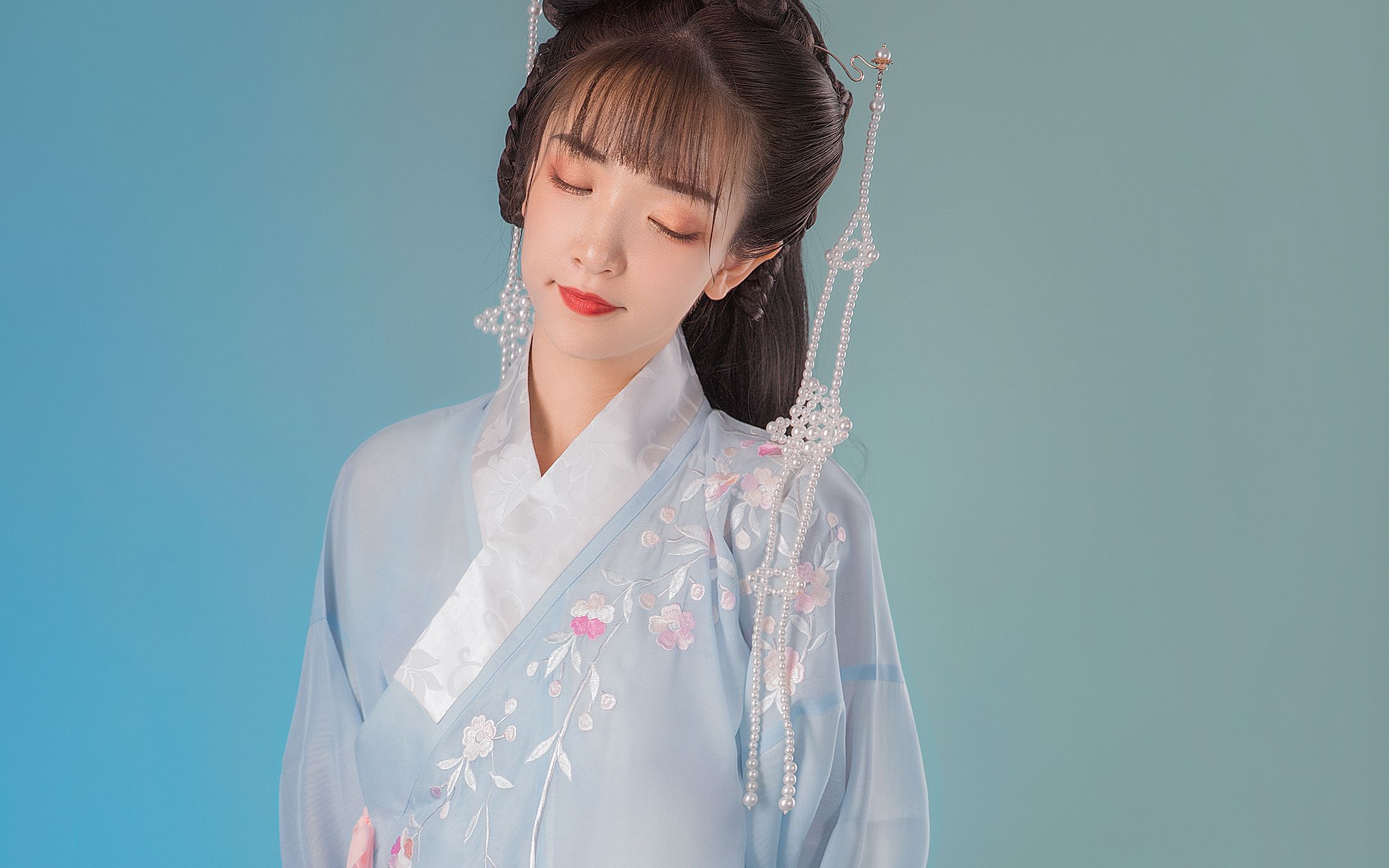
Its defining feature is that the top is worn outside the skirt instead of tucked in, a logic that the Chinese sources call “the skirt hidden under the jacket.” The style was rare in the Sui dynasty, but in the Song, women in the humid south often wore a short Beizi (褙子) directly over the chest band, leaving the hem outside the skirt, an early version of the same cut; in the north, where winters bit harder, women let the crossover-collar Ruqun top fall outside the skirt band. That northern habit survived the Yuan dynasty and influenced the dress of Goryeo women. What the Ming added was standardization: the Aoqun became the basic daily outfit for women, with clear conventions for collars, lengths and when each color was worn.
Collars, Lengths and Sleeves on the Ming Ao
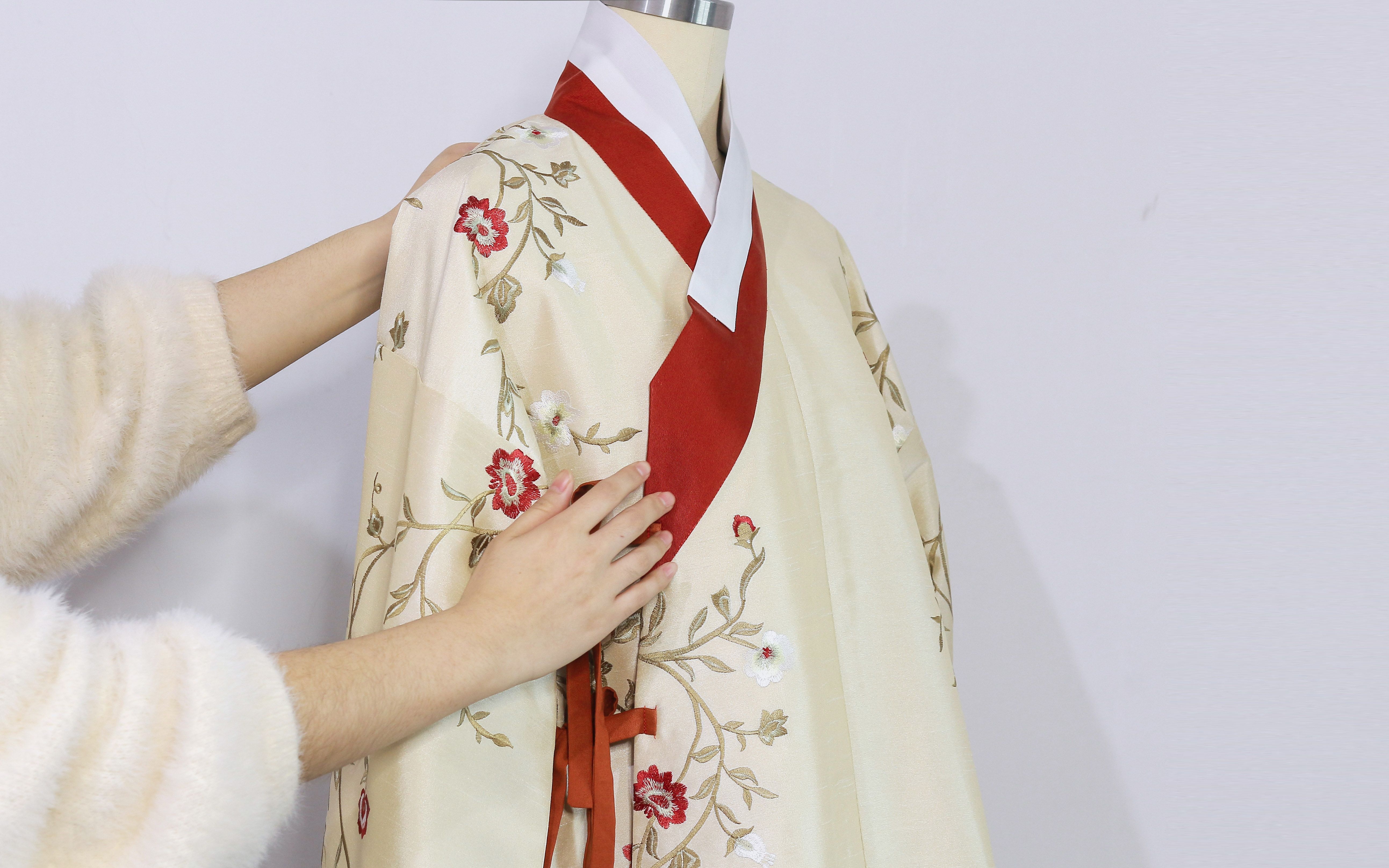
The jacket of the set, called the Ao or Aozi (袄子), carried the richest detail work in Ming tailoring. Collars came in two families. The Jiaoling (交领), a crossover collar closed on the right, is the classic Hanfu collar; the standing collar, also called the vertical collar, gives a clean line around the neck and is the direct ancestor of the modern Qipao collar. Ming and Joseon-dynasty Aoqun sets usually carried a detachable white or plain protective collar that could be taken off and washed, protecting the fabric and adding a layer of contrast. Lengths split the Ao into two grades: the short Ao (短袄) falls around the waist or just below, and the long Ao (长袄), also called the da Ao (大袄), reaches the calf and reads as the more formal cut. In the mid-Ming, long Ao were mostly standing-collar, slanted-placket and narrow-sleeved, while short Ao tended to use low collars and wide sleeves that stopped at the elbow with a full, straight cuff.
Sleeves themselves were a vocabulary of their own: pipa sleeves, wide at the armhole and gathered tight at the wrist, are the signature sleeve of Ming women’s dress; straight sleeves and arrow-shaped sleeves filled out the range. Buttons mark the second structural detail. From the mid-Ming on, fastenings multiplied across clothing, and the inner garment picked up a small round collar closed at the neck with a button, a placement rare in earlier dynasties and one of the markers of Ming dress. For festivals and weddings a woman wore a woven-gold Mamianqun in deep red; for daily life she chose plain colors, the greens, blues and moon-white of the palette, so one set could serve both everyday wear and formal occasions.
Four Door Panels: Inside the Mamianqun
The skirt of the set is almost always the Mamianqun (马面裙), also called the Mamian pleated skirt or Yuehua skirt (月华裙), the principal skirt of Chinese women from its Ming-era maturation through the Qing. Its structure is precise: four door panels, front and back, overlapping in pairs, with the outer panels decorated and the inner panels plain or lightly worked, and pleats pressed into the sides. The waistband is usually white cloth, a play on “white hair in old age,” and fastens with cords or buttons. The name Mamianqun, literally “horse-face skirt,” comes from the smooth, flat panels at the front and back, which resemble the projecting “horse-face” bastions that defended ancient city walls. Many Ming and Joseon Aoqun sets carry fine embroidery, woven gold or painted gold, concentrated on the hem bands, and such a skirt is called a banded hem skirt.
Motifs carry their own language: dragons and phoenixes stand for good fortune and a happy match, peonies for wealth, chrysanthemums for long life. Noblewomen could wear the lavish weave of Zhuanghua satin (妆花缎) in gold, while commoners kept to plain colors and simple patterns, so in the Ming the pattern on a skirt could mark social rank as clearly as any badge. Paired together, the Ao above and the Mamianqun below make the classic two-piece way of dressing that defined Ming women.
Three Rules for Layering in Autumn
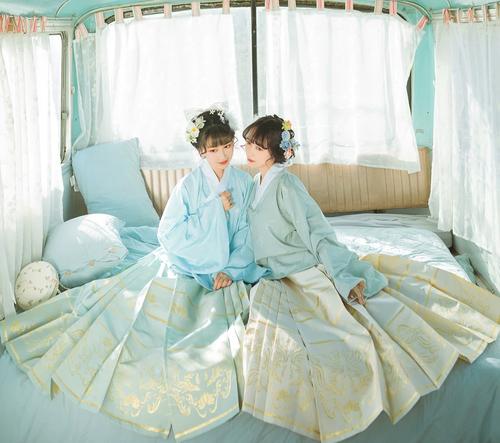
Layering is the core skill for wearing the Aoqun in autumn, and done well it lets Hanfu pieces cross seasons, so the same set handles the day-to-night temperature swing. Layering is not the same as piling on. Three rules keep it orderly.
The first rule is comfort. Hanfu with very wide sleeves does not belong in an inner layer, and anything too tight does not work as a middle layer either. Inner garments should be loose, and the looseness should taper from the inside out, so the outermost layer is the roomiest; otherwise the whole set binds and the posture turns stiff. The second rule is fabric. In cold months most people reach for wool and knits of similar thickness, but stacking same-thickness layers is exactly what looks bulky. A soft cotton layer against a firmer, crisper wool or suiting fabric works better than two heavy equals. Sheer summer fabrics should not be mixed into autumn layering on their own, though an opaque print can sit under a heavy coat as a detail, with a base layer underneath for warmth. The third rule is color. For anyone not chasing clashing combinations, the classic pairings are white, cream and khaki, or white, gray and black, arranged on the “light on top, heavy below” principle, which builds depth without effort.
On specific pieces, the layering logic of Hanfu is straightforward: standing-collar and round-collar tops go innermost; crossover-collar tops, airplane-sleeve tops and vests make the middle layer; for the lower garment, mid-length, knee-length and full-length Mamianqun sit alongside Poqun (破裙), Xuanqun (旋裙) and Baidiequn (百迭裙) cuts; and the outer layer runs to Beizi (褙子) and Yuanlingpao (圆领袍). When the temperature drops further, the Pifeng (披风), also called the Changyi (氅衣), is the standard Ming outer wrap.
Commute, Travel and Formal Occasions
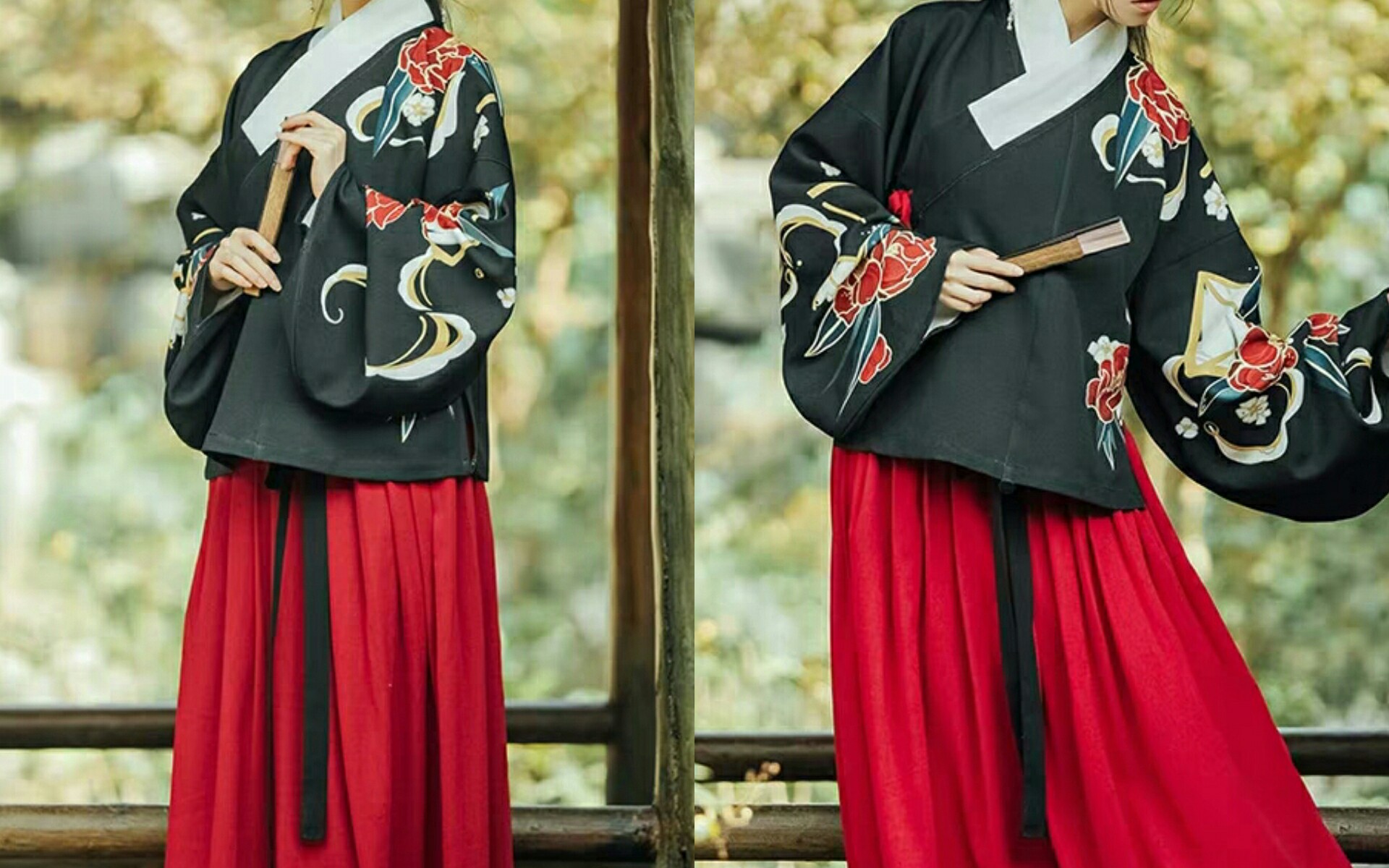
Autumn Aoqun outfits divide by occasion. For a commute or a day at the park, a short Ao over a Mamianqun, with a standing-collar or round-collar top inside and a knit cardigan or short wool coat outside, keeps the dignified Ming outline while matching the pace of daily life. For an old-town trip or an autumn City Walk, a full-length Mamianqun with a short Ao and an airplane-sleeve top or a bijia vest as the middle layer moves well and shows the layers in motion. For formal settings, a wedding, a festival ceremony or a Hanfu gathering, the full dress is a long Ao over a woven-gold Mamianqun, a Yunjian (云肩) cloud collar and a Pifeng on top, embroidered bow shoes on the feet, with the gold thread in the jacket and hem bands catching the light. The modern Mamianqun also pairs outside the Hanfu system, with Neo-Chinese tops, knitwear and shirts, so one skirt does several jobs: wool coats for festival days, a white shirt for the office.
Korea, Ryukyu and the Asuka Court
The Aoqun traveled far beyond the Ming border. Joseon Korea adapted the Ming set into its own national costume, the chima-jeogori ensemble of modern hanbok; the style reached the Ryukyu kingdom and became local women’s traditional dress; and Asuka-period Japan absorbed the same jacket-over-skirt habit. In the modern revival, the form re-entered the global conversation in 2022, when an international label released a mid-length skirt closely resembling the Mamianqun, and the pattern spread across social media. The numbers since then are concrete: during Tmall’s Double 11 shopping festival in 2023, Mamianqun sales passed 730,000 pieces, and Douyin e-commerce orders for the skirt grew 841 percent year on year. Full supply chains have formed in Caoxian County, Shandong, and in Haining, Zhejiang; Caoxian alone booked more than 7 billion yuan in Hanfu sales in 2023. The Aoqun began as a practical answer to southern humidity and northern cold, was standardized under the Ming, and is now layered onto autumn commutes in Shanghai and Beijing. The padded jacket and the floating pleats of the Mamianqun still carry the same two-piece logic that crossed Korea, Ryukyu and Japan, and the set has become one of the most reliable ways to wear Ming dress today.