
Shanghai’s Zhangyuan Art Museum (张渊艺术馆) in Minhang District set out to answer one question with its current exhibition: what happens to a craft once it leaves the seam of a garment? The result, “Kou Jian: Worlds Between Fingertips — a Shanghai-style Pankou art exhibition”, opened on August 13 and runs through August 31, from 10:00 to 16:30 daily except Mondays, at 305 Qixin Road. It gathers 71 works, 31 of them original pieces by teachers and students of Shanghai Minhang Vocational College, and traces a small button from traditional dress into pins, pendants, figurines and city souvenirs.
A Show Built by a Town, a College and a Craftsman
The exhibition was put together by the Xinzhuang Town government (莘庄镇), Shanghai Minhang Vocational College and Song Tao (宋滔), a municipal-level inheritor of Shanghai-style Pankou as an intangible cultural heritage (ICH) item. The town’s cultural and sports development center, the college’s School of Creative Design and the museum itself handled the production; the town’s cultural development advisory committee and the creative company Shenshu Nianlun Culture Creative joined the curatorial team. The reasoning behind the partnership is explicit in the wall text: campus craft teaching, moved into a public cultural space, can bring the Pankou closer to residents who would never step into a workshop.
Student pieces lean on the old techniques but are not bound by them. Using 3D printing, gauze and resin alongside conventional stitching, the young makers turned classroom sketches into brooches, hanging ornaments, sculptural objects and city-themed souvenirs. What the curators chose to show is the whole loop — a design sheet, the repeated reworking it went through, and the finished object that can actually be worn or carried.
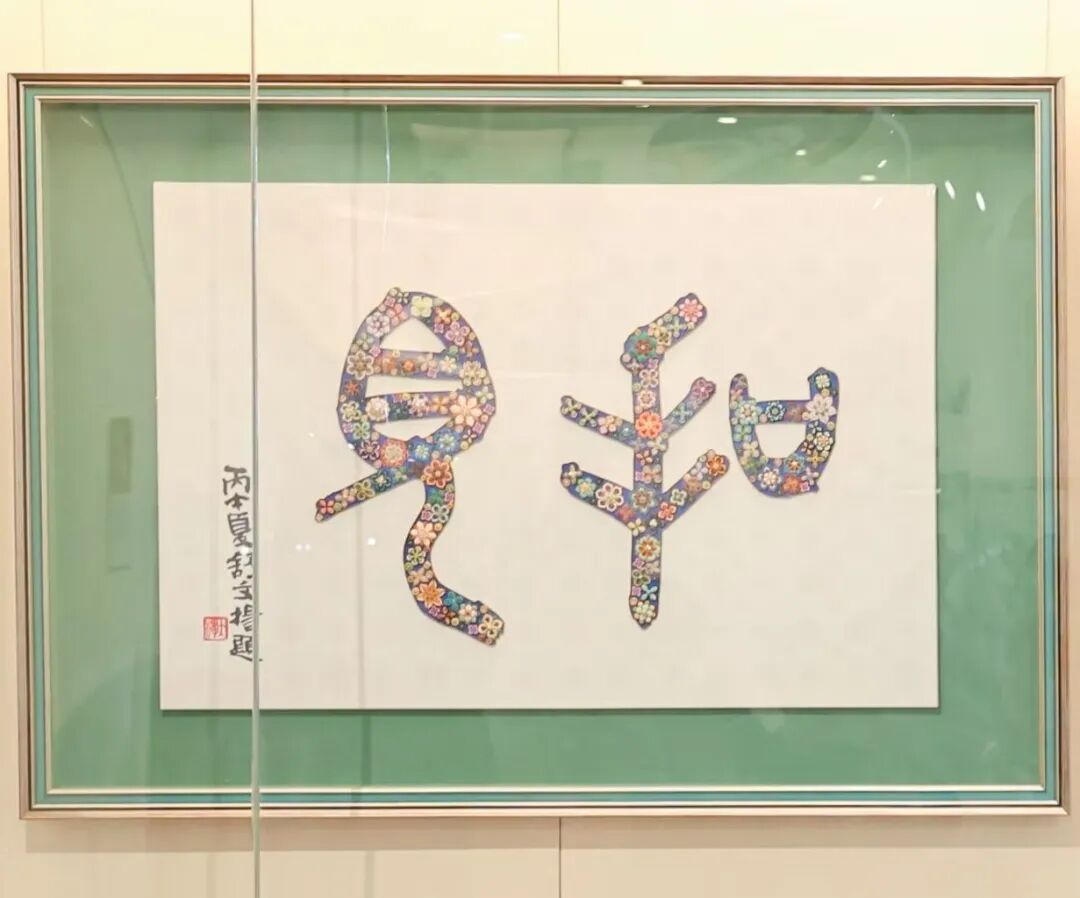
One work anchors the room. Titled “Kou Jian” after the show itself, it takes the hand-lettered calligraphy of the artist Shu Wenyang (舒文扬) as its blueprint: golden Pankou strips trace the outlines of the characters, and 100 separate buttons are nested into the composition, forming classic motifs — the persimmon-calyx pattern, its layered variant, and the Baoxiang flower (宝相花). The choice of motifs was deliberate. With international brands repeatedly caught in disputes over borrowed Chinese patterns, the curators wanted younger visitors to trace the original lineage of these designs rather than meet them first on a foreign label.
Reviving Steps the Trade Had Almost Lost
Behind the display cases is a story about technique. The Shanghai-style Pankou grew out of knotted-cord records used in ancient times and the sash fastenings of the Ming and Qing periods, and over the centuries it moved well beyond the single job of holding a garment shut. Song Tao’s team spent years studying Republican-era objects to bring back processes that were close to vanishing: traditional starching of the fabric, and the hand-rolled strips of bias cloth that form each knot. The exhibition spells out the production steps — pressing the strip to set the material, shaping it, inlay, and backing — because each stage decides whether the finished button stays true. For vocational students, the makers note, that sequence is itself a lesson in patience: one small deviation early on and the piece must be undone and restarted.
Each stage of the process carries its own discipline. Pressing the strip sets the state of the material — pressed too loosely and the knot goes soft, shaped too hard and it cracks. Shaping fixes the structure of the loop, while inlay and backing decide how cleanly the finished button sits against the cloth. A single small deviation anywhere along the line can undo the whole piece, which is precisely why the sequence reads as a skills lesson for vocational students: the button itself is the grade.
The liveliest contrast in the museum comes from the student section. Here the Pankou leaves the old qipao entirely: it becomes a brooch, an earring, a car ornament, even a stylized idol figurine and a three-dimensional cake. Veteran masters keep to the traditional method on one side of the hall, while the “post-00s” makers break out on the other, and the collision is the point of the room. Turning a hand craft into small everyday objects is what makes an ICH skill touchable, the curators argue — a visitor can see exactly what a button could become in daily life.

Between Classroom and Gallery
Works on display grew out of a teaching program. In recent years the college has run a Pankou Heritage Craft Workshop within its School of Creative Design, folding the skill into the curriculum and inviting inheritors to coach students from materials and technique into design and finished work. Han Sicheng (韩思成), a student whose pieces are in the show, described the early failures plainly: “At the start the shapes were often irregular and the paste uneven, so I had to take things apart and redo them. Repeated practice taught me to control the pressure and the rhythm of my hands — a very concrete sense of what it means to make something well.”
Putting the finished objects into a real exhibition changed how students think about their work, the teaching team said — facing an audience and a display environment forces decisions about design expression and use that a classroom critique never does.
A New Study Base for Handcraft
The opening also saw the unveiling of a Shanghai-style Handcraft Study Base at the museum, which will host further workshops, student showcases and cultural exchange. Chen Dongfa (陈冬发), the college’s Party secretary, said the school aims to “empower through skills and nourish through art,” folding Pankou heritage education into talent training and linking it with cultural creative enterprises so that an old hand craft keeps finding new uses in modern life.
Xinzhuang town officials placed the exhibition inside a longer policy of keeping small cultural spaces in the district active. In recent years the town has pooled its cultural service resources across venues, so craft shows, reading rooms and neighborhood stages each get programming instead of sitting empty. “Kou Jian” applies that approach to the Pankou: systematic in the historical survey, youthful in the student work, and aimed at the resident who may never have looked closely at a button before. The exhibition runs to August 31; entry is from 10:00 to 16:30 at the Zhangyuan Art Museum, 305 Qixin Road, with Mondays closed.