
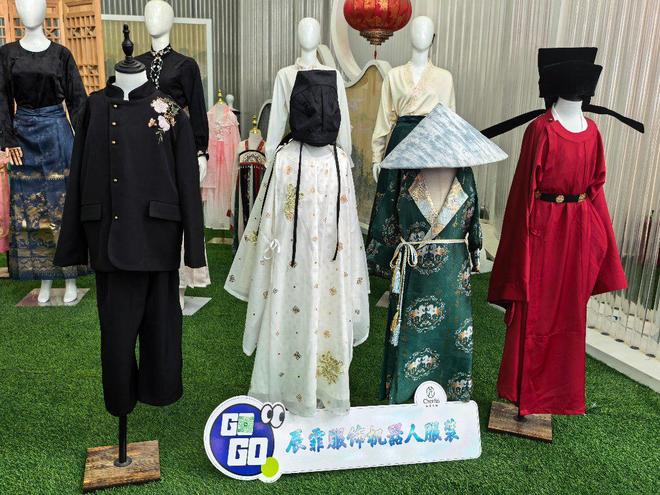
2,822 Hanfu companies, 15,627 online stores, 224 physical experience shops, a workforce of nearly 100,000 and 13 billion yuan in 2025 sales — those are the numbers Caoxian County (曹县) in Shandong built its reputation on. Its newest line of business is clothes for humanoid robots, and orders are arriving faster than the county’s usual garments. Journalists on the “Vital China Research Tour” heard the latest figures on August 27 at the Caoxian Digital Economy Industrial Park in Eshang Town: Chenfei Apparel has taken more than 2,000 robot-Hanfu orders since April.
A New Track Opens at the Hanfu Hub
Two milestones landed within nine days of each other this spring. On April 11, the country’s first intelligent humanoid-robot garment industry base was unveiled at the park, jointly built by Jiuzhou Yunshang (九州云裳), Hangzhou Zhongcheng Robotics and Caoxian’s own Chenfei Apparel. The base covers fabric cutting, sewing and quality control on a fully automated line. On April 20, the county’s textile-apparel chain task force led the launch of the world’s first humanoid-robot garment design and R&D center in Hangzhou, setting up a cross-regional loop the county describes as “Hangzhou research, Caoxian manufacturing” — an attempt to close the design gap that a manufacturing hub typically carries.
Four Generations of a County Industry
Hu Chunqing (胡春青), president of the Caoxian Hanfu Association and general manager of Chenfei Apparel, frames the robot clothing as the fourth stage of a long evolution. Generation 1.0 made purely performance costumes; generation 2.0 branched into school uniforms, square-dance outfits and ethnic dress; generation 3.0 pushed specialization down to the township and street level, with each area producing a different garment type; generation 4.0 crosses into robot clothing, pet wear and figurine costumes. He has been back in Caoxian for eight years, and the robot track, in his telling, is where the industry’s next margin sits.
Robot Hanfu is not a human garment cut to different proportions. Hu explained the redesign points: a humanoid’s joints move far less freely than a human’s, and the machine body runs hot, rubs against fabric and carries weight, so the clothes are re-engineered around those constraints. The cut uses split seams to suit how a robot gets dressed, and proportions follow the machine’s torso rather than a human one. Fabrics are chosen for abrasion resistance, breathability and heat dissipation while staying presentable on stage. Some pieces add luminous or reflective trim for stage shows and night operations, keeping the classic Hanfu patterning while adapting to the device’s working environment.
2,000 Orders and a Book Fair Cameo
Chenfei Apparel’s order book since April lists clients including Zhishen Technology (智身科技) and Unitree, two of the best-known humanoid makers in China, and the finished garments have been used in stage shows and brand events. The sector’s high-visibility moment came in June at the 32nd Beijing International Book Fair, where humanoid robots dressed in Ming-style Feiyufu (飞鱼服) and a Tang-style Yuanlingpao (圆领袍) drew crowds and spread across social media as short clips — a pairing of “traditional culture and frontier tech” that keeps putting the county’s tech-Hanfu in the industry spotlight.
The robot line also carries a cultural program. Caoxian has long pushed Hanfu past the label of festival-only dress, running a Hanfu-in-schools project that now reaches 23 universities across China with campus-themed garments, and extending its motifs and silhouettes into figurine clothing and pet wear. Hu Chunqing expects robot clothing to become a standard accessory of smart devices — “as common as phone cases,” he put it — with tailored fabrics and designs for care homes, educational companions and special operations. Zhang Longfei (张龙飞), director of the Caoxian e-commerce service center, said the county will keep deepening the “Hanfu plus technology” model and build out the robot-garment ecosystem as a benchmark for how a county-level industry upgrades itself.