
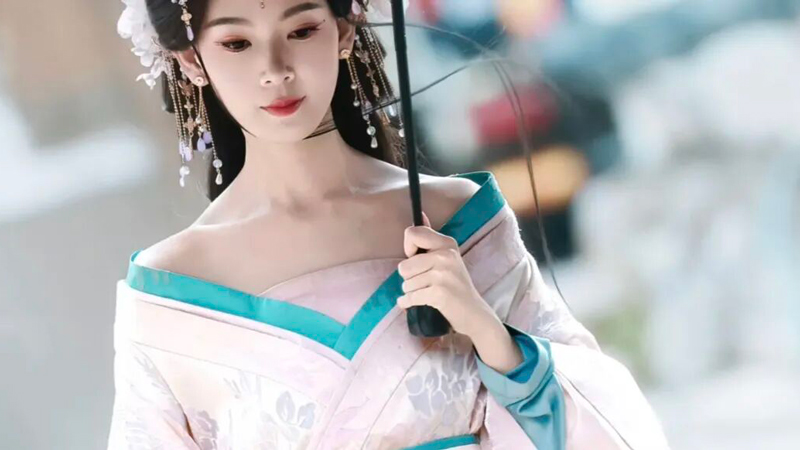
Why do so many historical Chinese dramas keep pulling collars down to expose collarbones? Has this become a lazy shortcut for on-screen romance—and a dangerous distortion of what traditional clothing actually looked like?
You have seen it in the latest series starring Chen Yao (陈瑶). Her wide-open collar, bare shoulders, and exposed collarbones feel strangely familiar—like a throwback to costume dramas from twenty years ago. But this look is no longer confined to television. Walk into any Yinglou (影楼)—a photo studio specializing in period costumes—and the stylist will tug your robe’s neckline down to your chest, adjust the undergarment, and pose you with one shoulder slightly forward. They call it “ancient-style photography.” Yet the result has very little to do with history; it is soft erotica draped in silk, using the past as a flimsy excuse.
History Tells a Different Story
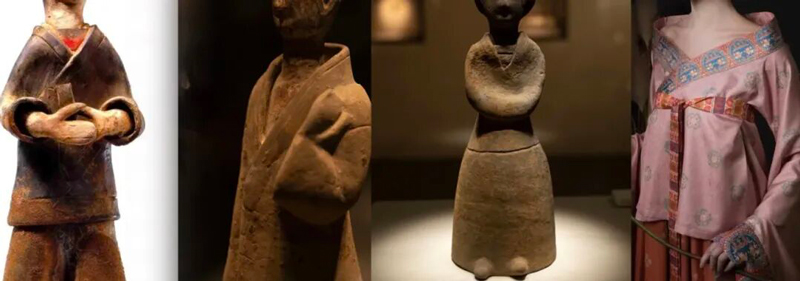
Let us go straight to the source. During the Qin and Han dynasties, broad collars actually existed—but they were never worn the way you see on screen today. Take the N10 Zhiju Pao (直裾袍), a straight-hemmed robe unearthed from the Mashan Chu Tomb (马山楚墓) in Hubei. Its side collar opening measured a stunning 43 centimeters across. That is undeniably wide. Yet ancient wearers had strict rules: they layered multiple robes, each with a slightly narrower collar, so the necklines cascaded like terraced rice fields—orderly, elegant, and completely covered. Alternatively, they pulled the fabric down and backward to secure the overlapping front panels, a wrapping technique that kept the whole silhouette neat and dignified. The final appearance, in every case, retained the formal, structured look associated with orthodox Han clothing.
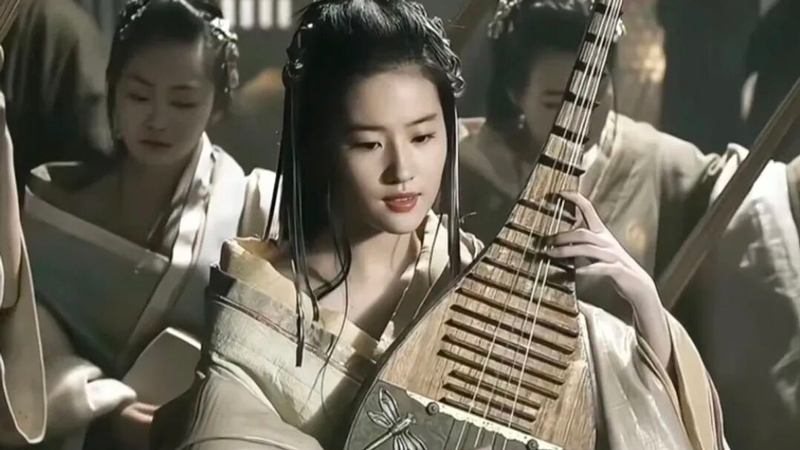
By the Northern and Southern Dynasties, wide collars reappeared—but again with a crucial difference. They showed up mainly on Ruqun (襦裙), a two-piece outfit with a short jacket over a skirt. When worn, the broad neckline revealed a round-collared inner layer underneath. Visually, this might remind you of today’s dramas, but do not be fooled. First, this style applied exclusively to separate tops and skirts—never to one-piece robes. Second, even in the two-piece system, the inner garment remained essential. It was not until the Sui dynasty, when the skirt rose to chest height, that women occasionally skipped the underlayer. For waist-high Ruqun, however, they always tucked a round-neck top or a Liangdang (裲档)—a sleeveless vest—underneath the open collar. The ancient aesthetic was subtle: skin hinted at, never flaunted.
How Cinema Rewrites Costume History
So where did the television version come from? The trail leads back to Hong Kong and Taiwanese productions from the 1980s and 1990s. Initially, those extreme low-cut collars only appeared in dramas set in the Tang dynasty, where artworks occasionally showed plump-cheeked court ladies with looser necklines. Then the trend migrated—without any historical justification—to stories about Qin, Han, and even Warring States periods. Producers copied the visual shorthand because it signaled sensuality and modernity, not because it reflected any period’s actual dress code. Once established, this “cinematic fashion” spread like wildfire. Filmmakers mixed and matched it across dynasties, and before long, the drooping collar became the default “ancient Chinese look” in popular imagination.
Early Qin-Han costume dramas, by contrast, got things remarkably right. Although the fabrics and dyeing techniques were simpler than today’s, the tailoring was meticulous. Garments wrapped with precision; sleeves fell in straight, clean lines; and the overall impression was one of solemnity and grandeur. Those productions treated historical clothing as a serious craft. Then the tide turned. As ratings chased eye candy, stylists began prioritizing skin over silhouette. The result? A gradual erosion of authenticity—and a wholesale dumbing-down of what traditional attire actually represents.
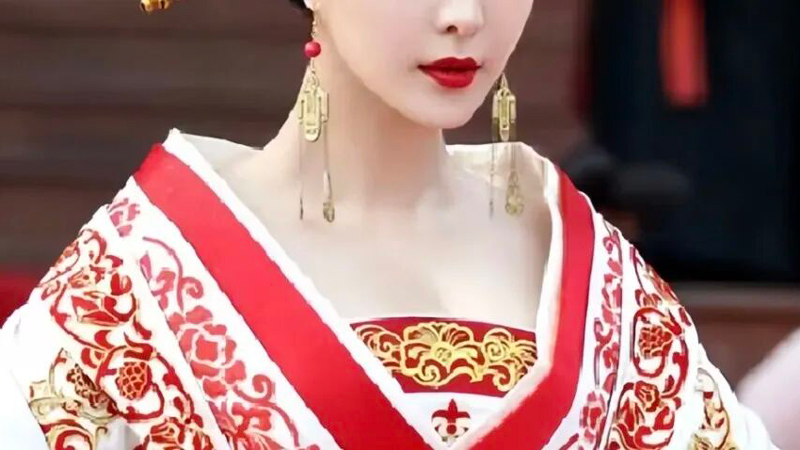
That erosion did not stop at the studio gate. It spilled directly into the Yinglou industry and, through it, into public perception. Today, many photography shops advertising “Han dynasty style” or “Warring States warrior” pull the robe’s collar so far sideways that it approaches a horizontal line. They deliberately expose the chest band or decorative under-wrap—a look that would have been unthinkable in any formal setting of ancient China. These images are neither Qin-Han nor Tang; they are a hybrid caricature. Worse, online merchants now slap labels like “authentic restoration” and “orthodox Hanfu” on these distorted designs, misleading customers who genuinely want to learn about traditional dress. The commercial incentive is clear: sex sells, even when draped in historical fiction.
Beyond the Screen—and Back to Reality
Put aesthetics aside for a moment. The physical act of forcing a robe’s collar downward damages the garment’s structural integrity. Traditional Hanfu is deliberately cut with ample Fangliang (放量)—generous fabric allowance that drapes naturally over the body. When you yank the neckline open, you pull the entire front panel out of alignment. The hem twists; the sides buckle; and what should be a flowing, balanced robe turns into a lopsided mess—wide at the chest, narrow at the feet—like a bathrobe that has slipped off one shoulder. The classical elegance disappears, replaced by a sloppy, contrived image that has no roots in any dynasty. It is not revival; it is misrepresentation.
That said, personal style choices deserve respect. If someone prefers a seductive photo or a dramatic on-screen look, that is their prerogative. The problem arises when fantasy masquerades as fact. Many viewers genuinely believe that ancient Chinese women walked around with their collarbones on full display—because that is all they have ever seen on their screens. This article does not intend to shame anyone’s taste. It simply urges you to separate entertainment from history. Costume dramas are artistic interpretations, not documentaries; they bend evidence for emotional effect. If you want to understand real Hanfu—its cut, its layering, its philosophy—do not copy what you see on Netflix or Youku. Dig deeper. Read archaeological reports. Visit museum exhibitions. Talk to scholars and independent makers who treat each stitch as a clue to the past.
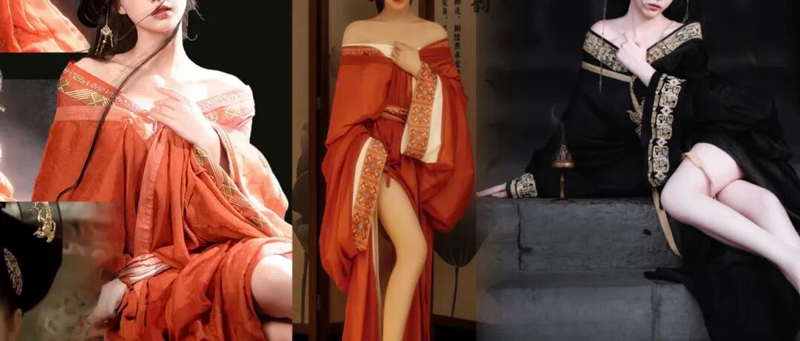
So what do you make of this mutated neckline—this modern invention dressed in ancient cloth? Is it harmless fashion, or a gradual erasure of a rich material culture? Perhaps the answer depends on whether you see clothing as mere decoration or as a living archive of how people once carried themselves with dignity, modesty, and quiet confidence. Next time a stylist reaches for your collar, you might pause—and ask: whose story am I really telling?