
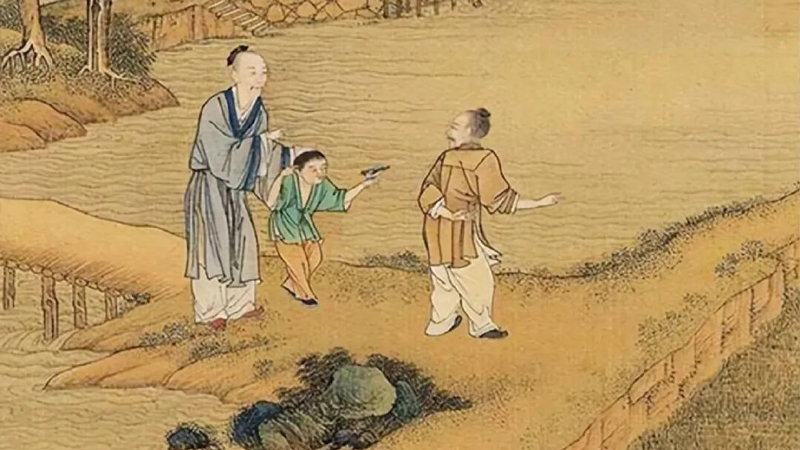
Could You Survive a Day of Ancient Housework? The famous poet Li Bai (李白) once wrote, “The moon over Chang’an (长安) shines bright, and from ten thousand homes comes the pounding of washing clubs.” To modern ears, that line feels romantic—a quiet night, silvery light, distant rhythm. But if you actually stood in that courtyard, you would hear no poetry. You would hear the gasping breath of women swinging heavy wooden mallets, their arms burning, their backs aching, while the moon did nothing but illuminate their sweat.
No washing machines, no running water, no gas stoves. For a woman in ancient China, housework was not a chore—it was a war of attrition fought from dawn past midnight, waged with muscle, bone, and sheer will.
Before Dawn
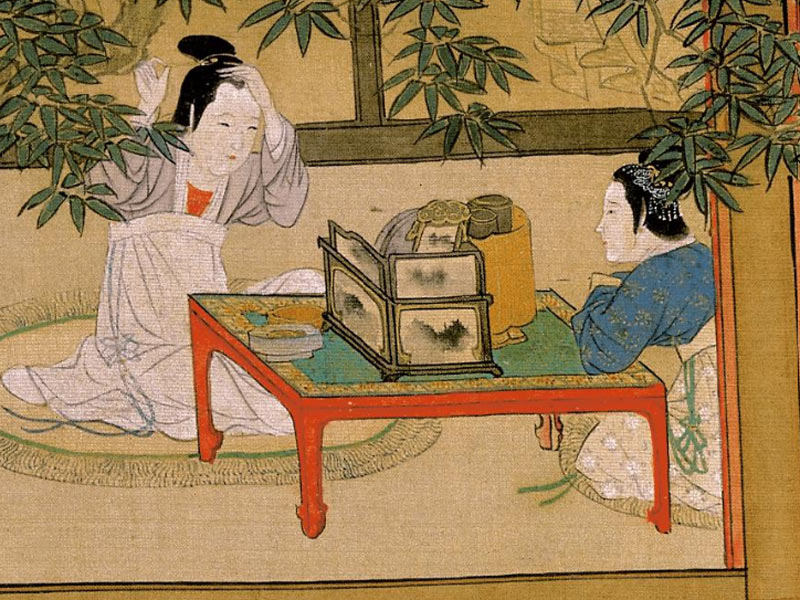
The rooster crowed once—just once—and she was up. Not by alarm clock, but by the iron grip of duty. According to the Book of Rites (礼记), the mistress of the household had to rise at the first cockcrow, tidy the rooms, greet her in-laws, and prepare washing water for her husband. But first, her own appearance: combing, twisting her hair into a tight bun, inserting jade pins and earrings—all in near-total darkness, all in absolute silence. A single clatter could wake the family, and a sleepy wife was a “lazy woman” inviting sharp tongues.
She moved like a shadow. No stretching, no groaning. Every motion had to be quiet and precise. By the time the sky turned pale grey, she had already swept the main hall, emptied the chamber pots, and filled the bronze basin with cold well water. Her fingers, numb from the chill, had not yet touched a single grain of rice—but the fire pit was already waiting.
Kindling the Flame
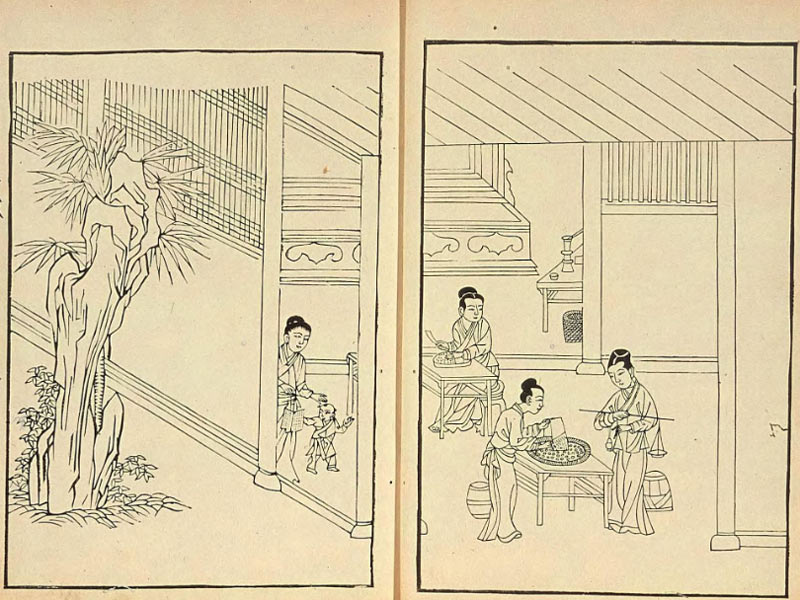
Lighting the morning fire was not a simple twist of a knob. In the Ming Dynasty, firewood was already one of the “seven necessities” —and in many regions, people struggled more to find fuel than to find food. Freshly cut wood was wet; it spat smoke, stung eyes, and refused to catch. She had to split it, dry it, stack it, and nurse the tiny spark with dry grass and desperate breath. Historical records note that a typical family spent one-third of the year just wrestling with wood—chopping, hauling, cursing under the breath.
Once the flames licked the bottom of the wok, she cooked the morning gruel and steamed the buns. But she did not eat first. Etiquette demanded that her husband, his parents, and any male guests take their bowls before she could even lift the lid. She stood by, wiping her hands on her apron, watching them chew. Only when they pushed back their chairs could she scoop up what remained—often cold, often thin. Then came the washing of bowls, the scrubbing of the cauldron, and the endless wiping of every surface that smoke had blackened.
By mid-morning, her lower back already screamed. But the day had barely begun.
Stitch by Stitch
No rest followed breakfast. A woman’s worth was measured by her needlework—embroidery, patching, weaving. Without these skills, marriage was nearly impossible. The Book of Han (汉书) records that “a female worker in one month effectively labors forty-five days”—because she spun and sewed far into the night, stealing hours from sleep. The loom was merciless. Warp and thread were coarse; silk and hemp were stiff, and needles often bent or broke against the fabric. Every stitch demanded force, and every forced stitch risked a bloody prick.
She sewed not just for herself, but for every member of the household—father-in-law’s winter robe, mother-in-law’s padded jacket, her husband’s working trousers, the children’s tiny socks. Sizes changed, seasons turned, and holes reappeared like weeds. She patched the same elbow three times before autumn ended. Her thimble was dented from thousands of pushes. Her eyes strained in the dim light filtering through paper windows, but she dared not pause—because tomorrow, there would be new tears.
And when the thread ran out, she did not buy new—she spun it, from raw cotton or silk cocoons, her wheel creaking in a rhythm that matched her own heavy heartbeat.
The Wooden Mallet
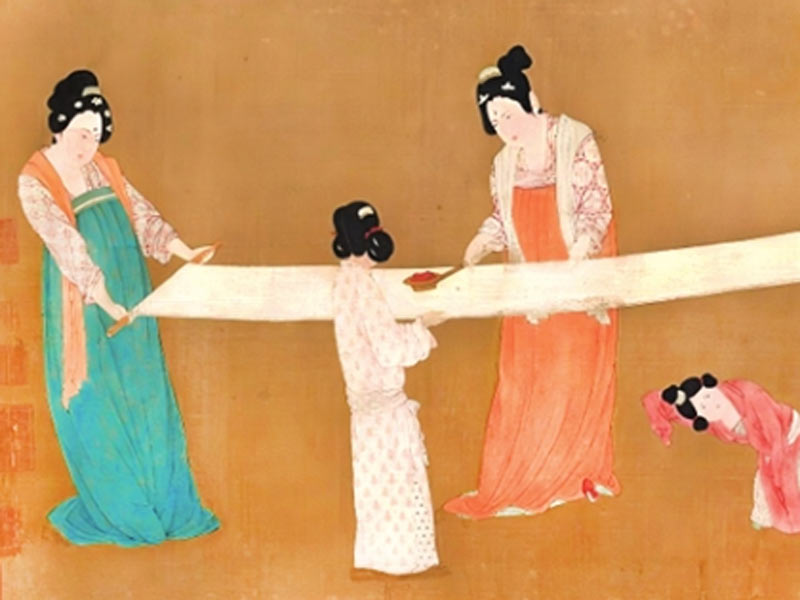
The afternoon’s great ordeal was washing. No machine—just a wooden mallet, about thirty centimeters long, and a flat stone slab. She soaked the soiled garments in a basin, then beat them, again and again, until the dirt loosened from the fibers. The poet Du Fu (杜甫) watched this and wrote, “They exhaust their strength within the women’s chambers—listen, the sound reaches beyond the sky.” He was not exaggerating. Two women often worked together, striking in alternating rhythm, but if she was alone, her arm swung without respite. One strike, two strikes, a hundred strikes per garment. The noise was deafening, the vibration traveled up her wrist to her shoulder, and her palm blistered within the first hour.
After the beating came the rinsing—but water did not flow from a tap. She carried every bucket from the village well, often a half-mile walk each way. At peak hours, the well was crowded; she waited in line under the scorching sun. During droughts, she rose at midnight just to secure a spot, sometimes trudging three to five li (里) to a neighboring village, returning with sloshing buckets that soaked her skirt and doubled her load. By the time she hung the last piece on the bamboo pole, her grip had weakened so much that she could barely untie the knots.
The poet Bai Juyi (白居易) also noted the nightly pounding—“under the bright moon, the mallet and anvil move, night after night beating autumn fabric.” He wrote it as a scene. She lived it as a sentence.
The Never-Ending Grind
Evening brought another fire, another meal, another round of washing bowls. But the night held two more terrors: husking rice and milling flour. No electric mills—only a heavy stone pestle, its iron head weighing nearly fifty kilograms, attached to a wooden lever. She stepped on the lever, lifting the pestle, then let it fall—crush, lift, fall—over and over, for every grain the family would eat tomorrow. Milling was worse: turning the heavy stone wheel in a circle, her whole body leaning into the motion, monotonous and exhausting. Historical accounts admit that “this task, which falls to the housewife, would tax even a strong laborer.”
She finished past the hour of the dog (19:00–21:00). Her shoulders were knots; her fingers were cracked from lye and cold water. She collapsed onto her straw mat—but sleep came in fragments. In a few hours, the rooster would crow again, and the entire cycle would reboot: sweep, fetch, light, cook, sew, beat, carry, grind. There was no weekend, no holiday, no relief. The Book of Rites praised the ideal wife as one who “rises at dawn, sweeps the courtyard, sews clothes, cooks meals, and never rests all day.” That was not praise—it was a job description.
She also worked the fields alongside men—transplanting rice, pulling weeds, harvesting—but the field ended at sunset, while the housework began anew. Her day stretched from the first cockcrow to the last ember. Modern estimates suggest that a woman of that era spent more than fourteen hours daily in active physical labor, not including the mental load of budgeting, child-rearing, and elderly care.
Today, we press a button and clothes spin clean. We turn a knob and blue flames appear. We twist a faucet and water gushes. But that moonlit woman—whose mallet echoed across a thousand rooftops—she gave more than time. She gave her spine, her hands, her sleep, and her silent endurance to a cycle that never acknowledged her. Next time you open your washing machine, pause for a second. Remember her. And know that the word “housework” has never been just two syllables—it was her entire existence, compressed into every strike of that wooden baton.
Yes, she had to do laundry and cook and whatnot, but surely even the rural woman (not to mention town/city dwellers) had the option of buying husked rice and milled flour? Water wheels and ox powered mills were a thing even if windmills might not have been a Chinese invention.
Fair thought. Processed grain was a luxury for poor villagers. Though water and ox mills existed, home grain‑pounding still fell heavily on women.