
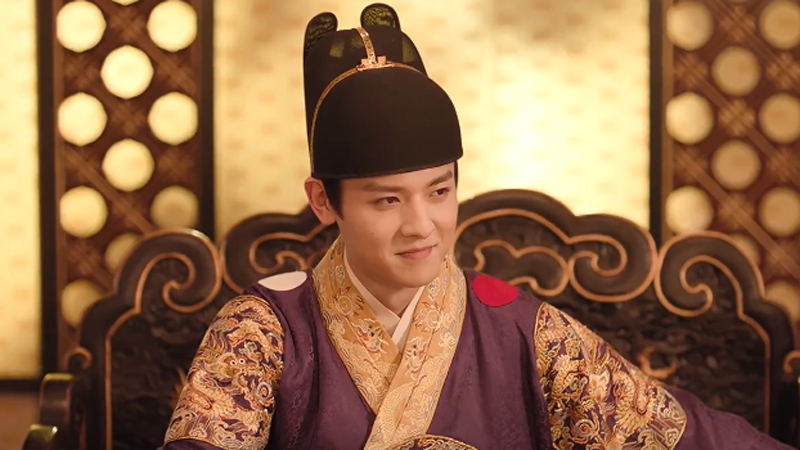
Ming dynasty dramas often dress their emperors in bright yellow robes with round collars and golden dragons. So when the emperor in The Road to Splendor (花开锦绣) appears in a deep purple, cross-collared robe with two round emblems on his shoulders, it looks jarring. Is this a costume mistake? Or did the production team uncover a lesser-known chapter of imperial fashion?
Why Purple?
Purple was not always a royal color in China. During the Spring and Autumn period, Duke Huan of Qi (齐桓公) popularized it as a personal preference. By the Tang and Song dynasties, purple had climbed the social ladder—only officials of the third rank or higher could wear it. The New Book of Tang (新唐书) and History of Song (宋史) both document this rule. But at the start of the Ming, purple was officially banned for civilians and officials alike. Some historians suggest the ban came from a Confucian saying, “Purple usurps red,” which treated purple as a deceptive substitute for the orthodox red.

Yet the ban softened over time. The Ming History Chronicles (明史纪事本末) mention that the Wanli (万历) emperor wore purple, and his portrait in the Rubi Tu (入跸图) confirms it. That painting shows him in a purple robe during a royal procession. So the The Road to Splendor costume designers did not invent the color—they reached back to late Ming reality. The robe’s deep purple base, far from a fantasy choice, mirrors what an actual emperor might have worn for certain occasions.
The decision also makes dramatic sense. Against the golden thrones and red pillars of a Ming palace, purple stands out as dignified yet subdued. It signals power without shouting. For a character who rules through subtlety rather than brute force, this color choice reinforces his demeanor on screen.
Sun and Moon on His Shoulders
Those round patches—one red, one white—are the most puzzling feature for modern viewers. They are not random decorations. In Chinese imperial regalia, they represent the sun and moon, two of the Twelve Symbols that appeared on the emperor’s ceremonial robes as early as the Zhou dynasty. The red patch is the sun; the white is the moon. Together, they form a phrase from old texts: “carrying the sun and moon on the shoulders.” That imagery conveyed the ruler’s cosmic responsibility—he was the earthly counterpart to celestial bodies.

These symbols endured through the Ming and Qing dynasties. Portraits of Ming emperors consistently show those red-and-white roundels, but usually on full ceremonial vestments for grand sacrifices or state rites. What The Road to Splendor does differently is place them on a daily court robe—the kind worn for regular meetings with ministers. That is a creative liberty, but the emblem itself is historically accurate. The production team simply transplanted a solemn ritual element onto a more casual garment, making the emperor’s authority visible even during routine affairs.
For viewers, this detail rewards close attention. Instead of the predictable dragon motifs, the drama offers a visual puzzle that leads back to ancient astronomy and Confucian statecraft. It makes the costume a conversation starter, not just background décor.
The Cross-Collar Revival
Most period dramas have trained us to expect a round collar on an emperor’s robe. That style, called panling (盘领) or round-neck, became standard for the Ming emperor’s regular court attire—the so-called gunlong pao (衮龙袍). It was formal, practical, and widely depicted in paintings. But it was not the only collar type in the imperial wardrobe. The older cross-collar style, or jiaoling (交领), traces back to the Shang and Zhou dynasties. For ceremonial dress like the mianfu (冕服) or Tong Tian Guan (通天冠) robes, Ming emperors still wore that classic left-over-right cross-collar.

Even during the Ming, the emperor did not spend every hour on the throne. In private quarters or informal councils, he preferred looser, cross-collared garments. The Jiajing (嘉靖) emperor, for instance, commissioned a specific type called Yan Bian Fu (燕弁服), which was cross-collared and right-over-left. The Da Ming Huidian (大明会典) describes its cut, and the Dingling (定陵) tomb excavation unearthed a cross-collared dragon robe worn by the Wanli emperor himself. These were not outliers—they were part of a layered dress code that matched occasion to outfit.
By choosing this less familiar silhouette, The Road to Splendor breaks the visual monotony of imperial dramas. It reminds us that the emperor, like any person, changed clothes for different parts of his day. The cross-collar also softens his image, making him approachable in intimate scenes while still draped in authority. That contrast—between the formal round collar and the relaxed cross-collar—adds psychological depth to how we read his mood and status from scene to scene.
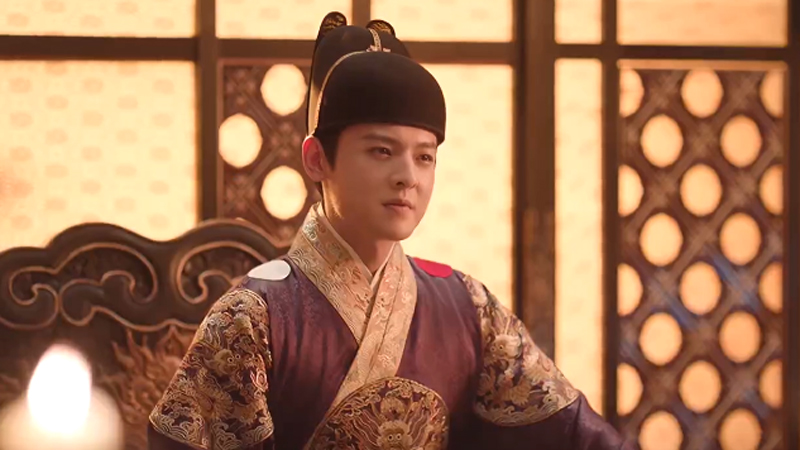
So is the purple cross-collared robe in The Road to Splendor historically odd? Only if we rely on the narrow lens of television tropes. The real Ming imperial wardrobe was a complex system of colors, collars, and emblems, each tied to time, place, and ritual rank. The drama did not invent the purple; it revived a late-Ming trend. It did not misplace the sun and moon; it relocated them to a more visible spot. And it did not guess at the cross-collar; it inherited a tradition older than the round neck itself. What seems strange at first glance becomes, on closer inspection, a thoughtful re-creation of a multifaceted ruler.
For audiences, this is a quiet lesson in looking beyond clichés. The next time a period drama presents an unusual costume, it might not be an error—it could be an invitation to explore the forgotten corners of history. And that, perhaps, is what makes The Road to Splendor worth watching: not for its plot alone, but for the hundred small decisions that bring a lost sartorial language back to life.