
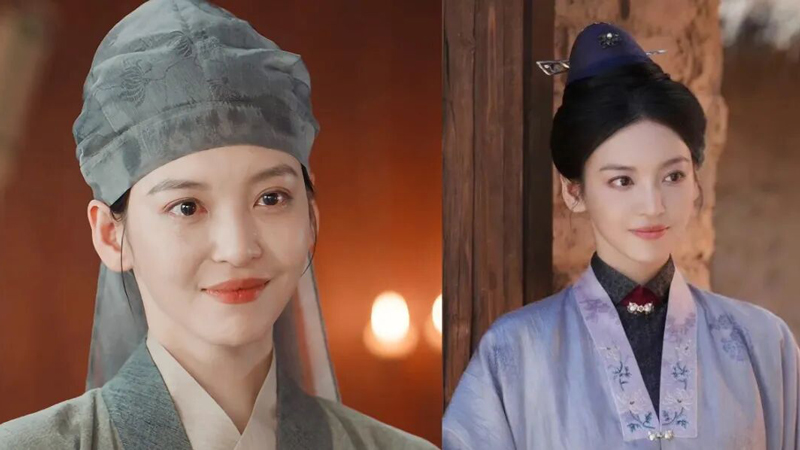
In the historical drama The Road to Splendor (花开锦绣), actress You Jingru (尤靖茹) portrays Zuo Shi (左氏), a secondary wife in a wealthy household. While other female characters dazzle with gold and jade ornaments in their hair, Zuo Shi appears with either a dark, cap-like object perched on her head or a plain grey cloth wrapping her entire coiffure. To modern viewers, these choices might seem odd, even dowdy.
But these are not stylists’ eccentricities; they are accurate reproductions of two specific types of headwear worn by women during the Ming Dynasty (1368–1644): the Di Ji (狄髻) and the Fu Jin (幅巾). Far from being mere decoration, these pieces were silent indicators of social status, economic standing, and even personal taste within the rigid hierarchy of the time.
Di Ji: The Social Ladder on Her Head
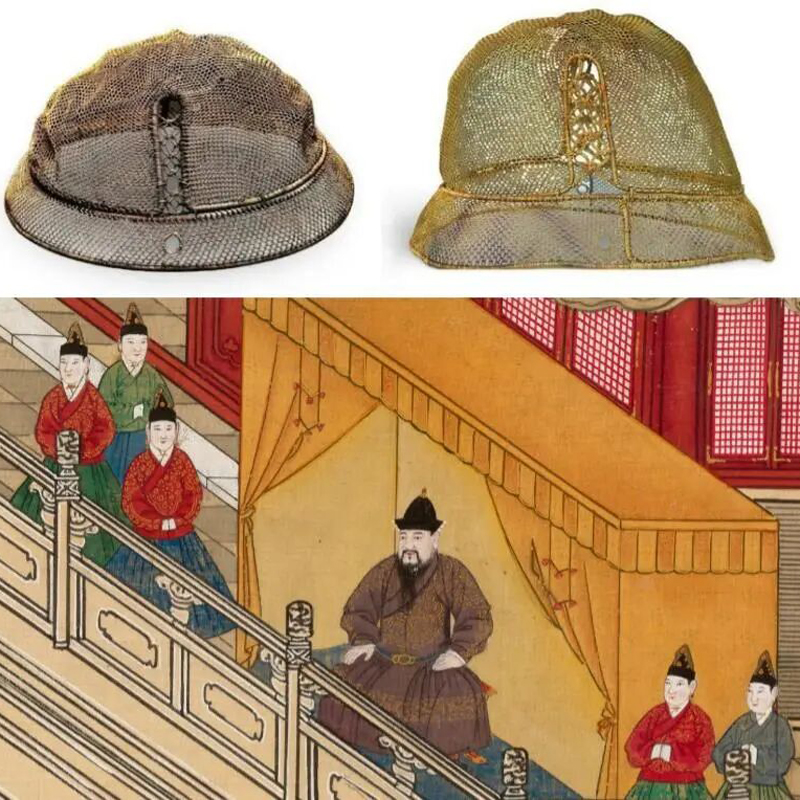
The Di Ji itself is not a full hairstyle but a foundation—a mesh cap woven from silver wire, horsehair, or human hair. It was placed over a tightly coiled bun to hold the shape and provide a stable base for pins and ornaments. This practical item appears in countless Ming-era portraits, such as those in The Happy Reign of Emperor Chenghua (明宪宗元宵行乐图), and has been frequently unearthed in tombs from that period. In the drama, the Di Ji worn by the character is secured with horizontal hairpins, matching the standard form seen in historical records.
However, the true marker of status was the suite of jewelry—known as the “head face”—that was inserted into it. This was not a casual accessory. The matriarch of a high-ranking official’s family or a woman from a prosperous merchant house would possess a complete set of ornamental pieces: a central pendant, side ornaments, temple pieces, and various hairpins. Wearing this full set was essential for formal visits and banquets, signaling wealth and respectability. The character of Madame Yu, for example, is shown with a fully decorated Di Ji in the show.
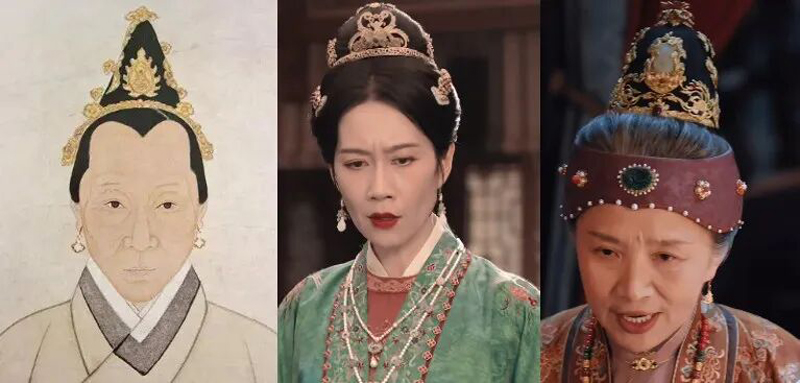
But this lavish display was not for everyone. Women from ordinary families, or those of lower status like concubines and junior branch relatives, typically wore only a plain Di Ji with perhaps a single silver pin to hold it in place. They could not afford or were not entitled to the full regalia. The character Zuo Shi’s position in the Fu household perfectly illustrates this social reality. She lacks the authority and financial resources of the main wife. Her simple, unadorned Di Ji is not a failure of the costume department, but a deliberate choice that visually narrates her humble position and limited power within the family. It shows that a single piece of headwear could immediately convey a person’s rank and affluence.
Fu Jin: A Cap of Humility and Style
The second type of headwear, the Fu Jin, is even simpler in concept—a piece of cloth used to wrap the hair. This practice has ancient roots, with similar forms seen as early as the pre-Qin period. It gained popularity among the scholar-official class during the Eastern Han Dynasty and became a symbol of elegance for the unconventional intellectuals of the Wei and Jin periods. By the Tang Dynasty, it evolved into the official’s headgear known as the Fu Tou (幞头), and during the Song Dynasty, the simple cloth wrap was revived by scholars, giving rise to variations like the famous Dong Po Jin (东坡巾).
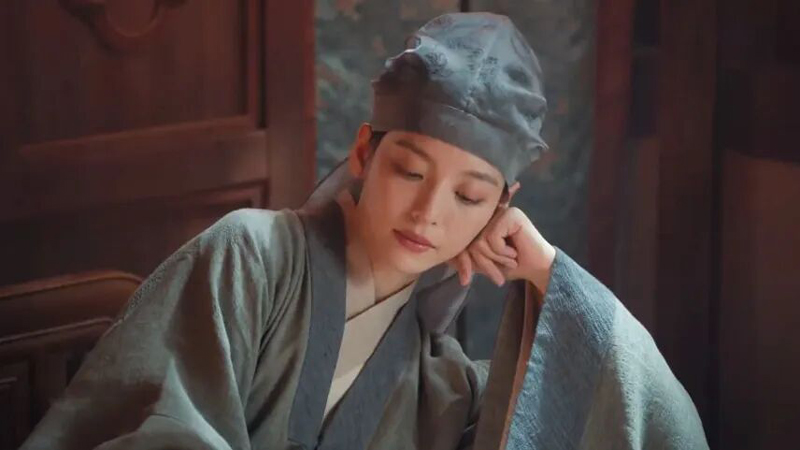
During the Ming Dynasty, the Fu Jin was not just for men. Many women, particularly those who labored at home or were traveling, adopted it for its practicality. It kept hair tidy and out of the way. The historical encyclopedia Sancai Tuhui (三才图会) includes illustrations of this type of head covering. Even more interestingly, in the late Ming period, it became fashionable in the Jiangnan region for women to adopt the male scholar’s appearance, wearing the Fu Jin as part of a trend of dressing in men’s clothing. This reveals that the Fu Jin was not simply a marker of poverty; it could also be a deliberate stylistic choice.
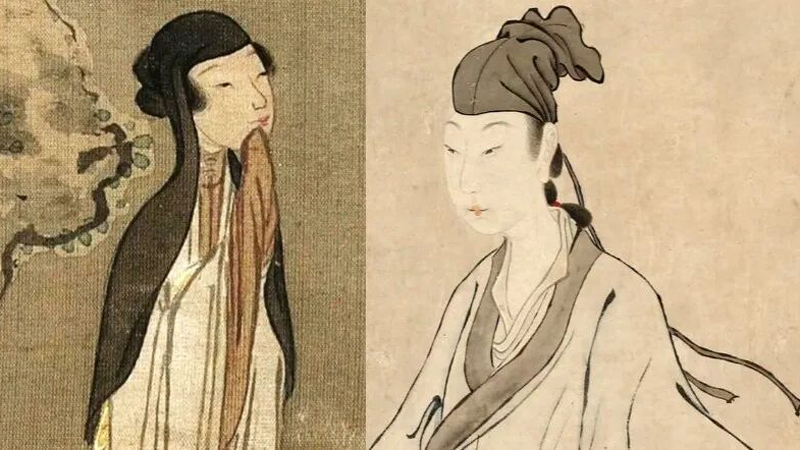
In The Road to Splendor, the character’s Fu Jin is made of a subtle dark-patterned fabric, with short ends hanging down on the sides. A few loose strands of hair are left at her temples, which softens the severe look. This design is consistent with how Ming women wore it. Some productions shy away from such a simple style, fearing audiences will find it dull or unattractive. This is precisely why many first-time viewers might mistake it for a Daoist nun’s attire. Yet, far from being a mistake, it is a testament to the drama’s commitment to historical detail, albeit with a slight adjustment in fabric quality for better on-screen aesthetics, ensuring the core form remains faithful to history.
Why Authenticity Feels Strange
Our perception of historical dress is heavily influenced by decades of television dramas that have often prioritized spectacle over accuracy. We have become accustomed to heroines in lavish, jewel-encrusted wigs, making the austere and functional headwear of the Ming Dynasty look alien and bizarre. The costume design in The Road to Splendor actively pushes back against these established visual tropes. The team behind the show referenced historical portraits, artifacts, and texts to build a world that feels grounded in its specific era. The headwear of Zuo Shi is one of the most prominent examples of this approach.

By choosing to dress a secondary character in plain Di Ji and Fu Jin, the show does more than just replicate history; it tells a visual story. It immediately establishes the character’s financial constraints and her subordinate status in a way that a line of dialogue could never achieve. This attention to detail invites the audience to look closer and understand that in a hierarchical society, clothing was a silent but powerful language. What seems like an odd design choice is, in fact, a clever and deliberate narrative tool.
So, the next time you find yourself questioning a character’s “weird” costume in a period drama, it might be worth asking: is the production being lazy, or is it being remarkably accurate? Sometimes, the most authentic details are the ones that initially surprise us the most. This is where the real value of the drama lies—using these small, sometimes overlooked elements to offer viewers a peek into the past, challenging our own modern expectations of beauty and status to reveal a world far more complex and fascinating than we imagined.