
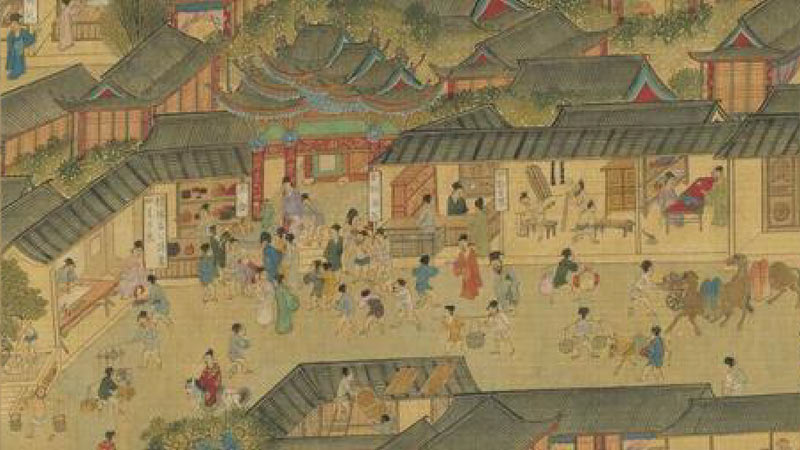
Have you ever stood at a supermarket checkout, clutching a rainbow of plastic bags, and wondered—how did our ancestors carry their purchases home without a single disposable sack? Before polyethylene and petrochemicals, ancient Chinese shoppers mastered a system so clever, so sustainable, that we might blush at our own throwaway habits. They didn’t need factories or fossil fuels; they used leaves, grass, fabric, and even their own clothing. Their “shopping bags” were biodegradable, reusable, and often fragrant. Let’s unwrap these forgotten arts—and ask whether we’ve lost more than just convenience along the way.
Nature’s Wrapping Desk

Long before Styrofoam trays and cling film, the natural world served as the ultimate packaging plant. Lotus leaves were the MVP: waterproof, subtly scented, and sturdy enough to hold raw meat, fresh fish, pastries, or even steamed rice. In the classic novel Water Margin (水浒传), the burly monk Lu Zhishen (鲁智深) orders a butcher to mince pork—and receives it wrapped in exactly such a leaf. No plastic, no waste, just a biodegradable bundle that added a faint floral note to the food.
Grass and willow twigs worked wonders for seafood. Fish sellers threaded a willow branch or straw rope through the gills, and the customer walked away with a natural handle. The poet Du Fu (杜甫), living in the Tang Dynasty, would have recognized this trick; so would Zhang Shun, the aquatic hero of Water Margin. For fried dough sticks, vendors used dried reed stems as skewers; for slabs of pork, a twist of hemp rope did the job. Many Chinese born in the 1980s or 1990s still remember buying groceries tied with rice straw—a fading echo of that pre-plastic world.
These methods weren’t quaint quirks; they were practical responses to a world without factories. Every leaf, twig, and stem returned to the earth after use. No recycling trucks, no microplastics—just a closed loop that kept rivers clean and landfills empty. And the best part? The packaging often enhanced the food’s flavor or freshness, something no synthetic bag can boast.
Everyday Carriers

For routine market trips, ancient shoppers never relied on shopkeepers to provide containers. They brought their own—a habit that modern environmentalists would cheer. The bamboo basket, in all its woven glory, was the universal shopping cart. From a handful of greens to a toddler’s afternoon nap, baskets came in every size. Women carried shallow trays for tofu, men hauled deep crates for vegetables. A cloth sack, the ancestor of today’s reusable tote, held rice, beans, and flour—sturdy, washable, and collapsible.
Liquid goods required even more foresight. Buying soy sauce or sesame oil? You’d take a ceramic bottle or a wooden ladle. Tofu, still warm from the vat, traveled in a small bowl that you’d brought from home. This wasn’t seen as inconvenience; it was simply how commerce worked. Shops measured products by weight or volume, and the customer’s vessel was part of the transaction—much like filling your own mug at a coffee shop today, but without the trendy label.
This self-sufficiency extended to street snacks. A traveler could buy a sesame cake and have it slipped into their own cloth wrapper, or carry a gourd for water. The system demanded trust and routine, but it also forged a bond between buyer and seller—each knowing that the container would return tomorrow, not clog a drain somewhere downstream. It was commerce with a conscience, born of necessity but polished by habit.
Pockets on the Body

What about impulse buys—a few candied fruits, a bundle of incense, or a small trinket? Surely nobody carried a basket just for that. Here, ancient fashion solved the problem with flair. The flowing sleeves of traditional Han robes hid a secret: inward-facing pockets sewn near the wrist, with openings angled downward. The deeper you reached, the tighter the grip. Coins, letters, or a folded fan would sit snugly, never falling out even when you waved your arm. That’s why heroes in period dramas can casually stash items into their sleeves with a flick—it’s not magic, it’s tailoring.
The chest area offered another hideaway. The overlapping front lapels of a robe created a natural pouch for banknotes, personal seals, or emergency medicine. Meanwhile, the waist belt became a mobile tool rack. From it hung embroidered pouches for coins and spices, jade pendants for status, small knives for daily tasks, and folding fans for instant cooling. A well-dressed gentleman or lady was essentially a walking convenience store, with every item within easy reach.
This belt-based system was so efficient that it survived for millennia. The hebao, in particular, was both purse and perfume sachet—its contents jingled and scented the air with each step. Unlike our zippered backpacks, these accessories were visible, decorative, and deeply personal. They told stories of wealth, taste, and even romantic intent. And they never needed charging, zipper repair, or replacement—just a spare piece of silk when the old one frayed.
Bulk and Distance
For serious hauls—think weekly market runs or cross-country travel—the ancients deployed heavier artillery. The baofu (包袱) was the ultimate improviser: a large square of cotton or silk, spread flat, goods piled in the center, then four corners tied diagonally into a knot. It became a shoulder sling, a hand-carry, or even a pillow on the road. Every period drama features this iconic bundle, often slung over a bamboo pole, because it’s simple, scalable, and surprisingly secure.
For larger expeditions, wooden trunks and bamboo chests served as portable wardrobes. These lidded boxes held clothing, books, porcelain, and bulk staples. Wealthy families hired porters with carrying poles to transport them across provinces. In cities, merchants used these chests to deliver wholesale goods—tea, silk, ceramics—from warehouses to shops. Unlike cardboard boxes, these containers were built to last decades, often passed down as heirlooms.
Even street vendors adopted modular solutions. A noodle seller balanced a wooden tray with bowls and chopsticks; a fruit peddler used tiered bamboo baskets that stacked like nesting dolls. The principle was always the same: reuse, repair, and respect the materials. Nothing was designed for single use. When a basket broke, a weaver fixed it; when a cloth tore, a seamstress patched it. This circular economy wasn’t a marketing slogan—it was survival, and it worked beautifully for thousands of years.
So next time you untangle a knotted plastic bag, remember the lotus leaf, the willow twig, the hidden sleeve, and the knotted square cloth. They weren’t primitive—they were profoundly intelligent. And they ask us a quiet question: in our rush for convenience, have we traded poetry for pollution? The answer may lie in how we choose to carry tomorrow’s groceries.