
On August 22, “The Spirit of Jing Embroidery” (京绣里的精气神), a teacher-student exhibition of Li-family Jing embroidery by fifth-generation inheritor Liu Xiaoyan (刘晓燕), opened at the Yanjing Bada Museum (北京燕京八绝博物馆) in Beijing’s Shijingshan District (石景山区). The show presents close to a hundred recent works of Jing embroidery (京绣) and runs through October 22.

The Palace Embroidery of the Eight Crafts
Jing embroidery, one of the Eight Imperial Crafts of Beijing, has long carried the title “palace embroidery” for its origins in the imperial workshops, and the craft’s court pedigree shows in its use of gold thread: coiled or couched into patterns in the Panjin technique, it is what gives the works their characteristic sheen. The exhibition reads the craft’s character through the three ideas in its title: spirit, vitality and soul, expressed in the layouts of its auspicious motifs, with symmetry as the frame, gold thread as the breath, and lineage as the core. The roughly one hundred pieces on view are organized into three units that trace the craft from the imperial court to contemporary classrooms.
Motifs, Masterworks and Student Work
The first unit, “Palace Embroidery Origins: Auspicious Lineage,” lays out a lineage reaching back to the Tang dynasty, with embroidered swatches of classic motifs such as the dragon, the auspicious tiger, the Qilin (麒麟), the crane and the butterfly. Each motif carried its own register in the palace system: the dragon stood for imperial authority, the tiger for bravery, the crane for longevity and the butterfly for harmony, and the unit explains how the orthodox ritual order of court dress chose among them.
In the second unit, “Masterworks: The Craftsman’s Treasury,” the focus is on technique. Demonstrations and objects show the Panjin (盘金), Dazi (打籽) and Tao (套针) stitches and the skills of gold-and-silver thread embroidery and double-sided embroidery, where the needleworker works both faces of the cloth so no thread tail shows. The anchors of this unit are three heavyweight pieces: a gold round fan embroidered in silk and steel that has served as a state gift in foreign affairs, a century-old antique “three-blue” Duijin jacket (三蓝对襟褂) kept in the family for generations and shading its motifs through three tones of blue, and a 24K gold dragon-motif robe certified by Guinness World Records.
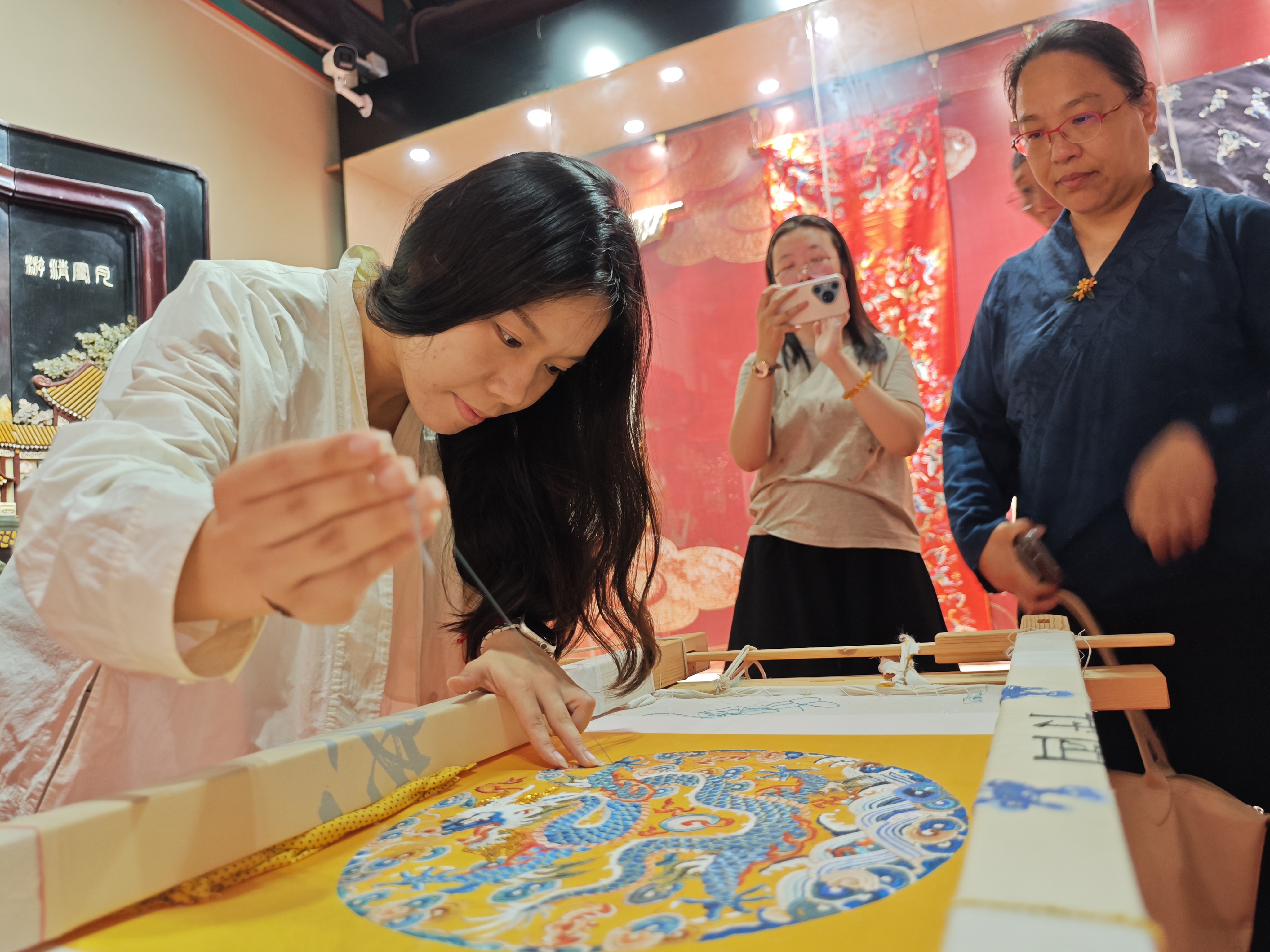
A third section, “Young Scholars, New Stitches,” documents how Jing embroidery has moved into schools, communities and society at large. More than 30 groups of teacher-and-student works are on view, made by university students, primary and middle school students, community residents and hobbyists into their sixties.
Old Rules, New Materials
Beyond the individual pieces, the show doubles as both an academic review of classic techniques and imperial motifs and a review of the inheritors’ experiments. While keeping the old methods as the base, the pieces explore contemporary transformation in materials, subjects and expression, guided by the principle of honoring the old without being bound by it and innovating without losing the lineage. In practice that means traditional stitches and motifs remain the baseline, while new fabrics, new themes and new display formats give the works a contemporary read without sacrificing the technical rigor the craft is known for.
Practical Details for Visitors
Yanjing Bada Museum sits in Shijingshan District. Visitors must purchase the museum’s regular admission ticket, and the exhibition itself requires no separate reservation.