
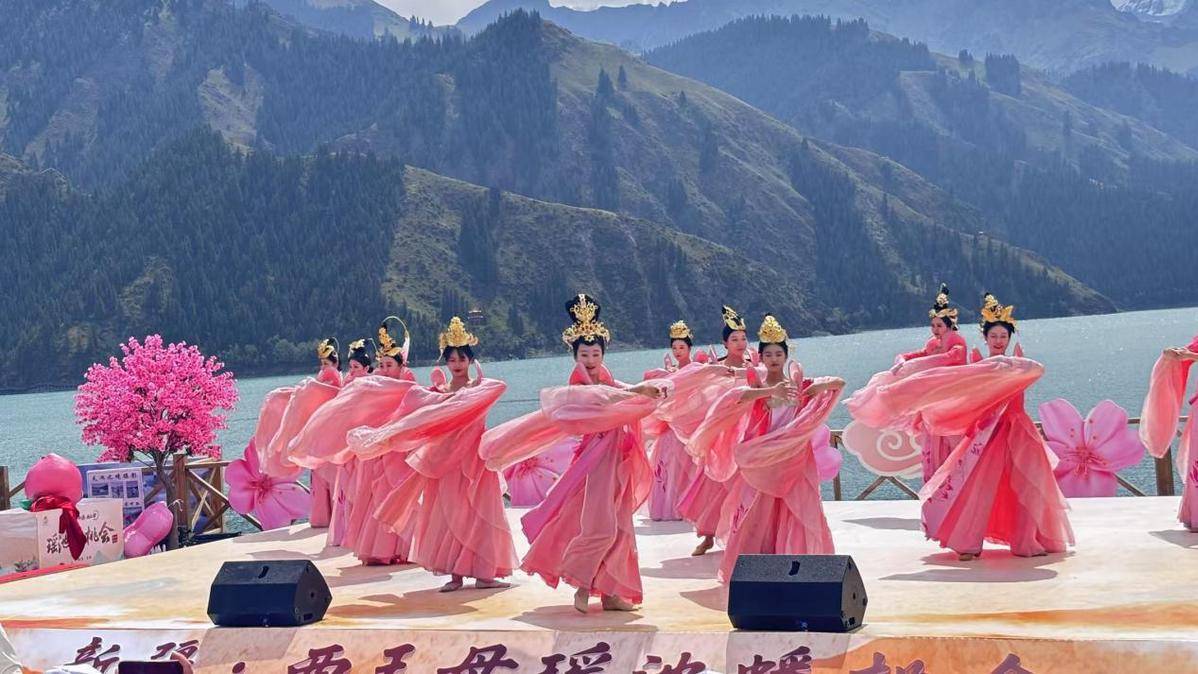
At dusk on August 21, the two blocks of Yaochi Tianjie (瑶池天街) filled with tables placed end to end, and servers dressed as the fairies of the Jade Pool moved down the line with platters. The moment marked the opening of the 2026 Xiwangmu Yaochi Peach Festival (西王母瑶池蟠桃会) at the Tianshan Tianchi (天山天池) scenic area in Fukang, Changji Hui Autonomous Prefecture, Xinjiang. The event runs through August 28 across two venues, the lakeside scenic area and the Yaochi Tianjie pedestrian street, under the theme “Splendor of Tianshan, a Feast at Yaochi.”
An Opening Ceremony on the Lakeshore
Opening ceremonies unfolded at the Haibei Platform (海北平台) by the lake, led by drum music titled “Drum Rhythms of Fukang.” Liu Likun (刘力坤), a scholar of Xiwangmu culture and head of a research studio on Xiwangmu mythology named after her, argued in her keynote that Tianshan Tianchi has been regarded since antiquity as the place where the goddess Xiwangmu held her peach feasts. She cited the Classic of Mountains and Seas and the Mu Tianzi Zhuan (穆天子传), and noted that the Xiwangmu myth is now a national-level ICH item. The festival, she said, turns the myth in old books into a tangible celebration, so that travelers come to know Fukang through peaches and Tianchi through the legend.
The ceremony unveiled dozens of festival merchandise items pairing Xiwangmu lore with the Tianchi landscape: crystal night lamps of the goddess’s lakeside meeting, canvas bags, notebooks and mugs printed with Bogda petroglyphs (博格达岩画). It also launched the “Yaochi Literary Banquet” (瑶池文宴), a catering brand that reconstructs ancient banquet protocol and Silk Road dishes from classical texts using local ingredients. The full menu runs to 30 hot dishes, 8 cold dishes, 10 soups and 8 desserts, with seven dishes presented at the ceremony: braised camel hump, desert-roasted lamb leg, freshly fried camel milk, lychee shrimp balls, “Dragon Soaring the Four Seas,” “Mandarin Fish in Peach-Blossom Water,” and “Yaochi Bright Shrimp.” Actors in antique costume, playing Xiwangmu and the Seven Fairies, carried peach-shaped pastries through the crowd, handing out cakes and peaches, and a Guochao fashion show followed with models in Hanfu of the Qin, Han, Wei-Jin and Tang periods.
A Long Table for a Thousand Guests
That evening, the “Yaochi Celestial Feast, One Table for All Lands” long-table banquet opened on Yaochi Tianjie: a table of roughly a hundred meters laid with Xinjiang staples such as peppercorn chicken, whole roasted lamb and lamb with braised flatbread, plus the literary banquet’s desserts. At the same time, a Shanxi-Xinjiang heritage gala took the stage on the street’s waterfront stage, the first of the festival’s many cross-province programs. Shanxi troupes that had traveled across the country performed Zuoquan flower songs (左权开花调), the Twelve Muqam (十二木卡姆), the Kazakh “Black Running Horse” dance, Qin opera fire-spitting, shadow puppetry, molten-iron spark shows and wind-and-fire meteor chains, with Shanxi fire-pot stunts closing the night.
Shanxi and Xinjiang Crafts on One Stage
The festival’s heritage craft contest brought inheritors from both provinces to the same street on the opening evening. The Shanxi side demonstrated miniature ancient-architecture models, wood carving, mural painting, Xinjiang County woodblock New Year prints (新绛) from southern Shanxi, Shanxi glazed-ceramic work, Xintian bronzes (新田青铜器) and the Li family’s filigree enamel; the Xinjiang side answered with Kazakh felt-making and embroidery, gourd pyrography and horsewhip making. Sixteen stalls in all displayed wood carving, prints, glaze and embroidery, with visitors free to vote for their favorites. The event also announced Fukang’s fifth municipal batch of intangible heritage inheritors.
Nine Dynasties of Dress, One Night of Parades
On August 22, from 6 p.m. to 8:30 p.m., costumed strolls led by the Azure Bird and the Twelve Flower Spirits moved through the street, joined by a Hanfu family garden party, an Honor of Kings esports challenge and peach-themed games. At 8:30 p.m., the “Rainbow Skirts, History Retraced” Guochao runway gala took the main stage with robes of eight periods, from Qin and Han through Tang, Song, Yuan, Ming and Qing to the Republic, staged alongside Qin opera, pipa music, the morin khuur (马头琴), Mei-school opera and a painting-and-dance show. On August 23 at 9 p.m., the closing night offered a water-surface concert and a live performance titled “Yaochi Illusion” (瑶池幻境) retelling the legendary meeting of Xiwangmu and King Mu of Zhou. From August 24 to 28, the Fukang cultural center runs “culture for the people” shows at Yaochi Tianjie each night at 10 p.m.
Peaches and Overnight Stays
A peach bazaar ran alongside the festival, selling local Fukang peaches, Xiwangmu merchandise and Bogda petroglyph items. Visitors quoted on site spoke of the food and the welcome: Li Jiahua (李佳华) from Shandong said the sweet peaches and fresh fish made the trip worthwhile; Hua Yuhan (华雨涵) from Henan praised the crowd and the warmth of Xinjiang people; Wang Chunmei (王春梅) from Beijing planned to take extra peaches home for family and friends.
Li Xian (李娴), director of the Fukang Bureau of Culture, Sports, Radio, TV and Tourism, said the city is pairing signature events, key projects and people-friendly policies, with the peach festival and the “Yaochi Illusion” show as its two cultural tourism brands, pushing visitors from one-day trips toward two-day and overnight stays. Built with Shanxi’s aid-Xinjiang funding as a flagship “culture nourishes Xinjiang” program, the two-week edition is organized around three chapters, “Pact of the Craftsman,” “Feast of Elegance” and “Finale of the Illusion,” with lawn concerts and troupe performances continuing on Yaochi Tianjie through the run.