
Every made-to-order suit of Ming-style Hanfu from Minghuatang (明华堂) takes three to four days to cut and finish by hand, and the Guangzhou-based label’s order book now runs to March 2027. The brand, often described as the ceiling of the Hanfu industry, was profiled on August 21 by China News Service in a report on its founder, Hong Kong-born designer Zhong Yi (钟毅), who was photographed at his Guangzhou studio showing a robe inspired by the classic Cantonese tune.
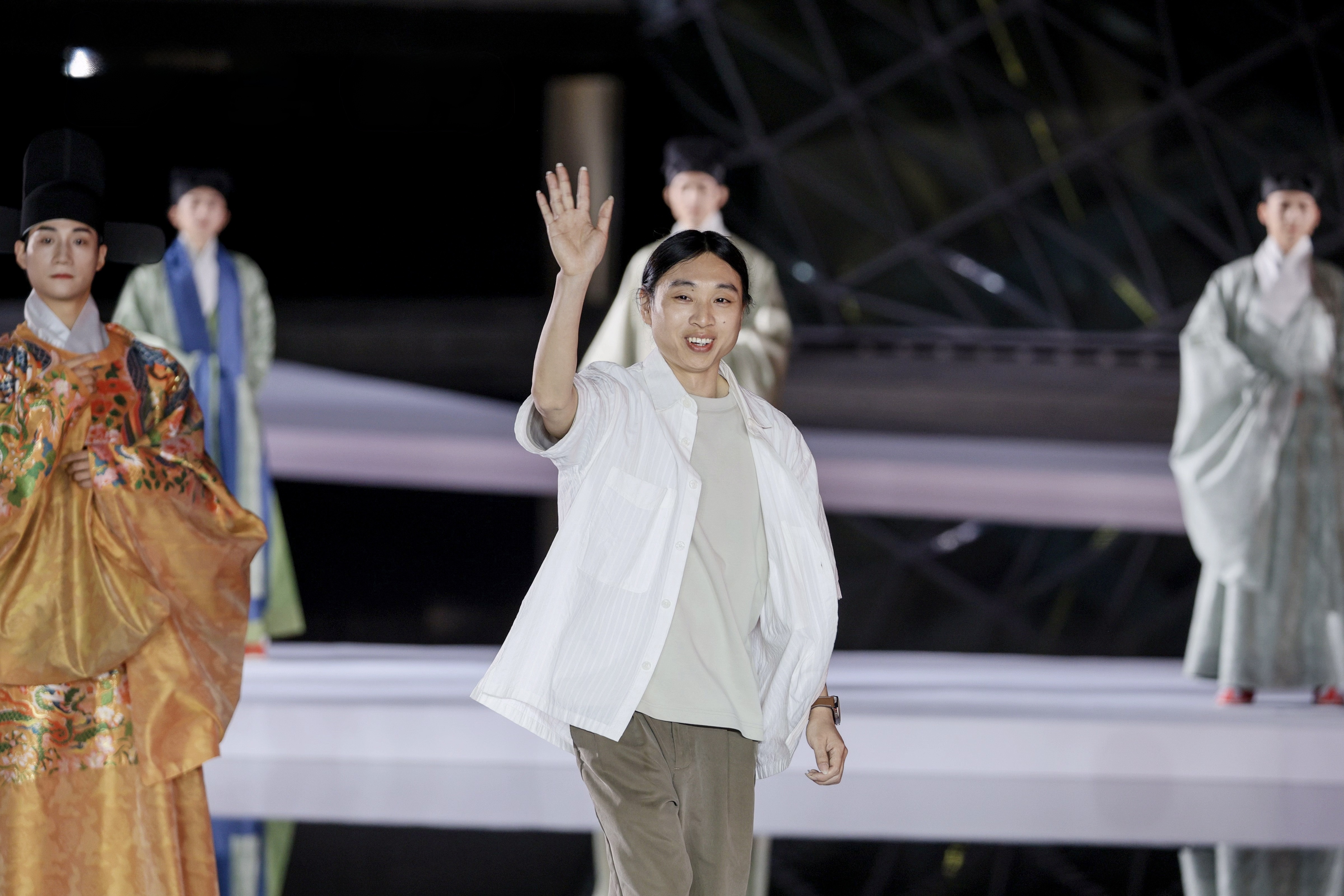
Zhong Yi, born in 1985, moved to Guangzhou with his family in high school and studied at the Guangzhou Academy of Fine Arts, where he began collecting materials on traditional Chinese dress and trying to reconstruct an authentic garment. He founded Minghuatang in 2007, making it one of the earliest Hanfu brands in the country. He chose Guangzhou, he told China News Service, because the food, culture and Cantonese-speaking environment felt familiar, because the Zhongda fabric market (中大布匹市场) sits nearby, and because Foshan (佛山) has a deep textile industry to draw on.
The brand’s ground-floor showroom displays more than a hundred garments on rails: Mamianqun (马面裙) skirts and full sets of men’s and women’s robes. One women’s robe on show takes its design from “Colorful Clouds Chasing the Moon”, a classic Lingnan melody. Zhong Yi explained that the pattern arranges crescent, half and full moons linked by contour lines, with a rabbit chasing the clouds and moon across the fabric, finished with ancient Ruyi clouds. He and his team research excavated textiles and historical documents for every piece, working through fabric development, color matching and motif design so that Ming-dynasty forms and techniques are brought back to life rather than merely evoked.
From the start, Minghuatang chose one-to-one custom tailoring over factory production lines. The cut of a Hanfu garment is fixed by tradition, Zhong Yi noted, but size, color and lining leave room for the customer to take part in the design. Each order is cut separately, which is why a single outfit takes three to four days to finish and why waiting lists stretch so far ahead. On social platforms, buyers regularly post photos of their finished Minghuatang pieces, and a made-to-order set has become hard to come by.
He remembers the brand’s first order: a Beijing customer who bought a complete set of Ming-style women’s dress, a straight-collar Pifeng (披风), a short Jiaoling (交领) jacket and a Mamianqun. Nearly two decades on, orders have spread from Asia to North America, Europe and Oceania, with overseas Chinese increasingly turning to the label to recover the dress of their ancestral homes.
The wider market keeps climbing. China’s Hanfu market exceeded 20 billion yuan in 2025, according to industry data cited in the report, and Minghuatang’s made-to-order model sits at the premium end of it. Zhong Yi has also produced Hanfu documentaries and staged Hanfu fashion shows to widen the audience. “Ethnic dress is a treasure for every people,” he said. “We have to find ways to pass it on, and I believe more and more people will join in so that it continues.”