
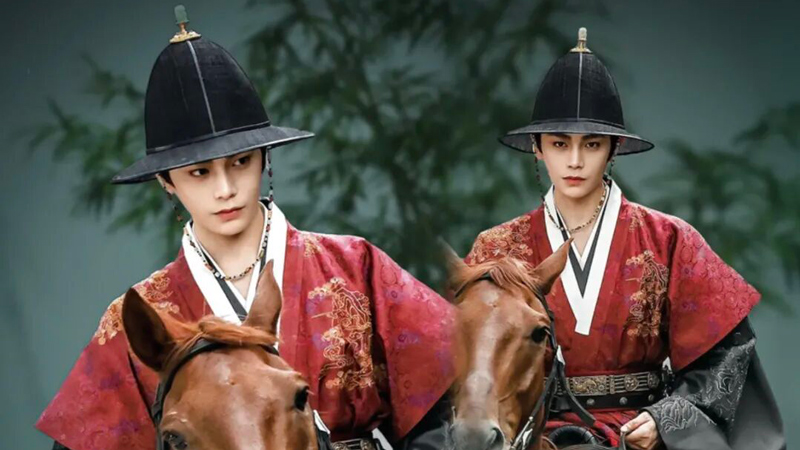
Ming Dynasty attire or Joseon fashion? When stills from the historical drama The Road to Splendor (花开锦绣) hit the web, a flurry of viewers immediately questioned the look of actor Ding Yuxi (丁禹兮), who plays the lead character Zhao Ling. The comparison seemed instant and almost reflexive: the wide-brimmed hat, the layered robes, it all looked like a standard costume from a Korean historical epic.
Yet this snap judgment misses the historical reality by several centuries. This is not a case of borrowing from Seoul, but a masterclass in authentic Ming-era fashion. The confusion is completely understandable, but it also reveals a much larger and more uncomfortable truth about cultural memory and the modern media landscape. It is a perfect storm of mistaken identity where the originator is now mistaken for the imitator.
The Hat That Started the Debate
The most talked-about piece is undoubtedly the hat. Viewers see a large, dark headpiece and immediately think of the iconic Heukrip from Korean dramas like Dae Jang Geum (大长今). However, what Zhao Ling wears in the show is a Damao (大帽), also known as a large-brimmed hat. It was the most common headwear for men in ancient China. Its prototype can be traced back to the Five Dynasties period, and it was perfected during the Ming Dynasty. It was a practical piece of everyday gear, woven from bamboo or palm fibers. People wore it for protection against the sun, wind, and sand during long journeys, not just as a formal accessory.

The historical accuracy goes even deeper. The accessories on the hat change throughout the drama, reflecting a real shift in Ming-era etiquette. In the early Ming Dynasty, the hat was typically adorned with beads made of materials like crystal or agate. But later, to purge residual foreign influences from the preceding Yuan Dynasty, the government simplified the design. They mandated that the hat should be secured with a simple cord instead of elaborate beads, a detail the show faithfully reproduces. This is not a production error; it’s a nuanced reflection of a cultural reformation.
Furthermore, it’s important to note the decoration on top of the hat. During the Ming Dynasty, only military officers would have a decorative top piece for their hats. Civil officials wore them plain and unadorned. Since Zhao Ling is a warrior character, his hat often features this specific martial ornament. This meticulous adherence to the social hierarchy of the time confirms that the design was a conscious choice to portray a specific identity within the Ming military class, rather than a random stylistic trend.
A Case of Mistaken Cultural Identity
The misconception that this is a Korean look stems from the massive popularity and early dominance of Korean historical dramas. These shows became global phenomena long before Chinese historical dramas gained a similar international foothold. The visual language of the Joseon dynasty, heavily influenced by the Ming style, became the “default” image for Asian historical clothing in the minds of many international viewers. It is a prime example of “first mover advantage” in cultural branding. By the time Chinese productions started investing in historical accuracy, they faced an uphill battle against decades of established visual memory.

However, this is a classic case of confusing the student with the teacher. The Joseon court dress was directly adapted from the clothing of the early Ming Dynasty after the founding of the Joseon kingdom. It was a deliberate cultural import, not an original creation. The key differences are in the details. The Damao is rounded and fits snugly on the head, with cords or beads hanging roughly a fist’s length away. In contrast, the Heukrip has a straight, rigid cylinder and a much wider brim, often paired with a long string of beads that dangle down to the chest. By mastering the source material, the drama forces us to re-evaluate who actually owns this aesthetic lineage.
This controversy should not be dismissed as trivial. For many young people, historical dramas are the primary gateway to learning about their own heritage. While it is a form of entertainment, it carries a responsibility. When a production like The Road to Splendor takes the time to consult historical records and revive lost details, it serves as an educational tool. It is a form of cultural preservation, even if it’s wrapped in a romantic story. This commitment is rare in an industry often tempted by simpler, generic costume templates. It fights against the erasure of history by making it visible and tangible.

The Future of Authentic Representation
Ultimately, the debate over Ding Yuxi’s costume is not just about a single actor or a single drama. It is a microcosm of a larger cultural struggle. The world is increasingly interconnected, but the flow of information is often lopsided. If we do not actively tell our own stories with accuracy and conviction, we risk having those stories rewritten for us. The challenge for modern creators is to balance artistic interpretation with historical responsibility, ensuring that the final product is both engaging for the audience and respectful of the past.
The production team behind The Road to Splendor should be commended for not taking the easy way out. They chose a path of greater resistance, incorporating details like the shift from beads to cords on the hat. This dedication creates a richer, more immersive world for the viewer. It plants a seed of curiosity. When audiences see the care taken with these elements, they are more likely to research and learn the history behind the visuals, bridging the gap between entertainment and education.

So, the next time you see a similar style on screen, take a closer look. Is it a direct descendant of Central Plains tradition, or a regional variation? The answer is often more complex than it seems. We need to look past the surface-level resemblance and understand the historical currents that shaped these styles. Only by recognizing the depth and breadth of our own cultural origins can we hope to share them with the world and ensure they are no longer misplaced or mislabeled.
A picture of the Korean hat would be helpful for visual comparison, although from the description it sounds like the hats we would see on the Saja Boys (in demon form) in KPop Demon Hunters?
Ming Damao: rounded close‑fitting crown, short fist‑length cords/beads, minimalist style.
Joseon Heukrip: rigid straight crown, wide brim, long bead tassels to the chest, beads plus knots for elaborate decoration.