
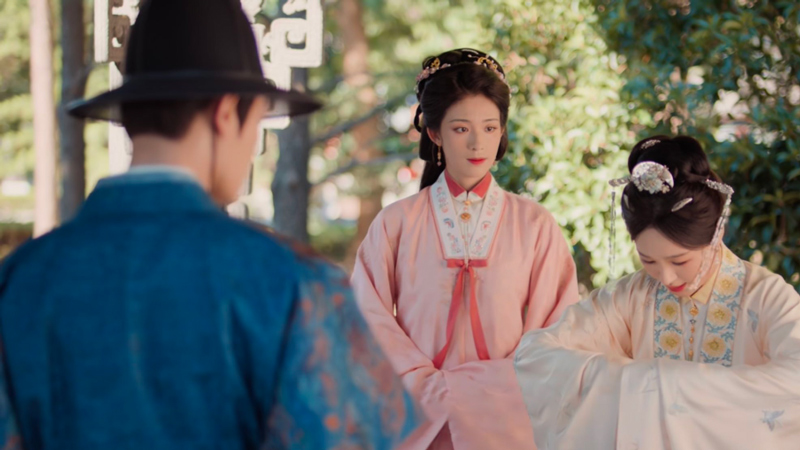
Miss Wu (吴) – a name that barely registers in the grand chessboard of The Road to Splendor (花开锦绣) – yet her presence rattles three powerful households, shifts political alliances, and exposes the ugliest side of female friendship. She is not a heroine, not a villain, but a piece passed from hand to hand: first as a gift to Zhao Ling (赵凌), then a pawn in the Wei (卫) family’s inner chamber, and finally a consolation trophy for Yu Jingxiu (俞敬修).
How did a woman with no noble blood and no sharp tongue manage to destabilize so many lives? The answer lies in her two lethal identities – and in the calculating women who weaponized them. This is not a story of love or revenge; it is a cold dissection of how a society trades human value, and how even a “lowly” figure can become the pivot on which fates turn.
Two Masks, One Price
Miss Wu’s first identity is that of a Thin horse– a term from imperial China for a young woman raised from childhood to please wealthy men. Trained in music, conversation, and seduction, she was never meant to marry, only to be sold. Her foster mother, Lady Wu, brought her to the capital with one goal: auction her off for the highest political or financial return. This alone would have made her vulnerable. But her second identity proved far more dangerous: she belonged to the Anshang (安商, the An merchant faction), one of two salt-trading blocs fighting for survival under the emperor’s new reform.
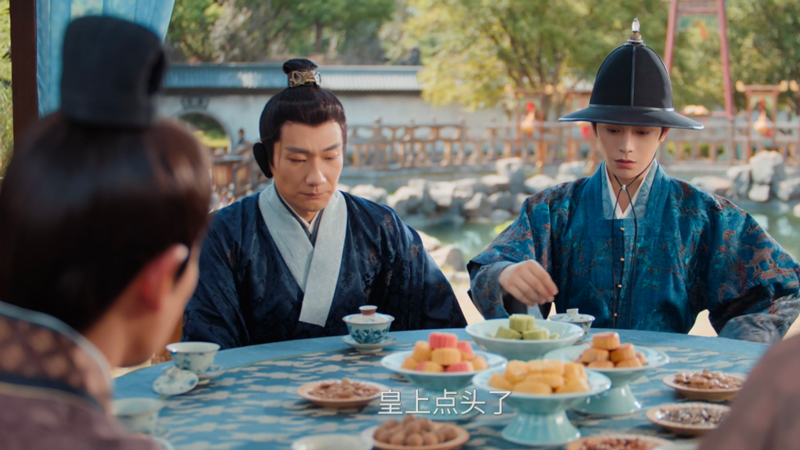
The emperor had appointed Zhao Ling to overhaul the salt monopoly – a move that sounded noble (lower prices for the people) but in practice squeezed merchants’ margins. The Yanshang (雁商, Yan merchants) and the Anshang were the two giants. Whoever controlled Zhao Ling’s ear controlled the reform’s terms. And Lady Wu, new to the capital, knew none of this – until Lady Yu stepped in with a poisoned invitation.
Lady Yu, desperate to sabotage Zhao Ling’s reform, whispered to Lady Wu that gifting Miss Wu to the minister would secure Anshang’s profits. She framed it as a golden opportunity: “He cannot refuse the face of a major merchant faction.” Blinded by ambition, Lady Wu staged a “rescue” scene and presented Miss Wu to Zhao Ling. He accepted – not out of desire, but political necessity – and immediately fled home to his wife, Fu Tingyun (傅庭芸), for a solution. Miss Wu, meanwhile, allowed herself to dream. She had seen how Zhao Ling doted on Fu Tingyun, even using his own body as a stepping stool for her. Could she not earn a fraction of that devotion?

The House of Cards
Miss Wu approached Fu Tingyun with a hairpin – a classic “paying respects” gesture to a first wife. She expected a tolerant, open-hearted rival. Instead, Fu Tingyun shut her down cold. Worse, she exposed the truth to Lady Wu: Zhao Ling was no fat cash cow; his reform post was a political minefield. Furious at being duped, Lady Wu withdrew her “gift.” But the game was far from over.

Enter Fan Yake (范雅客) –Fu Tingyun’s so-called best friend, a woman whose sweetness masked a venomous streak. Fan had her own grudge against Lady Wei, the formidable matriarch of the Wei household, for refusing to lend her money. Revenge came in the form of a recommendation: “The Wei family would be a perfect home for Miss Wu.” Lady Wu bit the bait. She paraded Miss Wu before Lady Wei’s mother-in-law, highlighting the girl’s “fertile” qualities – a direct jab at Lady Wei, who had borne only one child. The elderly mother-in-law, desperate for more heirs, secretly arranged a wedding ceremony for Miss Wu and Lord Wei, bypassing Lady Wei entirely.

Lady Wei caught wind of the plot and stormed the bridal chamber, halting the consummation. Under pressure, Miss Wu confessed that Fan Yake had orchestrated the scheme – suggesting Lord Wei take her as a concubine outside the main household. Lady Wei marched straight to Fan Yake and hurled a cup of green tea in her face. But Fan, ever the performer, turned indignant: “Is this how you treat a sister?” To which Lady Wei shot back, “A sister who sends concubines to my bed? The last woman who called you a sister nearly died.” That final line laid bare Fan Yake’s pattern – she betrayed every friend who trusted her, always wearing an innocent mask.
The Final Twist
Miss Wu’s journey ended not in wealth or status, but as a “budget edition” of Fu Tingyun. Yu Jingxiu –Lady Yu’s son – had long harbored unspoken feelings for Fu Tingyun. When he saw Miss Wu, who had been coached by Fan Yake to mimic Fu’s mannerisms, voice, and even her signature orchid-like poise, he fell instantly. To him, she was a ghost of his lost love. He took her as his concubine – not for her own sake, but as a “collector’s item” tied to his obsession.
And who deserves the dubious credit? Fan Yake. She had advised Miss Wu on every detail – the way Fu Tingyun tilted her head, the cadence of her speech, the quiet dignity in her walk. It was Fan who turned Miss Wu into a mirror, reflecting Yu Jingxiu’s deepest longing. The irony is brutal: Miss Wu was never chosen for herself. She was a copy of a copy, passed from one man’s political calculus to another’s emotional vacuum.
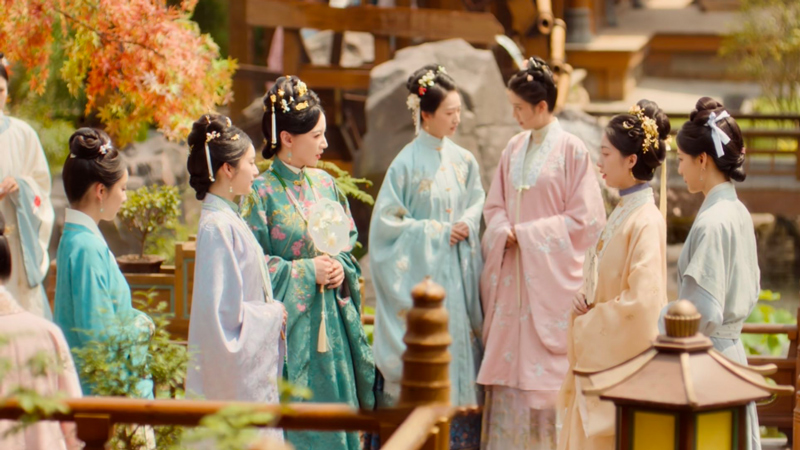
So what do we learn from Miss Wu? She was not a mastermind, not a seductress, not even a victim in the tragic sense. She was a commodity – but commodities, when mishandled, can break fingers. She exposed Lady Yu’s cunning, Fan Yake’s treachery, Lady Wei’s fierce independence, and Fu Tingyun’s unyielding boundaries. In a world where women were either pawns or players, Miss Wu remained stubbornly in between – used, discarded, then recycled. Her story is a warning: when you treat people as tools, you never know which tool will splinter and cut your own hand. And for those who recognize Fan Yake’s type – the friend who smiles while planting knives – the moral is simple: run the other way.