
The Qixi (七夕) river lantern tradition of Rongchang (荣昌) began in 2014, and the eleventh edition of the festival opened on August 15 in Wanling Ancient Town (万灵古镇), a national AAAA scenic area in Chongqing. The five-day event runs through August 19 under the banner “Millennium Rongchang,” pairing intangible-heritage performances, concerts, market stalls and night-light installations along the Laixi (濑溪) riverfront.
Wanling’s history carries the festival. The town preserves the Darong Bridge (大荣桥), the Zhao Clan Ancestral Hall and the Huguang Guild Hall (湖广会馆) among its protected monuments, and 21 provincial-level intangible cultural heritage items are registered here. That stock of buildings and crafts gives the Qixi observance a physical setting most festivals lack: lanterns released from the Niushiba Wharf (牛市坝码头) drift past stone bridges built centuries before the holiday took its current form.
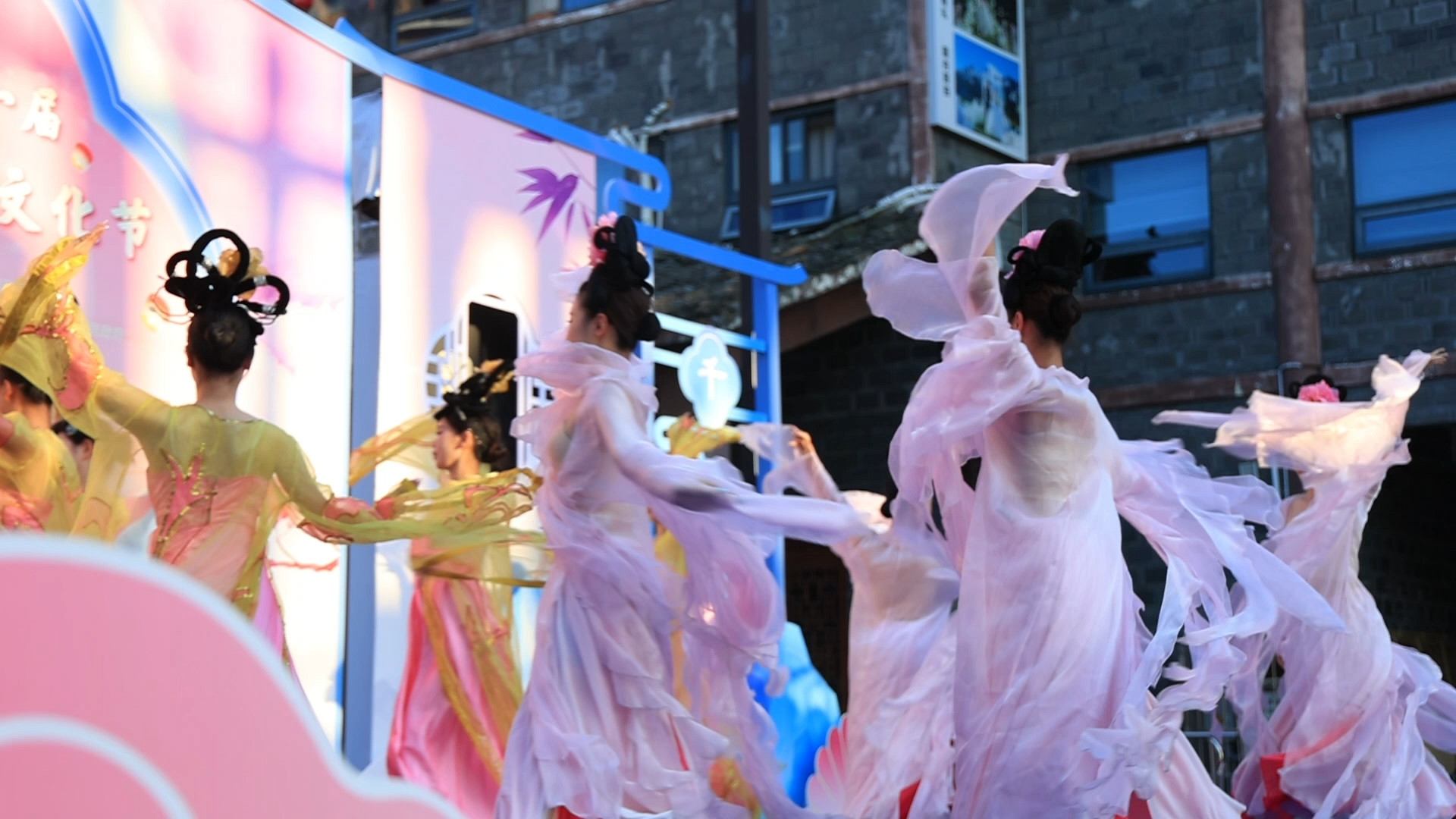
After dark the riverside doubled as a stage. Seven or eight Chinese-style mini stages lined the kilometer of street from Darong Bridge toward Wanling Fudi (万灵福邸), where classical dance gave way to a robot moving to music, and an actor playing the poet Li Bai traded couplets with visitors while a clown in antique dress made balloon animals. At the main stage, a “Starlight Concert” mixed guzheng-adjacent folk dance with band numbers; the act “Flying Apsaras” had dancers hand flowers to front-row guests, and the crowd sang along to “Sun Never Sets” and “Love You.”
The signature performance, “Lanterns and Phoenix Dance,” started with molten-iron fireworks, a heritage show in which molten iron flung into the night sky scattered like gold fragments over the Laixi River, and before the sparks died two performers danced on a bamboo raft while light-projected dragons and phoenixes turned above the water. The river, the light and the movement merged into a single scene, the kind of moment the festival’s organizers have spent eleven years refining.
Away from the main stage, the “Crafty Fun Garden Fair” ran its own games: a chopstick challenge where players fish marbles out of a bowl with long chopsticks, and a reaction contest catching falling sticks. At the “Poetry Meets Qixi” corner, a staff member handed a voucher to anyone who could complete the line “when golden wind meets jade dew” (金风玉露一相逢), a verse from the Song-dynasty poem that has anchored Qixi for eight centuries. Market stalls along the river sold Rongchang braised goose and Rongchang bean jelly beside heritage-craft goods, and lantern-release zones on both sides of Darong Bridge lit the water with Qixi-themed river lights. Immersive light installations and the drifting lanterns together gave the riverside its evening glow, drawing visitors into the festival’s night economy.
The festival closed with a collective wedding on August 19. Couples completed hand-washing, three bows and nine kowtows, hair-tying, shared-cup and marriage-certificate vows before receiving their certificates, then took part in pitch-pot, lantern-riddle and Chongqing-style wedding candy DIY games. A Rongchang district official described the event as a way to bind folk customs and intangible heritage to cultural tourism through the festival calendar, keeping the town’s name attached to the river of lanterns that gave it the tradition.