
At Liantang Port (莲塘) in Shenzhen, the border crossing that links the city to Hong Kong, the arrival hall turned into a stage on the morning of August 16, two days before the Qixi (七夕) holiday. At 11 a.m., a flash performance called “Elegant Melodies at Liantang” opened with guzheng strings and dancers in flowing robes, part of a Qixi program staged by the Shenzhen Hanfu Association with the Liantang Subdistrict office and the port’s management service center.
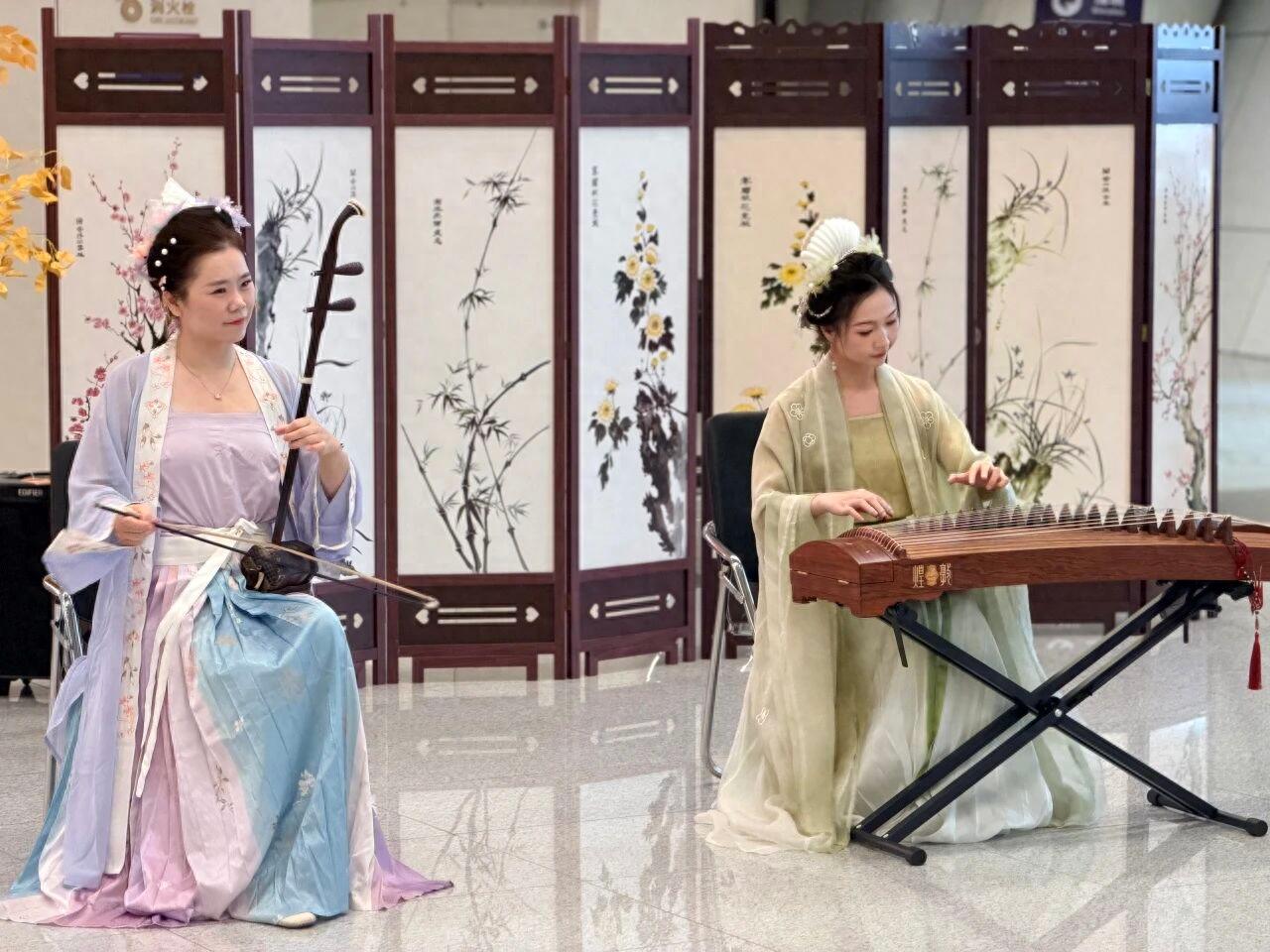
The first piece set the tone: as the orchestral suite A Thousand Li of Rivers and Mountains filled the hall, a dancer snapped her long sleeves open and spun, her green skirt fanning out like layered mountain ridges. Beneath the high ceiling of the second-floor arrival hall, the cool lines of steel pillars softened against the movement, and the blue-green tones of a Song-dynasty scroll suddenly looked at home in a transit hub.
Erhu, pipa and flute traded phrases through three folk numbers — “Stepping Higher,” “Clouds Chasing the Moon” and “Golden Snake Dance.” A Hong Kong traveler surnamed Chen, who had just cleared immigration, set down his suitcase to watch. He recalled that the tune carried him back to childhood visits to Wong Tai Sin Temple with his grandmother, and said the festive feeling “is written into our DNA.” Nearby, a returning traveler surnamed Li watched with her family for more than ten minutes. “Qixi is Chinese Valentine’s Day,” she observed. “Seeing young people dance in Hanfu makes me feel close to home and proud at the same time.”
A dancer in the second act, “Chang’an Ah”, wore a gold flower ornament on her forehead as drums rolled; her wide sleeves swung wide in a Tang-dynasty pose. Some foreign passengers stopped mid-stride. A British visitor filmed the whole sequence and gave a thumbs-up through a translation app, saying it was the first time he had seen real traditional Chinese dress and that it looked “beautiful, like a movie scene.”
“Wearing Hanfu is not cosplay; it is cultural confidence worn on the body,” said Huang, a Shenzhen resident who watched from the mezzanine. The organizers framed the event the same way: the port, they said, is the first stop on the border, and the festival aimed to let every traveler — from Hong Kong, the mainland or abroad — touch the texture of Chinese ritual music and dress culture.
The program ran under the guidance of the Shenzhen Port Office and was co-hosted by the Liantang Subdistrict office, Shenzhen Tefa Port Service Co., Ltd. and the Liantang Port Management Service Center. Beyond the stage acts, costumed flower-selling vendors walked the hall and handed out branded gifts to passengers. The port has put on cultural performances before, including Cantonese opera and ethnic-minority heritage flash events, and the Qixi show added a Hanfu parade to that list. “Qixi is not only the legend of the Cowherd and the Weaver Girl,” a Liantang official put it. “It is also how Chinese people express attachment to home, ritual and country.”