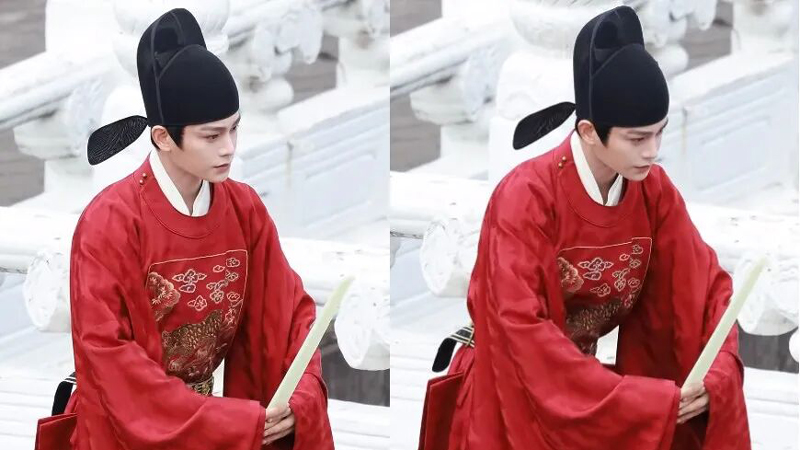
Why does Ding Yuxi (丁禹兮) wear such an odd red robe and belt in his new period drama? Is it a costume mistake, or is there a historical story behind those puzzling flaps and dangling straps? The answer takes us deep into the official dress code of the Ming dynasty, where every extra piece of fabric served a purpose. For anyone tired of generic, simplified costumes in historical dramas, these details are a fascinating glimpse into a lost world of rules, status, and practicality.
The Robe’s Secret Flaps
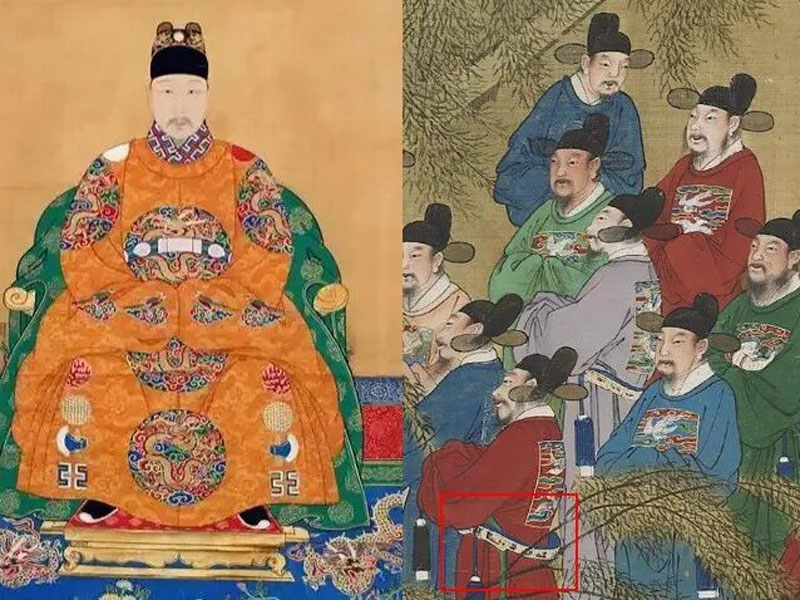
That seemingly redundant piece of cloth hanging at the side of his red robe is called the wai bai (外摆), or “outer drape”. During the Ming dynasty, officials wore a standard round-collared robe for daily court duties. The robe had slits on both sides to allow for easy walking and kneeling during ceremonies. However, these slits exposed the inner garments underneath, which was considered improper and undignified in the formal setting of the court. To solve this, the Ministry of Rites mandated the addition of curved fabric panels attached at the slits, hanging gracefully over the outside to conceal the underclothes.
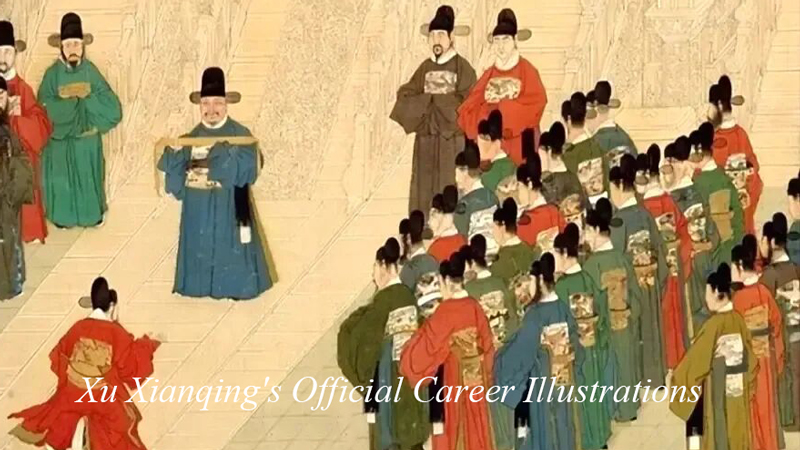
This design was not an invention of the Ming. Similar prototypes existed in the clothing of the preceding Yuan dynasty. It was the Ming that formalized it, making the outer drape a fixed element of the official uniform. This is clearly visible in surviving Ming dynasty portraits, such as those in the Xu Xianqing’s Official Career Illustrations (徐显卿宦迹图), where every official’s round-collared robe features these distinct side panels. Excavated Ming tombs, including that of the Wanli Emperor (万历皇帝), have yielded actual robes with this structure intact, confirming it was not just an artist’s convention but a real, functional piece of clothing. The robe in the drama faithfully replicates this, with the fabric and patterns matching the main body, a detail rarely seen in other productions.
Most historical dramas opt for a straight, slit-free version of the robe for simplicity and a cleaner silhouette, thus omitting the outer drape entirely. After years of watching these simplified costumes, audiences have become accustomed to an inaccurate standard. So, when a production like The Road to Splendor (花开锦绣) presents the historically accurate version, it looks strange and out of place to the modern eye. It is a testament to the power of visual habit; we often prefer a comfortable fiction over an unfamiliar truth. By restoring this feature, the show’s costume designers are not just being pedantic but inviting viewers to question their preconceptions about the past.
The Double-Tailed Belt
The “odd” belt is equally steeped in history. It is a “double-tailed leather belt”. In ancient China, an official’s belt was far more than a functional accessory to hold up trousers. It was a critical marker of rank and status. Detailed regulations specified the material of the ornamental plaques, their number, and the pattern they bore, all depending on the wearer’s official grade. The belt itself was a complex construction, including the leather strap, buckle, plaques, and the “tails” – the terminal ends of the belt, often rounded or square and carved with rank-specific designs.
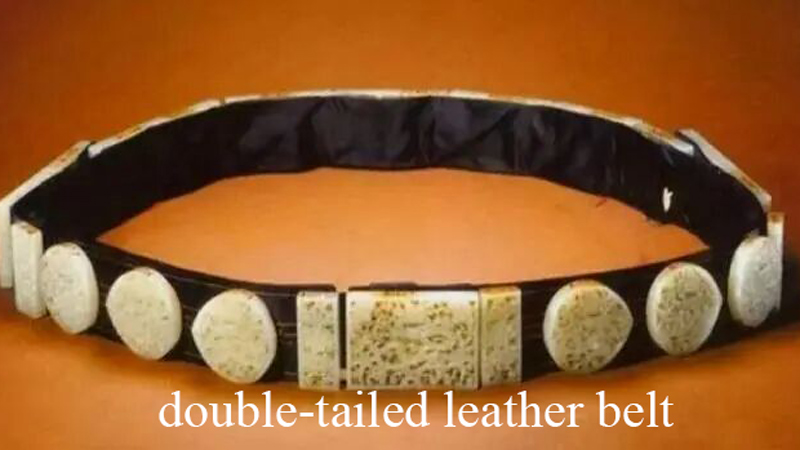
What most of us are familiar with from television is the single-tailed version, where only one end hangs down at the back. However, after the Yongle (永乐) era of the Ming, the official regulation was updated to a double-tailed format. This meant both ends of the belt were decorative and designed to be seen. When fastened, the two tails would hang symmetrically on the left and right sides of the lower back, creating a more solemn and balanced appearance. This two-tailed configuration is prominently featured in imperial portraits of Ming emperors, formal portraits of high-ranking officials, and numerous excavated belt sets from the period.
The belt worn by Ding Yuxi’s character features golden plaques against a black leather base, with the two tails hanging neatly at the back. This directly matches the characteristics of the Ming double-tailed belt. It serves as a visual shorthand for the character’s status and the rigorous social hierarchy of the time. The subtle adjustment in the curvature of the outer drape or the specific patterns on the belt plaques are likely small concessions to modern aesthetics and the character’s specific role, but the core structure is a direct nod to historical authenticity. The “strangeness” is, in fact, a sign of dedication to detail, prompting a richer appreciation for the social complexities embedded in historical fashion.