
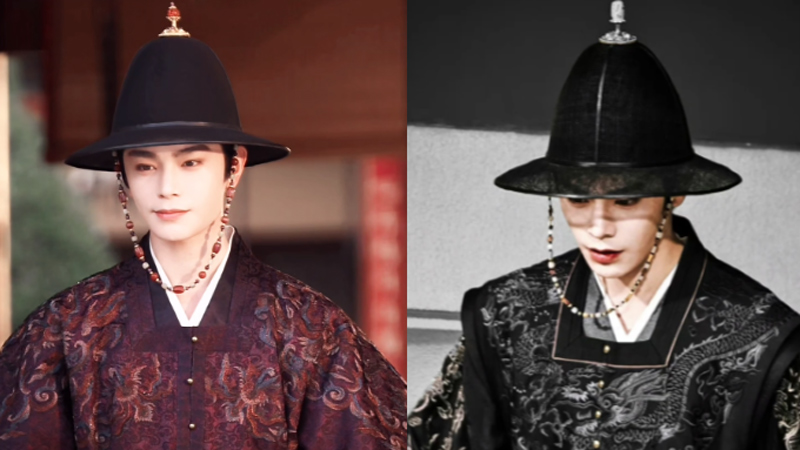
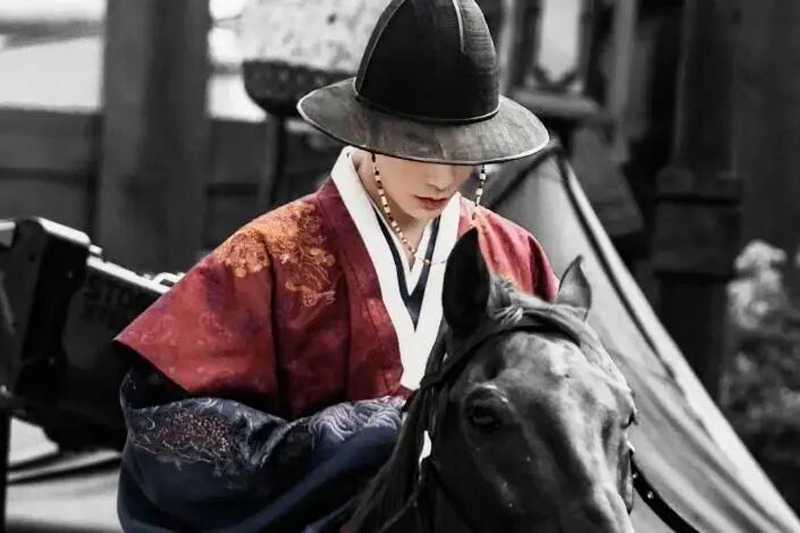
Ding Yuxi wears a striking black broad-brimmed hat in his new historical drama The Road to Splendor (花开锦绣), yet many viewers instantly label it “Korean-style.” That snap judgment reveals more about our screen habits than about history. The hat in question, a tall-crowned black headpiece with a flat, wide brim, a gold finial on top, and a beaded string dangling below, looks unfamiliar because period dramas rarely feature it.
But this distinctive accessory is not a borrowed Korean design. It is a faithful recreation of a Ming-dynasty male hat called Damao (大帽), a common everyday headwear worn by everyone from officials to commoners during that era. Its story stretches back over a thousand years, evolving through successive dynasties before settling into the form we see on screen. So why does a native Chinese artifact get mistaken for something foreign? The answer lies in a mix of visual similarity and a modern lack of exposure to our own traditions.
A Hat Born from the Road
Long before the Ming dynasty, the broad-brimmed hat already served travelers well. As early as the Wei and Jin periods (220–420 AD), people on long journeys wove sun-shielding headgear from rattan and called it Ximao (席帽). Its wide brim could shade the entire face, a practical solution for dusty roads. Over time, this basic design sprouted veils, becoming the Mili (幂篱) and later the Weimao (帷帽), which Tang-dynasty women famously loved for horseback riding. By the Five Dynasties and Song period, a new version called Fanyang Li (范阳笠) appeared. Made of lightweight felt without rattan ribs, it was ideal for marching armies. In the classic novel Water Margin (水浒传), the hero Lin Chong (林冲) wears exactly this kind of hat, firmly rooting it in Chinese military and folk culture.
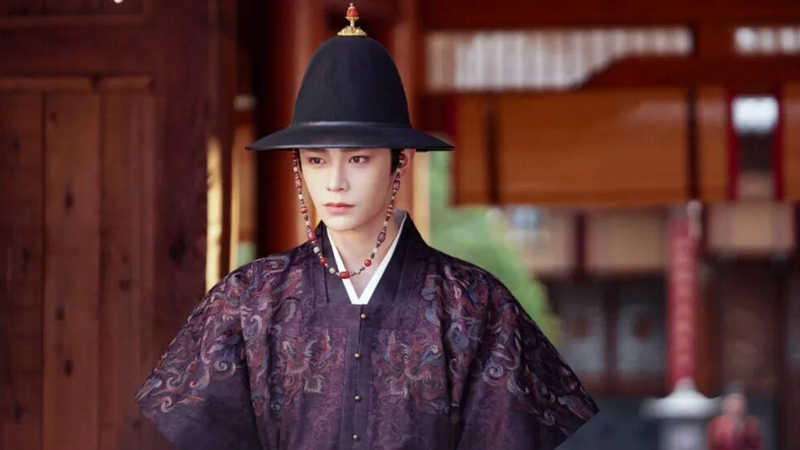
Then came the Yuan dynasty, when Mongol rulers adapted the Song-era felt hat into their own ceremonial headpieces. They raised the cylindrical crown, added gold finials and bead ornaments, and transformed a commoner’s item into a noble’s accessory. Two distinct styles emerged: the cymbal-shaped Boli Mao (钹笠帽) and the straight-brimmed Damao. These were the direct ancestors of the Ming hat we see today. When the Ming dynasty overthrew the Yuan, it kept the straight-brim structure but stripped away some nomadic decorations, making it more suitable for Han Chinese daily life. Early Ming versions still featured bead strings under the brim, while mid-Ming ones replaced them with chin straps for a snugger fit. The Sancai Tuhui (三才图会), a Ming encyclopedia, even includes an illustration of it, proving its established place in mainstream culture.
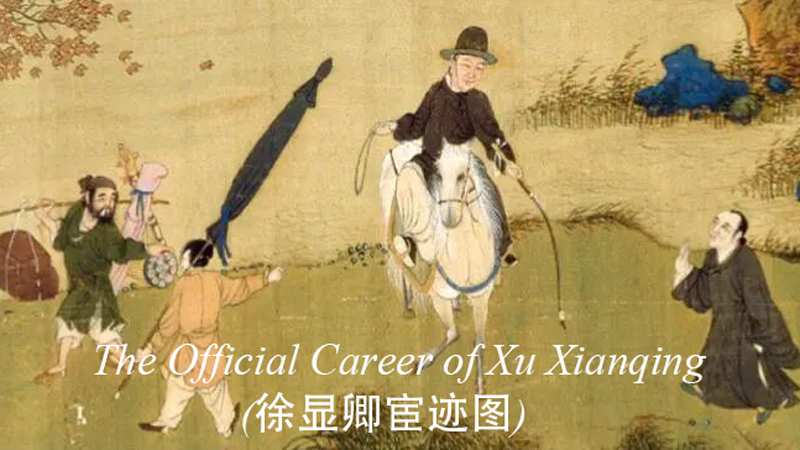
Ming paintings confirm how common this hat was. In works like The Official Career of Xu Xianqing (徐显卿宦迹图) and Imperial Procession (入跸图), figures wear it casually in crowd scenes. Archaeologists have also unearthed a well-preserved Ming Damao from a tomb in Shandong, which now resides in the Shandong Museum. Its shape closely matches what Ding Yuxi wears in the drama, though the production team slightly adjusted the brim contour and finial for visual appeal. So the hat is no fantasy—it is a documented historical object with a lineage that is unmistakably Chinese.
Why Do We See Korean First?
Two main reasons fuel the confusion. First, the visual resemblance is striking. Korean traditional hats, known as Gat in Korean, evolved from the very same Yuan and Ming headpieces. When the hat traveled eastward, local artisans reshaped it to fit Korean aesthetics, gradually creating their own iconic style. But the two are not identical. Ming Damao typically features a rounded dome crown and diverse finial shapes, while the Korean Gat has a taller, flat-topped cylinder and often longer beads that can hang down to the chest. These differences are subtle for untrained eyes, but they exist. Yet the casual viewer, seeing a tall wide-brimmed outline, instantly associates it with Korean period dramas, not Chinese ones.
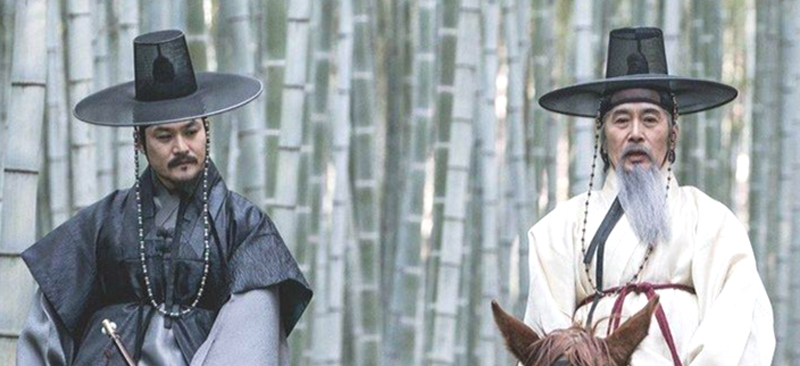
Second, our screen memory plays tricks. Most Ming-dynasty series focus on court politics, so we see official headgear like the black gauze Wu Sha Mao (乌纱帽) or the winged Yi Shan Guan (翼善冠) again and again. Everyday outdoor hats rarely get screen time, so audiences never build a mental library for them. Meanwhile, Korean historical sagas feature various Gat styles so frequently that viewers internalize them as exclusively Korean. This is not a sign of malice—just habit. When you see something new every week on Korean dramas, you assume it belongs to that culture. The sheer repetition shapes perception more strongly than historical fact.
This misidentification stings because it highlights our own unfamiliarity with traditional attire. A hat that Chinese people wore for centuries gets claimed by another culture in the popular imagination, simply because they showed it more often. It is a classic case of “use it or lose it.” The more we ignore our heritage, the more we cede it to others. But that does not make the Korean version the original. It only makes us poor historians of our own past.
Reclaiming Our Visual Memory
Ding Yuxi’s hat in The Road to Splendor is not a trend—it is a restoration. The production team deliberately chose to recreate a Ming Damao based on archaeological finds, adjusting only minor details for the camera. The overall structure stays true to the 15th-century originals. When you watch the show, you are not seeing a borrowed Korean accessory; you are seeing a recovered piece of Chinese daily life. This is a small but meaningful step toward bringing forgotten objects back into public view. Every drama that dares to show non-court headgear helps rebuild that visual vocabulary.
The mistake is understandable, but it also points to a bigger opportunity. Instead of blaming viewers, we can use this moment to educate. The next time someone calls a Ming hat Korean, we can calmly explain its thousand-year journey—from Ximao to Fanyang Li to Mongol ceremonial wear to Ming everyday attire. We can point out the rounded crown versus the flat top, the chin strap versus the long beads. These details matter because they carry stories of cultural exchange, adaptation, and continuity. Chinese and Korean hats share a common ancestor, but each took a different path. Recognizing that shared root does not diminish either tradition; it enriches both.
So, did you mistake Ding Yuxi’s hat for Korean? If you did, you are not alone. But now you know the full story. The next time a historical drama features an unusual accessory, pause before jumping to conclusions. Ask where it came from, what it evolved through, and who wore it. That curiosity is the first step toward reclaiming our own cultural memory. And perhaps, over time, we will see fewer Korean labels and more Chinese names—not because we reject others, but because we finally remember ourselves.