

Is That a Hair Roller on Her Head? What Liu Tao’s (刘涛) New Look Reveals About Ancient Style
When recent behind‑the‑scenes images from Liu Tao’s latest production surfaced online, viewers did a double‑take. Perched atop the actress’s head sat what looked uncannily like a modern curling wand—stiff, tubular, and utterly out of place against her period costume. “Why is she wearing a hair roller?” asked one puzzled commenter. “It looks so rare, and so strange!” Yet this peculiar accessory is no styling mishap. It is, in fact, a carefully researched recreation of a Shang‑Zhou dynasty headpiece known as Kui (頍), an ancient forehead band that later evolved into the familiar Mo’e (抹额) of Chinese costume drama. To understand why Liu Tao’s character—widely believed to be the legendary warrior‑queen Fu Hao (妇好)—sports this coiled ornament, we must travel back over three thousand years, where fashion met function, ritual met warfare, and a simple strip of cloth became a symbol of status, warmth, and martial spirit.
The Curious Case of the Curled Crown
What exactly sits on Liu Tao’s head? Archaeologists and costume historians point to the Kui, also called Kui Guan (頍冠), which later generations renamed Mo’e—the forehead band. In its earliest form, it was nothing more than a strip of leather or fabric tied around the hairline to secure the hair or hold a ceremonial cap in place. Some scholars trace its use back to prehistoric times, but the earliest physical evidence comes from Shang and Zhou sites, where jade figurines depict figures wearing exactly such coiled or flat bands.
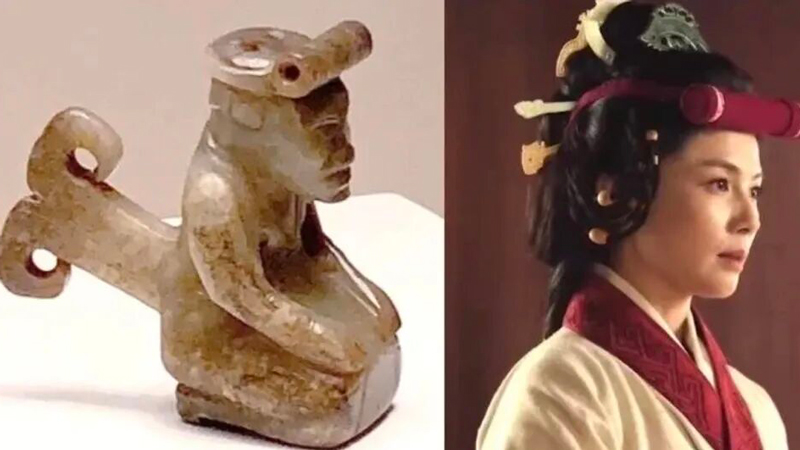
One particularly revealing artifact is a kneeling jade figure excavated from Fu Hao’s tomb at Yinxu (殷墟), the ruins of the Shang capital. That tiny effigy wears a headpiece strikingly similar to Liu Tao’s “roller”—a rounded, cylindrical adornment wrapped around the forehead. Though the exact structure remains debated, most experts agree it represents the Kui in its matured form. The Shuowen Jiezi (说文解字), an Eastern Han dictionary, defines Kui as “raising the head,” and quotes the Book of Songs (诗经): “There is the Kui‑capped cap,” confirming its ancient pedigree. Meanwhile, the Xu Han Shu Zhi (续汉书志) notes that in antiquity, men wore caps without headcloths; when they donned them, they added a Kui to steady the structure—essentially a counterweight for stability.
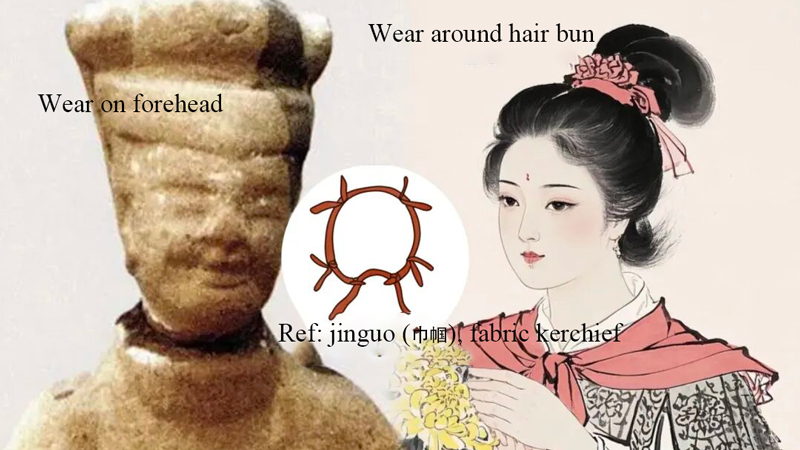
This functional origin explains why Liu Tao’s headdress looks so rigid and raised: it was not mere decoration but a practical tool, akin to a built‑in anchor for ceremonial crowns. Over time, the Kui morphed from a plain hoop into a flat, ornamental band, sometimes adorned with small jade pendants at the knot—a detail that foreshadowed the lavish forehead ornaments of later dynasties. So when viewers ask why it resembles a hair tool, the answer lies in its stripped‑down utility: it was the simplest, most honest headwear ever devised, and its survival in costume design is a testament to its iconic silhouette.
Warrior Bands to Winter Warmers
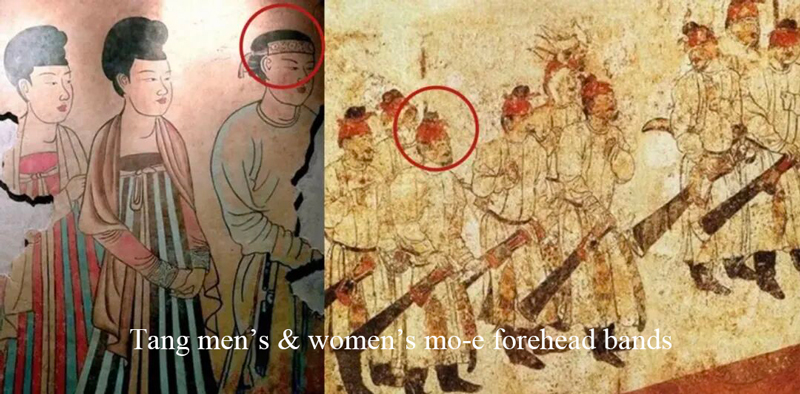
By the Qin and Han periods, the Kui had shed its purely ceremonial role and entered military life. The so‑called “military‑appearance Mo’e” became standard for imperial guards and marching troops: soldiers wrapped red or colored cloth around their foreheads as unit identifiers, a practice vividly captured in Tang‑dynasty murals. The Zhonghua Gujin Zhu (中华古今注) even attributes this custom to Emperor Qin Shi Huang, who, during his coastal inspections, received sea‑deities wearing crimson forehead bands and wide trousers—a ritual that supposedly remained unchanged for centuries.
Parallel to this martial use, the Mo’e gained a cozy second life as cold‑weather gear. In northern China, men began cutting strips of silk or cotton, stuffing them with floss or fur, and tying them across their brows to fend off winter chill. Han‑era texts refer to such padded headbands as Mao Xu (冒絮) or Mo’e Xu (陌额絮); by the Jin dynasty, they were called Xu Jin (絮巾). The Xu Han Shu commentary quotes an official named Hu Guang: “In the north, it is so cold that sable fur is used to warm the forehead, attached under the cap, and thus it gradually became an ornament—this is the origin of the Mo’e.”
Women, too, adopted the style, but with a softer touch. Han‑period ladies wound silk bands from the front to the back of the head, tying them at the nape and letting the ends hang down, sometimes sewing circular decorative plaques onto the fabric. This feminine version persisted through the Tang dynasty, when servant girls wore flattened Mo’e—simple ribbons—especially when cross‑dressing in round‑collared robes for a more dashing, androgynous look. That Tang iteration directly echoed the martial spirit of the Shang original, proving that a practical forehead band could, across eras, convey both prowess and elegance.
A Legacy That Still Turns Heads
Two competing origin stories exist for the Mo’e, yet they are not contradictory. One traces it directly to the Shang‑Zhou Kui, a silk or leather band worn by both genders and all classes. The other derives it from the Qiao Tou (幧头)—also called Xiao Tou (绡头) or Mo Tou (陌头)—a kerchief popular after the Eastern Han, tied across the forehead in a manner analogous to the Kui. A third theory posits that the Kui itself was the prototype for the Qiao Tou. While historical records remain inconclusive, the functional continuity is clear: whether as a crown anchor, a regimental badge, or a thermal pad, the forehead band never disappeared from Chinese wardrobes.

It even survived into modern times among rural women, who continued to wrap padded strips around their heads during harsh winters—a living fossil of a three‑millennium‑old tradition. And now, Liu Tao brings it back to the screen, not as a relic but as a vibrant character statement. Her portrayal of Fu Hao, a historical general and consort, demands an accessory that bridges femininity and ferocity; the Kui does exactly that, framing her face with an archaic angularity that signals authority. Unlike later, more ornate Mo’e—embroidered, bejeweled, or fur‑lined—this Shang version is stark, almost industrial, which may explain its jarring effect on modern eyes accustomed to silken softness.
Yet that strangeness is precisely its virtue. It challenges our assumption that ancient beauty must align with contemporary tastes. Liu Tao’s “hair roller” is not a mistake; it is a conversation starter, a window into a world where headwear could keep a crown steady, identify a soldier, warm a traveler, and, thousands of years later, still make us pause and wonder. So, would you wear such a piece today? Perhaps not. But next time you see a historical drama, look beyond the familiar—and you might just spot a curling wand that changed the course of costume history.