
Hashtags related to #becomingchinese and #chinamaxxing have passed 4 billion combined views on TikTok, Instagram and X by the summer of 2026. The phrase owes its start to a 20-second video posted in late 2025 by Zhu Xirui (朱溪瑞), a 22-year-old Chinese-American creator, who listed her “Chinese lifestyle rules”: slippers at the door, hot congee for breakfast, no iced drinks. Tens of thousands of overseas Gen Z users have since taken the list literally, drinking warm water in the morning, soaking their feet before bed, practicing Baduanjin (八段锦) and rolling walnuts in their palms, and many have added a trip to China to their bucket lists.
Maxxing, Explained
“Maxxing” is a suffix popular among Western Gen Z internet users, meaning to push one thing to its extreme: looksmaxxing for appearance, moneymaxxing for income, sleepmaxxing for rest. Chinamaxxing translates directly as “going maximally Chinese,” the habit of taking the Chinese way of living to its fullest. Overseas influencers now post their immersive Chinese daily routines and joke about entering a “very Chinese time” in their lives, spreading the meme line “You met me at a very Chinese time in my life.”
A Family Tree of China-Themed Hashtags
Chinamaxxing is the newest entry in a line of China-themed terms that includes China Travel, China Cool, China Shopping, Becoming Chinese, C Style and China Chic. Zhou Ting (周亭), executive dean of the Institute for Regional and Country Communication Studies at the Communication University of China, describes the trend as meme-style communication: it does not announce a serious cultural allegiance but invites users in through jokes and challenges that are cheap to copy and easy to mutate. The Guardian and Time have both published analyses of the wave, CNN has pointed to it as evidence of widespread dissatisfaction with everyday life in the United States, and Michelle She, a London fashion brand founder, summed it up in one line: “People, whatever their ancestry, are trying to become more Chinese.”
Multiple forces are feeding the movement. High living costs and a perceived lack of security in the West push young people to look for alternative lifestyles. Better urban governance, public services and the growing quality of domestic brands make the Chinese version of daily life genuinely attractive. Short-video platforms let foreign viewers see the country through the lenses of their peers. Pew Research Center data shows that 34 percent of Americans under 50 hold a positive view of China, against 19 percent of those over 50, and curiosity about Chinese culture runs markedly higher among 18-to-24-year-olds.

Inbound Numbers Are Moving
Travel data confirms the shift. In the first half of 2026, 22.914 million foreign visitors entered China, up 20.4 percent year on year, with visa-free entries accounting for 77.7 percent of the total. Fifty-five countries enjoy the 240-hour transit visa-free policy, which has lowered the bar for short trips. The average stay has reached 2.8 days, stretching to 4.7 days in summer, and nearly 500 cities have recorded foreign visitors. Where visitors once moved along a “Great Wall, Forbidden City, pandas” circuit, they now travel deeper into central China and mountain villages, shifting from sightseeing to living.
In Luoyang, more than 30 visitors from 19 countries walked Luoyi Ancient City (洛邑古城) in Hanfu, following NPC performers through a recreated Song-dynasty street. Paulo, a Portuguese visitor, described the experience as “not sightseeing, but understanding China’s culture and traditions.” In Sandu county, Guizhou, French tourists watched village horse races and learned horsetail embroidery from Shui women weavers, saying they would treasure the work for life. At the Zhengzhou oil-refinery creative block, foreign visitors tried tie-dye and Jingjie lemon tea. “Immersive cultural tourism” has become a catch-all category that covers Hanfu photo shoots, heritage embroidery, fish-lantern processions and qipao tailoring, with Shanghai’s South Bund qipao ateliers turning into a fixture on foreign shoppers’ lists. More than 15,000 duty-refund stores operate nationwide, and the number of outbound visitors who claimed tax refunds grew 366 percent in the first half of 2026.
The First Wearable Sign
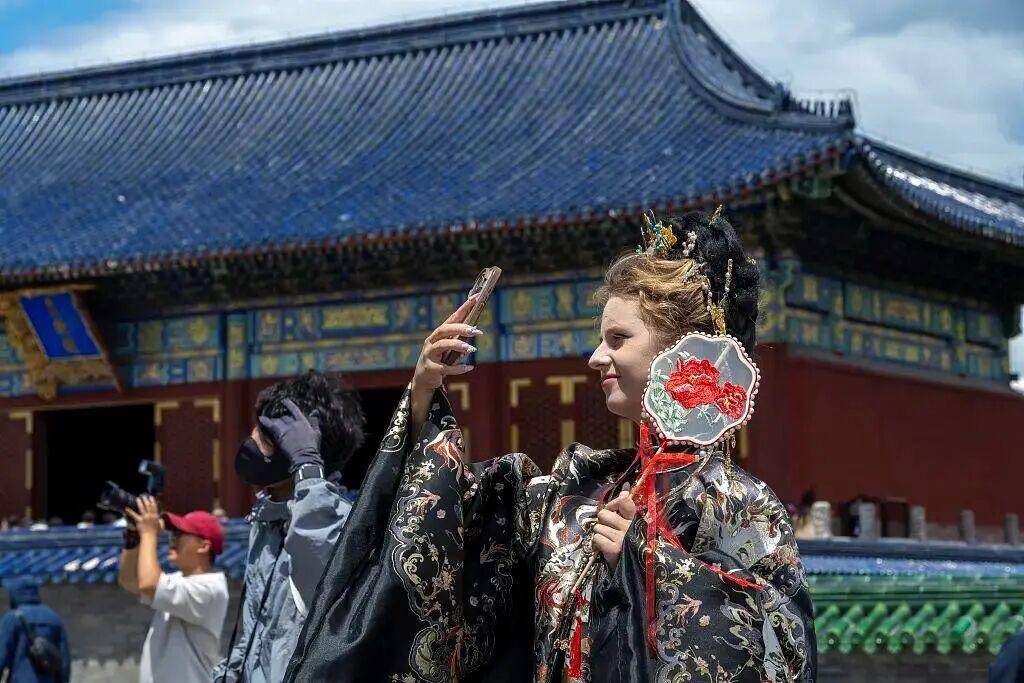
Within the Chinamaxxing feed, no single behavior marks “a person becoming Chinese” faster than putting on Hanfu. One observer explanation runs through role-switch theory: drinking warm water is a habit that can be dropped anytime, practicing Baduanjin is an activity that can stop, but wearing Hanfu is an identity change. The moment the sash is tied and the collar and skirt fall into place, posture, gait and even tone of speech shift. Behind the crossed Jiaoling (交领) collar and the wide sleeves sits a cultural code of yin-yang order and harmony between heaven and man.
#Hanfu has accumulated billions of views on its own. Ahmed, an Egyptian student who tried the hand-washing ritual at the Confucius Temple in Changchun, said the water running over his fingers felt like touching the purification rites recorded in the Rites of Zhou (周礼). Kim Minji, a Korean student who researched Hanfu, found that the high-waisted line of the hanbok descends from Ming-style Hanfu, which she said reshaped her understanding of shared East Asian dress. In 2025, Hanfu experience activities across China grew 68 percent year on year, with foreign participants making up 23 percent. The Metropolitan Museum of Art in New York reported more than 500,000 visitors to its 2026 Hanfu special exhibition, 60 percent of them non-Asian.
The Factory Behind the Trend
The movement sits on measurable industrial capacity. Caoxian county in Shandong is China’s largest Hanfu production base: one of every two Hanfu sold in the country comes from the county. In 2025 its Hanfu sales passed 13 billion yuan, supported by more than 2,800 upstream and downstream firms, 15,000 online shops and over 100,000 workers. Caoxian Hanfu now reaches 32 countries and regions, including Japan, Italy, Australia, the United States and Saudi Arabia, shipping roughly 50,000 sets a year and earning about 10 million dollars annually. Hu Chunqing (胡春青), chairman of the Caoxian Hanfu Association, put the philosophy plainly: “The rise of Hanfu is not a simple restoration of the past, but a harmonious fusion of traditional dress with modern life.”
Caoxian manufacturers have folded heritage elements into individual garments. Chenfei Apparel built its Yichu Dongfang series on Caoxian willow-weaving and shadow-puppetry motifs. Chen Long (陈龙), a designer at the Shanhe Jinxiu Hanfu Design Studio (山河锦绣汉服设计馆), uses hand-push embroidery (手推绣) to make peony patterns bloom across skirt panels. Zhang Zichen (张子晨) of the Luoruyan brand produced a Ming-style Hanfu in the “Hundred Birds Paying Homage to the Phoenix” (百鸟朝凤) pattern, aligning every seam so the motifs meet exactly, a hard discipline of traditional tailoring. On the factory floor, hand embroidery and AI design systems run side by side, needle workers beside flexible smart lines that can turn out 10,000 Mamianqun a day.
Overseas runways have picked up the same signals. HEAVEN GAIA presented a 2026 spring-summer collection with Hanfu elements at Milan Fashion Week, and Rome has hosted a Hanfu parade for three consecutive years. A Kenyan model who has walked twice in the Mamianqun said she would keep wearing it. Li Ming, head of the Italian Industrial Design Association, recalled his first sight of a Caoxian Mamianqun in Milan: the densely woven gold patterns on the hem, he observed, resonated with the craftsmanship details of Italian haute couture.
Why Not Kimono?
Foreign coverage often asks why global Gen Z has not staged an equivalent “Japanmaxxing.” The usual answer is that the kimono barely lives at home: Japanese young people wear it almost only for Shichigosan and coming-of-age ceremonies, its dressing rules are complicated and policed by self-appointed “kimono police,” and the garment is positioned as a museum piece and a tourist experience, a one-off consumer display. Hanfu runs on a different track. It is a living fashion system with industry, design, supply chains, price advantages and everyday adaptations, from skin-friendly cotton-linen fabrics to shortened hems built for commuting and campus. A good piece costs a few hundred yuan, and no one lectures a stranger about the correct lapel. The comparison is often drawn as showroom versus wardrobe: the kimono is “Japan’s traditional culture, welcome to experience,” while Hanfu is “China’s culture, you can become part of it.”
The Soft-Power Ledger
Institutional metrics have moved in the same direction. Brand Finance’s 2026 Global Soft Power Index ranks China second worldwide with a score of 73.5, the only top-10 country to rise, and China’s “reputation” sub-index surpassed the United States for the first time, with 19 of 35 national brand attributes ranked above America’s. The World Travel and Tourism Council projects that by 2035 China’s tourism industry will support more than 100 million jobs, with international visitor spending reaching about 1.5 trillion yuan.
Cultural products are exporting alongside the trend: Black Myth: Wukong has sold more than 30 million copies worldwide, over half outside China, and Labubu dolls sold more than 100 million units last year across over 100 countries and regions. The Wall Street Journal wrote that such commercial results are redefining China’s soft power. In April, Wei Wuxia (魏无瑕), a French girl, wore a Caoxian Hanfu in the peony fields of Heze and tried the local Jiangmi figure craft, and her video spread widely. Li Chunlin (李春霖), who organized the trip, drew a blunt conclusion: an overseas creator’s camera is more persuasive than any documentary or advertisement, but only if the creator genuinely believes in what he films.
The shift from distant curiosity to daily participation is visible in a single wardrobe change. One cup of warm water, one pair of slippers and one home-cooked meal have done what formal promotion could not, and Hanfu, as the movement’s most visible entry point, is being worn by choice by a generation that had never heard of it three years ago.