
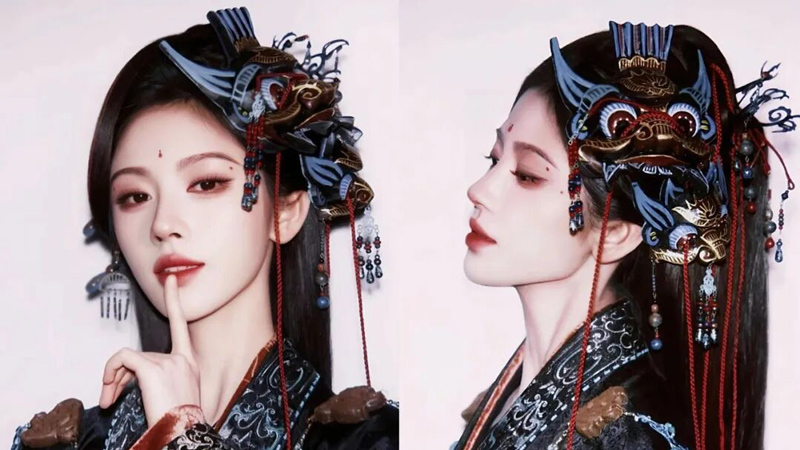
Recently, set photos from the upcoming Chinese costume drama Wanhua Shijie (万花世界) have been circulating online, and one particular look worn by actress Ju Jingyi (鞠婧祎) has sparked widespread curiosity. Instead of the usual hairpins, combs, or dangling step-shakes that dominate historical dramas, her character Su Lüxia (苏绿夏) sports a striking headpiece—two blue-and-gold beast-face ornaments flanking her temples, complete with dangling red tassels. It looks like a miniature mask perched on her head, utterly different from the conventional ancient Chinese hairstyles audiences are used to seeing.
Was this bizarre design simply made up by the costume department, or does it draw from something deeper? The answer lies in an ancient Chinese theatrical tradition known as Nuo opera (傩戏), a living piece of intangible cultural heritage that most viewers have never encountered in a female lead’s wardrobe before.
A Mask That Isn’t a Mask
At first glance, Ju Jingyi’s headpiece might seem puzzling—why would a costume drama put what looks like a fearsome mask on someone’s head instead of their face? The production team behind Wanhua Shijie didn’t invent this design from scratch. They adapted it from traditional Nuo opera masks, but with a crucial twist: instead of having the actress wear a full or half-face wooden mask (which would obscure her expressions), they extracted the iconic beast totems from Nuo masks and transformed them into three-dimensional crowns worn at the temples.

The result is a bold blue-gold-red color scheme—blue for mystery and authority, gold for texture and divinity, red for festive and protective meanings—all classic Nuo mask palettes. The large glaring eyes and upturned horn-like structures are also signature features of Nuo’s mythical beast masks. The red tassels hanging down? They’re actually a common element in ancient Chinese hair ornaments, added to soften the heaviness of the beast crown.
What Exactly Is Nuo Opera?
Nuo opera is one of China’s oldest theatrical forms, with roots stretching back to the Neolithic Age. Archaeological discoveries at the Gaomiao site (高庙遗址) in Huaihua (怀化), Hunan Province, have unearthed white pottery engraved with fanged beast-face patterns—considered by archaeologists to be the earliest prototype of Nuo culture in the Yangtze River basin, dating back approximately 7,800 years.
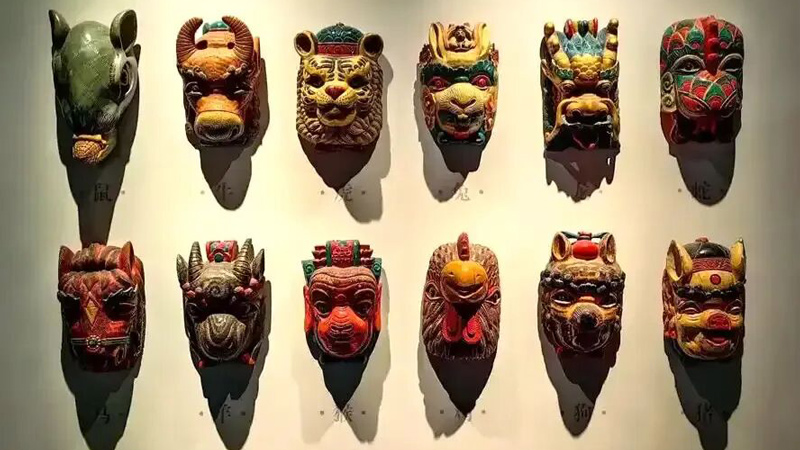
Historical texts like the Rites of Zhou (周礼) and the Book of the Later Han (后汉书) also document exorcism rituals that involved masked performers driving away evil spirits. In traditional Nuo performances, actors wear wooden masks—some covering the full face, others half—depicting deities, immortals, and mythical beasts with exaggerated features and vibrant colors. These masks aren’t mere props; each design carries cultural meaning. Ferocious beast imagery, for instance, embodies the hope of warding off evil and inviting blessings. The scarier the mask looks, the more protective its intended purpose.
Why Put It on Her Head Instead of Her Face?
The production team’s decision to turn a face mask into a headpiece wasn’t random—it serves two clear purposes. First, innovation. Traditional Nuo performances always place masks on the face; audiences have seen that countless times. But turning the mask into a crown? That’s fresh, unexpected, and keeps the visual identity of Nuo while completely reimagining its presentation. Second, visual storytelling. If Ju Jingyi wore a full or half-face Nuo mask, viewers wouldn’t be able to see her eyes or expressions—critical elements for conveying emotion and driving the plot forward. By shrinking the beast motifs to temple-side ornaments, the design retains Nuo’s distinctive aesthetic without sacrificing the actor’s facial performance.
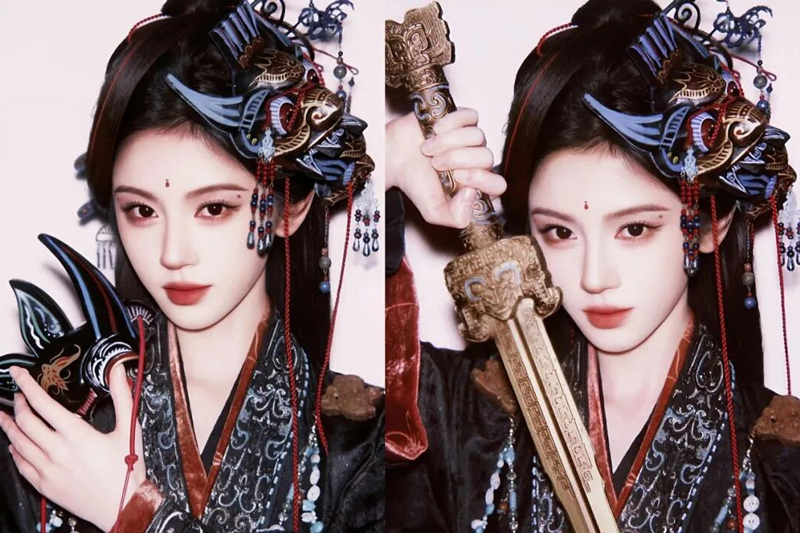
The result is a look that feels both ancient and fresh, culturally grounded yet dramatically effective. It’s no wonder netizens have called this “an excellent example of bringing intangible cultural heritage to the screen”. Love it or find it strange, one thing is certain: Wanhua Shijie just made a whole new audience aware that Nuo opera exists—and that alone is worth applauding.