
Moving 95 relics across roughly 3,000 kilometers, through four provinces and five museums, is the part of an exhibition that no visitor ever sees. The public part began on August 13, 2026, when “Zhenguan Tianxia” (贞观天下) — “The Tang World Under Emperor Li Shimin” — opened in the first-floor temporary gallery of the Huizhou Museum in Guangdong, free of charge and without reservation. Of the 95 pieces on view, 27 are national first-class cultural relics, a concentration local media have called the highest-grade Tang-dynasty special exhibition Huizhou has seen in years.

The loan list reads like a map of early Tang archaeology: the Zhaoling Museum, custodian of the mausoleum complex where Li Shimin himself was buried; the Gansu Provincial Museum; the Guyuan Museum in Ningxia; the Zhenjiang Museum in Jiangsu; and, anchoring the show at home, the Huizhou Museum. Every leg of the journey ran under professional escort, with temperature and humidity monitored at each stop. On the morning of August 10, a transport truck operated by Huizhan International Logistics pulled into the museum, and a 20-person staging team — staff from the China Cultural Relics Exchange Center, the Zhaoling Museum and the Zhenjiang Museum, together with Huizhou Museum personnel and the transport company — carried out the artifact handover and inventory.
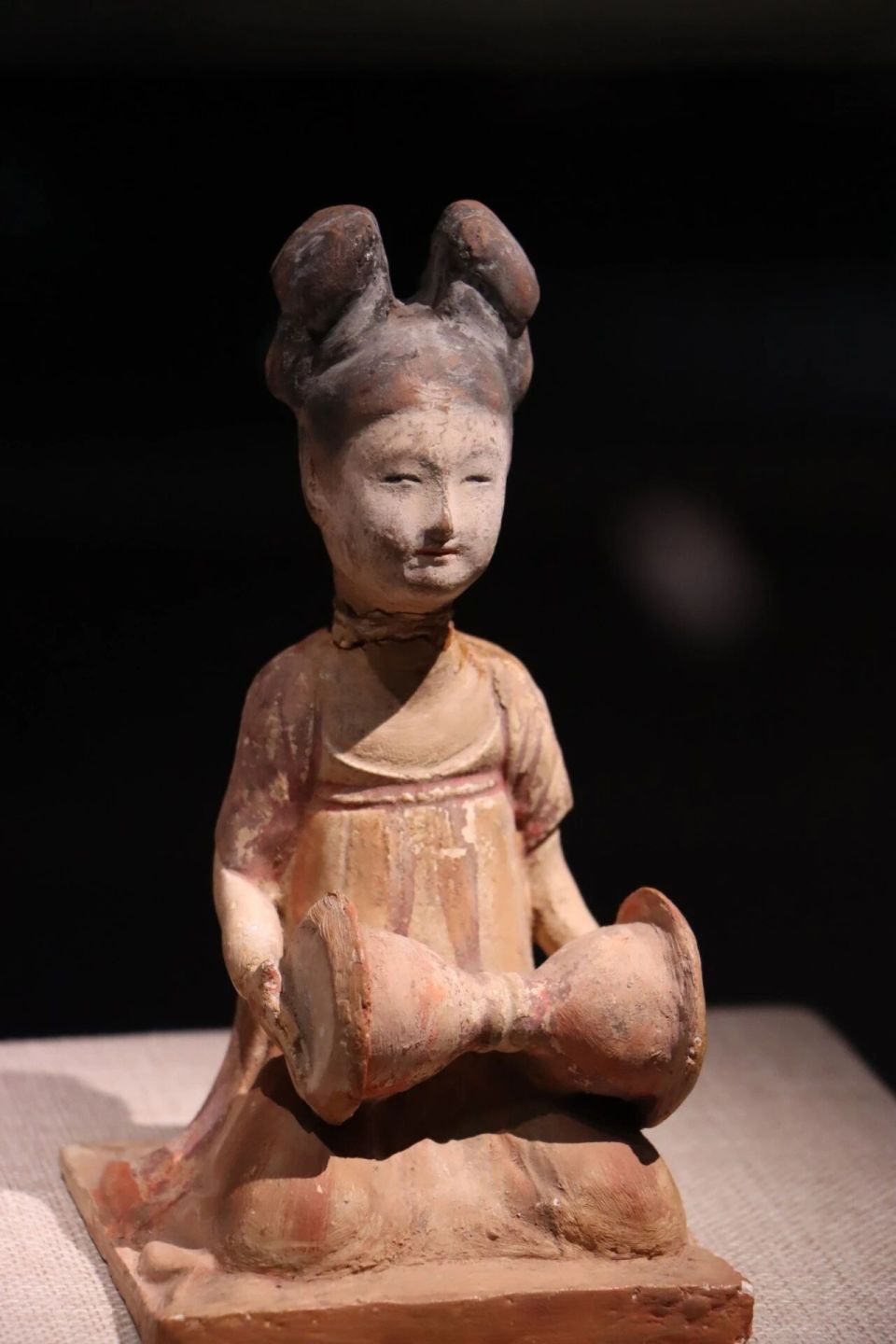
Unpacking the crates became a small ceremony of its own. Out of them came a painted guardian figurine of a heavenly king excavated from the tomb of Princess Linchuan: helmet on head, armor on body, eyes wide and glaring, one foot planted on a demon, the posture still forceful after thirteen centuries. Most of the ceramics, porcelains, murals and gold-and-silver objects in the show were recovered from the companion tombs around the Zhaoling mausoleum, and curators present them as material testimony to the society of the early Tang.
The star cases reward a slow walk. A white pottery dancing horse from the tomb of the general Zhang Shigui, milk-white and warm-toned, lifts one hoof as if caught mid-step of the palace dance-horse performances that Tang courtiers staged to music. A white-glazed Biyong inkstone from the tomb of Princess Changle carries 25 hoof-shaped column feet and traces of ink that survived on its surface — a working desk object, not a burial prop. A painted glazed pottery camel from the tomb of Zheng Rentai is loaded with bales of silk, a flat flask and a quiver, a Silk Road caravan in miniature. The epitaph of Ashina Simo, the Turkic chieftain who served the Tang after surrendering, is displayed as material evidence of the celebrated tale of Taizong sucking the poisoned blood from the wound of a general who had come over to his side — the era’s ideal of harmony between Han and Hu peoples. Huizhou’s own contribution includes the Tang stone mill “Kunshan Pianyu”, a local first-class relic, alongside replicas of the Six Steeds of Zhaoling and the three-ridge Jinde ceremonial crown.
Five galleries — Founding a New Dynasty, Early Signs of Prosperity, The Silk Road in Its Prime, The Legacy of a Well-Governed Age and The Splendor of Xunzhou — structure the narrative, and each hosted a checkpoint for the “Zhenguan Poetry Gathering: Tang Poetry Challenge” held at 10:30 on opening day. Five examiners in Tang costume posed two questions per gallery, ten in all; ten correct answers entered a draw for 100 cultural-creative prizes, while partial scores were still rewarded at the Tang market next door: four checkpoints earned a Hanfu try-on, three a Huadian forehead sticker (花钿), two a relic seal stamp, one a souvenir ticket.
That same afternoon at 15:00, a concert of three surviving Tang court pieces kicked off the exhibition’s music program. “Qin Wang Po Zhen Yue” (Battle-Formation Music of the Prince of Qin) grew out of the army songs of Li Shimin’s campaigns and matched the show’s founding chapter; “Sheng Ming Yue” (Music of the Sagely Bright Reign) was composed during the Zhenguan years to praise peace and good governance; and “Man Qu Zi Yi Zhou” (Slow Tune: Yizhou) takes its name from Yizhou, a pivotal Silk Road town, fusing Central Plains elegance with the idioms of the Western Regions.
The exhibition runs to November 15, 2026, open daily 9:00 to 17:30 with last entry at 17:00, closed Mondays, admission free. Visitors this summer can read, in the museum’s own phrasing, the grandeur of a dynasty 1,300 years gone — embodied in a dancing horse, an inkstone and a camel still carrying its silk.