
At noon on August 9, 2026, the 36-episode costume drama The Road to Splendor (花开锦绣) premiered exclusively on Tencent Video, surpassing two million reservations on the platform and pushing its heat index past 21,000 within two hours of airing, with overseas simulcasts on Disney+ and WeTV. Almost immediately, the production’s costume and styling work became the audience’s favorite topic of debate: the crew prepared 800 outfits and more than 500 looks for its characters, with Mamianqun (马面裙), Aoqun (袄裙), Bijia (比甲) and cloud-shoulder yunjian (云肩) recreated from Ming Palace Records (明宫史) and the collections of the Confucius Mansion in Qufu, down to the handwoven kesi silk of the Pibo sash (披帛) the heroine wraps around herself while on the run. The research-driven aesthetic of “costume as narrative” drew a wave of praise online.

A Three-Stage Wardrobe for the Heroine
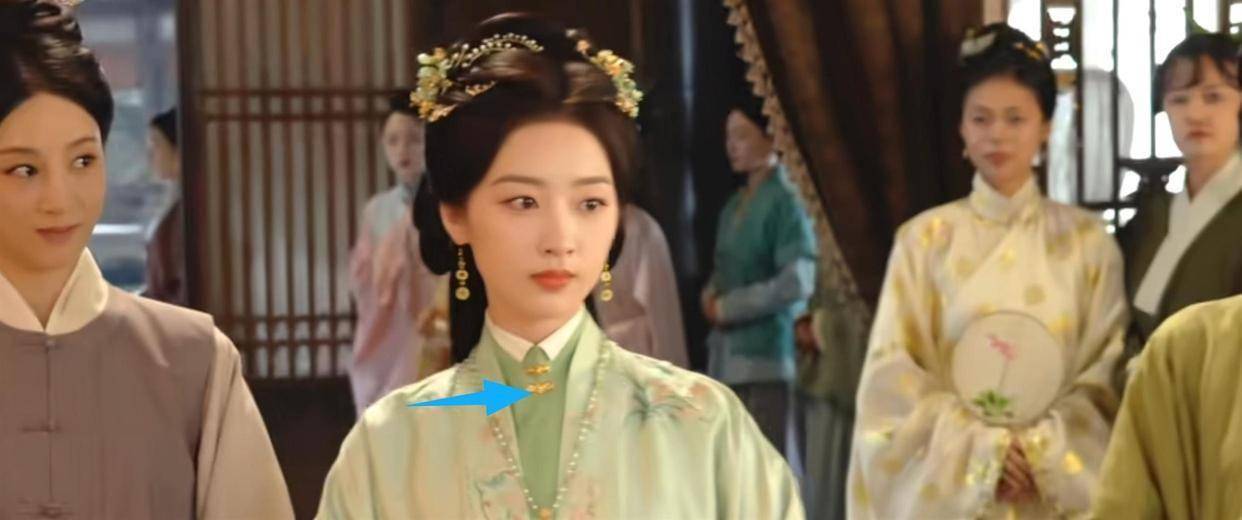
Costume director Gao Qiuwan (高秋婉) designed a “three-stage wardrobe system” for the heroine Fu Tingyun, played by Deng Enxi (邓恩熙), turning clothing into a chronicle of the character’s fate. In the first stage, the sheltered Jiangnan lady of letters, Fu Tingyun wears a plain-silk Beizi (褙子) in low-saturation colors — light beige-white, soft pink, pale apricot and bean green — a standing-collar Duijin (对襟) jacket with pipa sleeves, and fabrics of dark-patterned gauze and figured silk, with motifs of orchids, crabapple and magnolia blossoms; her hair is coiled in a small, gentle bun threaded with fine diancui inlay and pearl strands, matching the restrained temperament of a scholarly family’s daughter. In the second stage, falsely accused and fleeing west with the salt smuggler Zhao Ling, she changes into narrow-sleeved Hu-style riding dress for easy movement. In the third stage, arriving at Dunhuang, she drapes a Kucha gold-brocade Pibo in a dignified yellow-toned dark embroidery, the hairpin crown grows heavier, gold diancui ornaments multiply, her brows sharpen and her lip color deepens — a woman weathered by ordeal into quiet strength.
Salt-Stained Brows: A Groom’s Rise in Three Looks
Makeup and hair director Yang Xiaohai (杨晓海) gave the male lead Zhao Ling, played by Ding Yuxi (丁禹兮), a “salt-stained brow” (盐渍眉妆): years on the salt roads have soaked saline residue into his brow bone, leaving the brow tails faintly bluish-gray — not a special effect but the physiological trace of a real salt worker. Zhao Ling’s three looks read like a promotion ledger. In his early life as a wandering outcast, his signature prop is a large straw hat, with a loose-cut, naturally dyed Jiaoling (交领) robe in dark green and gray-blue coarse cloth, no gold brocade, and a curved saber at his waist. Midway, joining the border army, he wears a black distressed leather and riveted armor with a wide-brimmed Ming-style military helmet, every nail and scuff rendered in detail, over dark-patterned arrow sleeves for mounted combat. At the end, entering court officialdom, he wears a deep-blue dark-patterned official robe, then a crimson robe bestowed by the emperor with a gold-brocade rank badge (补子), a round-collar gown in rich brocade, a Ming black gauze hat (乌纱帽) and a jade belt and pendant — the roughness of the road gone, replaced by the composure of the court.
Supporting characters each get their own visual language: Wen Zhengrong (温峥嵘) as Lady Yu wears a red gold-brocade Daxiushan (大袖衫) with a loose bun and a simple gold crown — a dignified, muted red that wears the matriarch’s authority on its sleeve; Bai Shu (白澍) as a royal figure pairs a yishan crown (翼善冠) with a purple-based gold-brocade Yesa (曳撒), the purple-gold scheme carrying imperial air; Lü Xiaolin’s gray-blue square-collar cloak is quietly reserved; Fan Tiantian’s Jiaoling long gown has the ease of the marketplace. Throughout, the costumes draw on Ming Palace Records and the Confucius Mansion collection, with Aoqun, round-collar Yuanlingpao (圆领袍), Xiapei (霞帔) and Daxiushan all finished by hand, their gold-brocade embroidery painstakingly detailed.

Set Research: 287 Days, 63 Script Revisions
The research extends beyond wardrobe. Art director Shao Changyong (邵昌勇) took his team through Yingzao Fashi (营造法式) and Ming Dynasty Artisan Lineages (明代匠作谱系), even reproducing the cloud-pattern queti bracket of a Shanxi Wang-family compound from a Jiajing-era craftsman’s manuscript. History consultant Chang Yu (常彧) spent 287 days with the production and revised the script 63 times, ensuring that Ming salt-policy terms — the salt certificate, the gang salt system and the tax conversion of zhe se (折色) — drive the plot rather than decorate it. The crew shot on location in Shanxi and Dunhuang, Gansu, letting the gray-tiled eaves of Shanxi manor houses and the vast desert and golden poplars of Dunhuang give the Ming-style costumes their true space. The series is directed by Deng Ke (邓科), whose credits include My Heroic Husband and The Guardians of the Ancient, and written by Nan Zhen (南镇), known for The Romance of Tiger and Rose; the cast also includes You Jingru, Lü Xiaolin, Zhang Meng, Tan Kai and Chi Peng.
From the plain-silk Beizi of a Jiangnan boudoir to the Kucha gold-brocade Pibo of the northwestern desert, The Road to Splendor turns “costume as narrative” from slogan into tangible detail. Dubbed by viewers “Ming Dynasty haute couture, hand-made,” the series proves once again that what moves an audience is not piled-up splendor but letting every fold of cloth tell the story of a character’s shifting identity and fate.