
The 2026 “Tea for Harmony” (茶和天下) cultural exchange series has been rolling out across multiple cities worldwide. On May 21, International Tea Day, the Chinese Embassy in Indonesia held a “Tea for Harmony: Beauty Shared” cultural event in Jakarta; from June 19 to 20, a program themed “Among Grass and Trees: Green Mountains, Clear Waters, Fresh Tea” ran at the Whale Palace exhibition center in Budapest, Hungary. With tea as the medium and the arts as the bridge, Chinese tea culture, silk dress and guofeng cultural products together presented the appeal of an Eastern lifestyle aesthetic to the world.
Jakarta: Five Teas for a Hundred Guests, Human and Robot Co-Hosting
On International Tea Day, the “Tea for Harmony: Beauty Shared” event hosted by the Chinese Embassy in Indonesia brought together more than 100 guests — Indonesian government officials, cultural institution representatives, and envoys and delegates from Thailand, Laos, Cambodia, Kazakhstan, Russia and Spain. The event was designed to carry out the important consensus between the two countries’ heads of state on strengthening people-to-people and cultural exchange, deepening the “people-to-people pillar” of China-Indonesia relations.
Chinese Ambassador to Indonesia Wang Lutong (王鲁彤) said in his address that Chinese tea culture embodies the spirit of tolerance, equality and mutual learning, and offers a unique vehicle for bridging cultural differences and bringing hearts closer. Tea symbolizes the harmonious coexistence of humanity and nature, he added — “green mountains and clear waters are what make good tea.”
The event was co-hosted by humans and Chinese-made robots in Chinese and English. The backdrop screen drew on five classic Chinese tea paintings, including “Elegant Gathering” (文会图). Guests were served five brews — Chinese white tea, Dahongpao and Tieguanyin, alongside Indonesian black tea and turmeric tea — and the program included a lecture titled “Eastern Lifestyle Aesthetics and the Concept of Harmony,” a gongfu tea ceremony, a tea-art-and-dance performance, and a bamboo tea-space display from Zhenghe. A guzheng and erhu duo played the Chinese folk song “Jasmine Flower” and the Indonesian classic “Bengawan Solo,” and the homegrown robots performed tai chi. Interactive stations offered lacquer fans, rubbing, Javanese calligraphy and Indonesian angklung playing, alongside Indonesian batik crafts themed on the Chinese dragon and the Lantern Festival — a vivid picture of two cultures meeting and enriching each other.

Three Performances, Immersive Jiangnan Culture
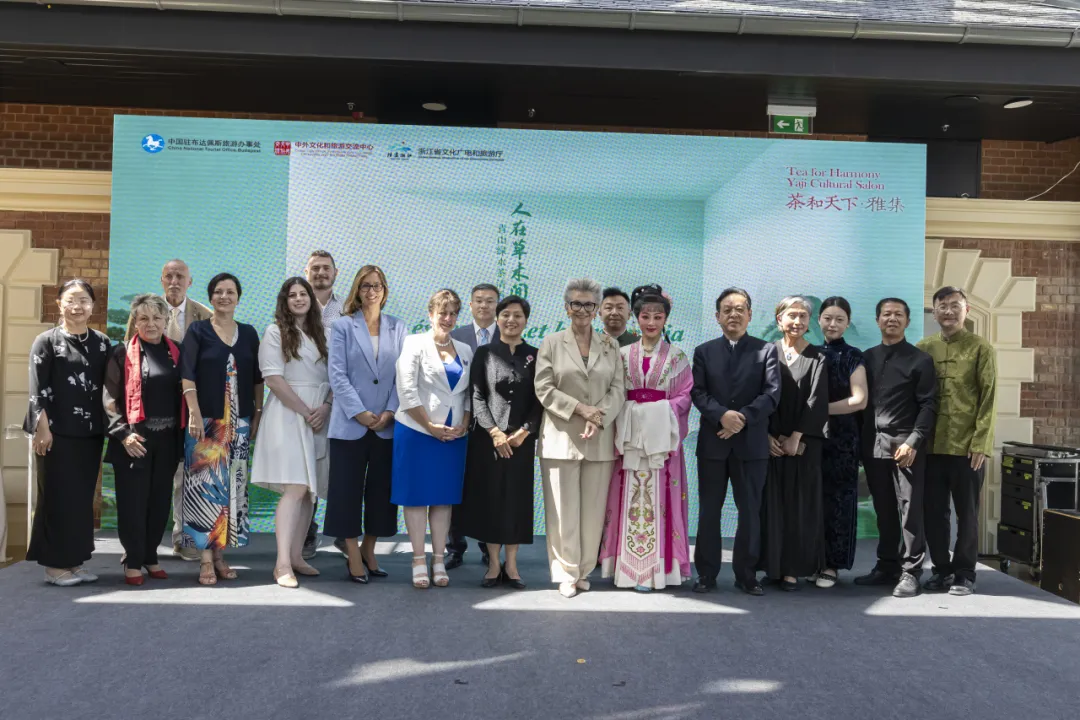
From June 19 to 20, the “Among Grass and Trees: Green Mountains, Clear Waters, Fresh Tea” program — organized by the China Center for Cultural and Tourism Exchange, the China National Tourism Office in Budapest and the Zhejiang Provincial Department of Culture, Radio and Television, and hosted by the Zhejiang Provincial Cultural Center — took place at the Whale Palace exhibition center in the Hungarian capital. A key component of the “Dialogue · Bosom Friend — 2026 Budapest Silk Road Civilization Dialogue and China Intangible Cultural Heritage Tourism & Cultural-Creative Exhibition,” it staged three special performances plus interactive sessions for local residents, weaving tea art, folk music, Yue opera and calligraphy-and-painting into an immersive Jiangnan cultural experience.
Chinese Ambassador to Hungary Gong Tao (龚韬), Hungarian National Commission for UNESCO President Katalin Bogyay, Hungarian-Chinese Friendship Association President Judit Eva Nagy, and China National Tourism Office in Budapest Director Li Huixin (李绘新) attended and addressed the opening, joined by more than 120 representatives from politics, culture and tourism, media, enterprises and professional audiences; hundreds of local residents took part in the interactions. Xinhua covered the event on site.
Each of the three special sessions opened with the ensemble piece “Tea-Picking Dance Tune” (采茶舞曲), its cheerful melody evoking the joy of Jiangnan tea-picking amid pastoral scenes. Yue opera actress Wen Shanshan (温珊珊) and flutist Wang Yuezhou (汪悦洲) performed in close partnership while artist Miao Hongbo (缪宏波) painted at the side of the stage and tea master Zeng Huizhi (曾卉知) demonstrated brewing — music, ink and tea aroma converging on one stage. The most magnetic part of the program was the immersive tea-culture experience threaded through the whole event, with three featured tracks — everyday tea practice, professional tea appraisal, and tea in daily life — showing the many facets of Chinese tea drinking.
Tea Beyond the Cup
While “Tea for Harmony” travels abroad, tea culture at home is fusing with silk dress and guofeng creative products. People’s Daily reported on June 9, 2026, that the “2026 Tea for Harmony · Yaji” series opened at the China Cultural Center in Budapest, with new-style tea drinks, silk dress and guofeng cultural products sketching a living picture of Chinese aesthetics in modern life. The examples are concrete: Fang Liyan (方丽彦), a post-95 drink mixer in Tunxi, Huangshan, who reworks Taiping Houkui into tea-cake infusions; the Chongqing Banan Hospital of Traditional Chinese Medicine, whose “Five-Flavor Good Formula” line offers a poria-and-lotus-leaf latte; and the Fuzhou team of Fuyun Tea House, which pairs Fujian gongfu tea with Shoushan stone and Min opera in its tea gatherings. Tea has long outgrown the cup: it has become a cultural carrier linking traditional aesthetics to modern ways of living.
From Jakarta to Budapest, from gongfu tea to Yue opera and folk music, the “Tea for Harmony” series uses tea as the medium and the arts as the bridge, embodying the ideal of “harmony in diversity, beauty shared” and adding a fresh, lasting current to people-to-people exchange between China and the world.