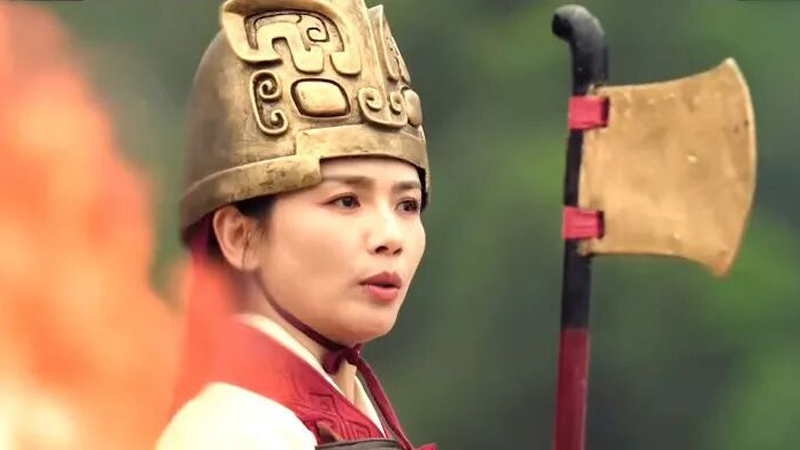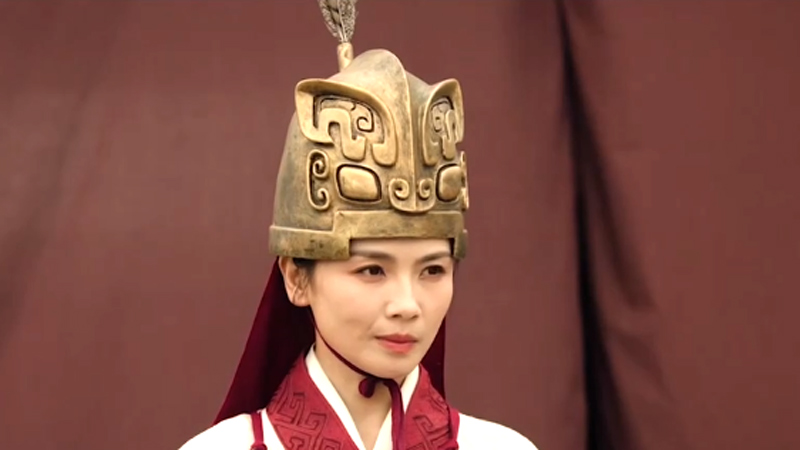
Liu Tao (刘涛) wore a strange bronze helmet in the show Civilization in Bronze and Stone (金石探文明). It was not a prop master’s fantasy. It was a direct replica of a 3,000-year-old artifact: the Shang Dynasty (商朝) beast-face bronze helmet. Why does it look so alien to our eyes? Because we are used to the iron helmets of later dynasties. This bronze headpiece, unearthed in Jiangxi (江西), represents the very first chapter of Chinese military headgear, and its design tells a story far deeper than just battlefield protection.
The Bronze Beast
When viewers saw the helmet on Liu Tao’s head, many thought it looked like a ritual object rather than practical armor. That confusion is understandable. The artifact in question, the “Shang Dynasty Beast-face Bronze Helmet” (商代兽面纹青铜胄), was cast as a single solid piece. Its most striking feature is the front: a pair of bulging eyes, a thick nasal ridge, and symmetrical patterns spreading outward. It carries the exact same design language found on the massive ritual ding (鼎) cauldrons used in royal temples.
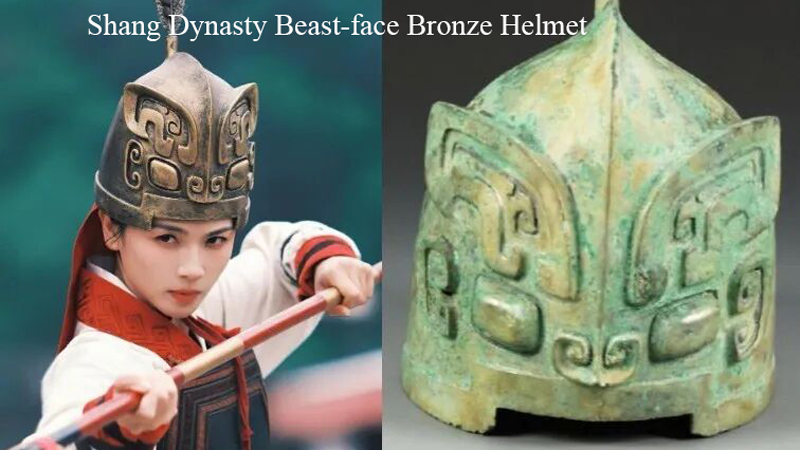
This helmet was unearthed in the Da Yang Zhou (大洋洲) site in Jiangxi, a tomb that shocked archaeologists with its wealth of bronze artifacts. It dates back to a time when bronze was more precious than gold. The helmet’s top features a hollow tube. This was not an antenna or a decorative spike for show. It was designed to hold feathers or a silken tassel. In the program, Liu Tao’s helmet replicated this detail perfectly. The audience saw a warrior, but the warrior was also a walking emblem of royal authority. The beast was not just a scary face; it was a protector and a status symbol, combining the roles of soldier, priest, and noble into one bronze shell.
Why the Beast?
This design was not random artistic expression. First, it was a matter of social rank. In the Shang Dynasty, bronze was the ultimate luxury, controlled exclusively by the royal family and high-ranking nobles. A common soldier would never have access to such a helmet. The complexity of the beast-face pattern directly indicated the wearer’s status. A more intricate design meant a higher rank. This helmet was the ancient equivalent of a general’s stars, immediately signaling to everyone on the battlefield who was in charge.

Second, it was about spiritual belief. The Shang people lived in a world full of spirits and ancestral power. They believed the beast-face pattern had an inherent deterrent force. It was meant to terrify the enemy’s spirit while also protecting the wearer. The same motifs appear on bronze yue (钺) axes and cauldrons. The helmet was a mobile altar, shielding the wearer’s soul from harm and ensuring his safe return. It was not mere superstition; it was the psychological warfare of the ancient world.
Third, it was about aesthetics. The Shang dynasty loved symmetry and imposing dignity. Whether it was a jade pendant, a building, or a bronze vessel, visual weight and balanced lines were paramount. The helmet is perfectly symmetrical. The lines are thick and heavy, satisfying the noble class’s taste for solidity and grandeur. This was not about ergonomic comfort; it was about projecting an image of unshakeable power. The wearer became a statue, a part of the ritual landscape, even in the chaos of war.
Lost in History
This style of helmet did not survive the ages. As the Western Zhou and Spring and Autumn periods unfolded, the design evolved and simplified. The single cast piece gave way to segmented, assembled bronze helmets. The intricate beast-face motifs grew vague and eventually disappeared. By the middle and late Warring States period, iron-making technology took over. Iron became the new standard, and the bronzed beast was slowly phased out.
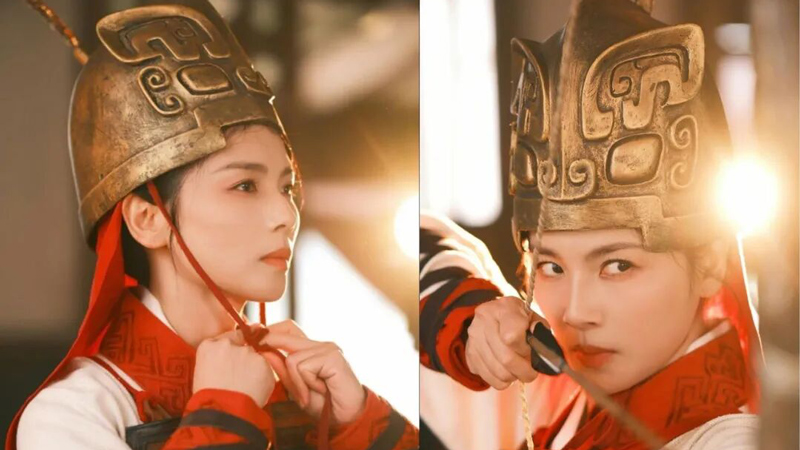
This is why the helmet looks so bizarre to modern viewers of historical dramas. Our visual memory of ancient soldiers is shaped by the iron helmets of the Tang and Song dynasties, which are more rounded and practical in appearance. The Shang bronze helmet is a relic from a different paradigm of war. It stands as a reminder that ancient battles were not just about physical combat but also about ritual and display. It is a piece of art designed for survival, even if the “survival” depended as much on spiritual confidence as on the metal itself.
In Civilization in Bronze and Stone, Liu Tao played Fu Hao (妇好), the famous female general of the Shang Dynasty. Her wearing of this specific helmet is historically accurate, proving that the showrunners did their research. This program does not just show us artifacts; it revives them. It takes the dusty relics from museum glass and places them back on the human body, reminding us that these objects were once alive, heavy, and worn by people of flesh and blood. Through this performance, history ceases to be a distant concept and becomes a tangible, physical reality.