

Yang Zi (杨紫) wears a pale blue costume in the historical drama The Mo (家业), set in the Ming Dynasty. Right at the center of her robe’s front placket sits an embroidered motif that looks uncannily like a lantern—round, symmetrical, and vertically aligned. Some viewers find it charming; others wonder if it’s just a designer’s whim or a genuine ancient pattern. It turns out this little emblem carries over a thousand years of Chinese textile history.
Known as the Lantern Pattern (灯笼纹, also called “lantern brocade” or “universal joy brocade”), it first appeared in the Tang Dynasty as a festive decoration for the Lantern Festival.
By the Song Dynasty , it had evolved into a luxury fabric called Shu Brocade (蜀锦), reserved for the highest nobility. The Ming era saw it spread to everyday women’s wear, and the Qing Dynasty expanded its repertoire with intricate variations. So why did our ancestors stitch a lantern onto their clothes? The answers lie in three deeply human impulses—hope, celebration, and a quiet sense of beauty.
Fortune and Harvest
The Chinese character for “lantern” sounds almost identical to “ascend” or “register”. That homophone turned the lantern into a visual pun for upward mobility—both in the rice fields and in the imperial examination halls. A woman wearing this pattern wasn’t just decorating her sleeve; she was literally carrying a wish for a bountiful autumn harvest or her son’s name on the palace roll. But the symbolism didn’t stop there. The lantern itself radiates light, and in a culture that valued family continuity, that glow meant “bright completion” and “household safety.” One small embroidered shape packed enough good omens to fill a prayer scroll.
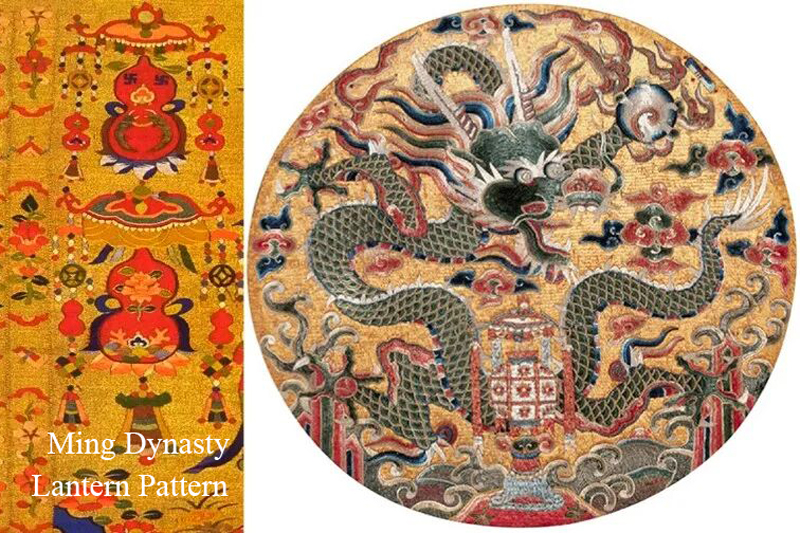
Ming and Qing weavers took this further by pairing the lantern with other lucky icons. You’d find bats (蝠, homophone for “blessings”) fluttering around it, or Ruyi (如意) scepters for “everything goes as you wish.” Some versions even wove characters like “Fortune,” “Prosperity,” “Longevity,” and “Joy” directly into the lantern’s frame. This wasn’t random clutter—each element was a silent verse in a poem of aspiration. The pattern became a kind of wearable talisman, and because it was vertically arranged, it also drew the eye upward, subtly suggesting growth and rising fortunes. For a commoner’s daughter or a merchant’s wife, that little lantern was a daily reminder that good things were not just hoped for—they were literally woven into her identity.

Festive Flair
The lantern pattern never lost its original party spirit. It was born from the Lantern Festival, the fifteenth day of the first lunar month, when every household hung glowing paper globes and paraded through crowded night markets. Wearing a lantern on your chest during that season was like wearing a Christmas sweater in December—it put you in the mood and told everyone around you that you were part of the celebration. But the Chinese didn’t stop at one night. They brought out the lantern brocade for weddings, birthday banquets for the elderly, and especially for the New Year, when red and gold lanterns dominated every doorway.

Historical records like Zhuozhong Zhi (酌中志) and Ming Jili (明集礼) note that both palace ladies and common women wore lantern-decorated jackets and long capes during these occasions. In the Qing dynasty, the motif grew more elaborate—think curling Ruyi clouds and fluttering bats embroidered in metallic threads—but the purpose stayed the same: to amplify joy. Even the simpler folk versions, found on short padded jackets and horse-face skirts, carried that festive DNA. Imagine a young bride stepping into her in-laws’ house on her wedding day, her robe’s lantern pattern catching the candlelight—it wasn’t just pretty; it was a declaration that this house, too, would be filled with light and laughter. The pattern turned cloth into a social signal, a non-verbal way of saying, “We are here to celebrate.”
Understated Grace
Beyond all the symbolism and seasonal cheer, the lantern pattern simply looked good. Its shape is naturally round and perfectly symmetrical, which gave weavers a satisfying grid for repeat designs. When placed vertically along the center placket or the side seams, those repeated lanterns created a slimming, elongating effect—a clever optical trick that Ming and Song women appreciated long before fashion magazines existed. But the real genius was in the subtlety. Many high-end versions used tone-on-tone embroidery or woven shadows, so from a distance the robe appeared plain and elegant, almost austere. Only when you stepped close could you catch the delicate lantern outlines, the fine silk threads catching the light like a secret.

That restrained aesthetic fit perfectly with the Ming dynasty’s preference for modesty and inner refinement. The The Mo costume team understood this—they placed just one lantern motif at the front center of Yang Zi’s robe, then added winding coin patterns below and twining peony vines at the collar. The overall effect is quiet, never flashy, yet rich in detail for those who look twice. It’s the opposite of modern logo-mania; instead of shouting, it whispers. And that whisper carries the weight of centuries—from Tang festival tents to Song imperial looms, from Ming market stalls to Qing bridal chambers, all the way to a streaming drama in 2026. So when you see that lantern on Yang Zi’s chest, you’re not just watching a costume—you’re reading a thousand years of hopes, parties, and quiet elegance, all stitched into a single, glowing thread.