
“Overseas orders for Mamianqun at the start of this year were about ten times what they were in the same period last year!” Hou Guodong, head of Shandong Caoxian Shengming Garments Co., told Xinhua in a report filed from Jinan and Nairobi on March 16. His company’s trajectory mirrors the broader boom in Chinese Mamianqun exports. “In the past, we made whatever foreign clients asked for. Over the past year, we have been weaving international fashion elements into our Hanfu designs to spark new demand,” Hou said. The firm has joined international Hanfu trade shows and cross-border e-commerce platforms, introducing more of the world to the pleated skirt.

The Mamianqun, a signature silhouette of Hanfu, features flat front and back panels with knife-pleated sides; its name comes from the skirt’s flat overlapping panels, which resemble the “horse-face” (mamian) gate towers of ancient Chinese city walls. It is among the most popular categories of the modern Hanfu revival. Caoxian County in Shandong Province — a landmark of both Mamianqun production and the Hanfu industry — offers the clearest numbers: 2025 Hanfu sales surpassed 13 billion yuan, with more than 2,800 Hanfu companies and nearly 100,000 workers, making the county one of the world’s major Hanfu production and sales bases. Liu Xia, deputy director of Caoxian’s e-commerce service center, noted that the county covers the full industrial chain within a five-kilometer radius, from original design and pattern cutting to embroidery, printing, accessory supply, online marketing and after-sales service.
Overseas enthusiasm is turning into real business. Ma Xiaomei, chairwoman of a Kenyan garment company with years in manufacturing, has registered a Caoxian Hanfu trademark tailored to the Kenyan market, positioning the garments for festivals and stage performances. Local consumer Mercy Maina said the Mamianqun “instantly elevates any outfit — it works for daily wear and for formal occasions like ribbon-cutting ceremonies; it is truly versatile.” In Brazil, Chen Xiangguang, general manager of a cultural media firm, is in talks with local distributors to stock Caoxian Mamianqun alongside European and American luxury labels in the same storefronts. Sarah Nyawira, a Nairobi travel agency manager who bought her first Caoxian Mamianqun at a local fashion boutique, has worn the skirt to multiple events and now plans a bolder stage: having the Mamianqun appear at the upcoming World Rally Championship in Kenya. “It is a hugely influential event — we intend to attend in Mamianqun,” she said.
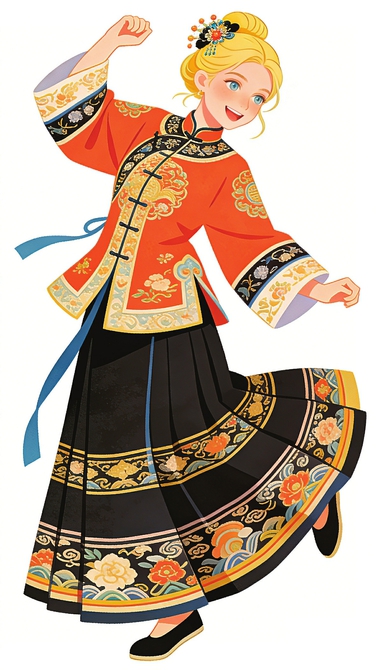
International fashion and design figures have taken notice too. Li Ming, China business head of the Italian Industrial Design Association, first encountered the Caoxian Mamianqun at a Hanfu runway show in Milan: “The intricate woven-gold patterns on the skirt hem resonated remarkably with the craftsmanship details of Italian haute couture.” Kenyan fashion model Nyakwar John discovered the skirt through a viral social media moment. “When I first saw the Mamianqun, it seemed to blend multiple cultural elements, and the way of wearing it was unusual — it was hugely popular among models,” she said. She has since walked the runway in Mamianqun twice, to strong responses.
Caoxian has now rolled out silhouettes including the moon-glow skirt (yuehuaqun) and phoenix-tail skirt (fengweiqun), weaving international visual language into colors, motifs and patterns under a “culture + fashion + industry” export strategy. In 2025, the county’s Mamianqun-led Hanfu reached 32 countries and regions, including Italy and Australia. It is also staging Hanfu runway shows and setting up overseas Hanfu societies to raise its global market share. As Caoxian Mamianqun sways in Milan’s sunlight, on Nairobi campuses and across Rio de Janeiro’s dance floors, it carries a Chinese county’s digitized, industrialized effort to put Eastern aesthetics on the world stage.