
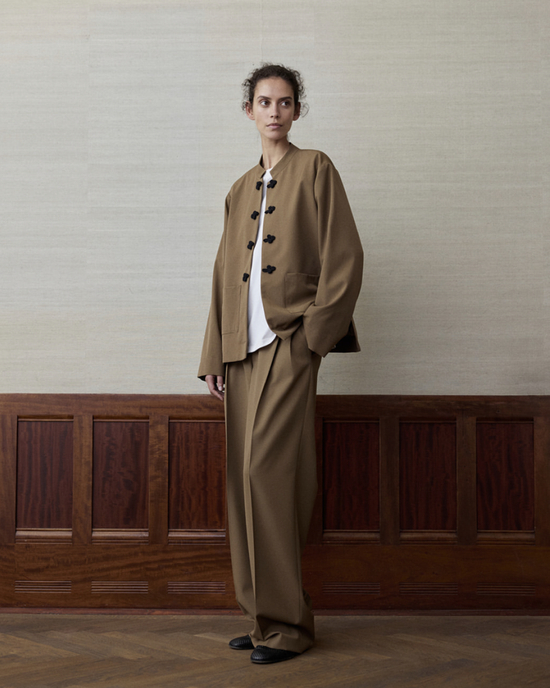
In the spring-summer season of 2026, a Chinese-style jacket defined by Pankou (盘扣) buttons and a standing collar swept from overseas social-media outfits into mainstream fashion. Known internationally as the “Tang Jacket,” it has become the first global Eastern fashion symbol to follow the Mamianqun (马面裙) — an adidas China-exclusive version resold for as much as $488, a wave of international brands from Zara to Ralph Lauren and Lemaire chasing the silhouette, and “Chinesemaxxing” turning into a buzzword abroad. The rise of one jacket has opened a wider conversation about cultural confidence, cultural appropriation and global taste. This article traces the Tang Jacket from the origin of its name to its worldwide moment.

How the Tang Jacket Got Its Name
According to CCTV’s style channel, which cited Harper’s Bazaar in a report dated May 20, 2026, the term “Tang Jacket” was not born overnight — it is the product of cultural exchange and shifting taste. As early as 1956, Hollywood star Grace Kelly wore a Chinese-style jacket in the film High Society. Even earlier, the Chinese word “Tangzhuang” (唐装) had already become familiar abroad. The term does not directly describe garments of the Tang dynasty: because the Tang was among the most influential dynasties in China’s foreign relations, many countries came to call Chinese people “Tang ren” (people of Tang), attaching the character “Tang” to things associated with them — hence clothing was called Tangzhuang.
In 1994, Hong Kong industrialist Sir David Tang founded the Shanghai Tang (上海滩) brand. He translated Tangzhuang as “Tang Suit” and called the Chinese-style jacket a “Tang Jacket,” giving the garment an international name. In the years that followed, as overseas Chinese embraced Tangzhuang, as Tang Jackets appeared in films, and as stars such as Gong Li and Maggie Cheung wore them on international red carpets and at film festivals, this strain of Eastern romance gradually became seen, accepted and desired in the West.

The Spark: A Shanghai Launch and a $488 Resale
The trigger for the current wave can be dated to October 2025. As China Daily reported on April 9, 2026, adidas Originals released its “Chinese New Year” limited jacket at that year’s Shanghai Fashion Week — the garment that social media began calling the “Tang Jacket.” It first sold only in mainland China, then expanded to a few Asian markets, and only reached Europe in February 2026. The design borrowed from the Qing-dynasty magua (马褂) riding jacket and from Tangzhuang itself: Pankou buttons and a standing collar. Compared with the clichéd “dragon-and-phoenix motifs plus festive red” of past Chinese New Year designs, it was restrained and modern, projecting an understated, scholarly Eastern temperament.
An HKCNA feature of February 27, 2026, citing CNN, reported that the jacket — originally priced at around $150 — was being resold for up to $400 on platforms such as StockX; China Daily’s April 9 report noted some online resale listings reaching $488. A TikTok video titled “POV: your dad just came back from China,” showing a man handing out Tang Jackets in different colors to family members straight from a suitcase, drew more than 9.5 million views; a young American woman’s photo wearing the dark-grey version on the street received over 1 million views. HKCNA also quoted an American girl who “flew to China just for this viral jacket — totally worth it.” Back home, inquiries, resale listings and purchasing-agent services multiplied across Chinese platforms from Xiaohongshu to Xianyu; a shopkeeper on Beijing Road in Guangzhou posted on Xiaohongshu: “Chinese style has won completely — this time we hosted sisters from Indonesia, and they couldn’t wait to find out where to buy this Tang Jacket.”
Chris Zou, a social-media creator from Toronto, recalled wearing a wine-red Tang Jacket during a visit to China: he bought more than two, and noted that “the people buying and wearing these jackets aren’t even Chinese — they’re Singaporeans, Malaysians, Americans, Australians.” CNN’s comment was that the Tang Jacket’s success “has an important reason: it sits at a fascinating intersection of identity, internet culture and even geopolitics.”
“Chinesemaxxing”: Young Consumers Try Living Chinese
The HKCNA feature noted that multiple overseas media outlets had picked up on how the Chinese New Year had accelerated the “Chinesemaxxing” (学做中国人) trend, reporting that “China is no longer a geopolitical issue but ‘modern, aesthetic and confident’ — even a source of fashion and lifestyle.” Beyond snapping up adidas Tang Jackets, young people on social media were trying drinking warm water, walking around the house in slippers, and following Chinese New Year customs such as “don’t cut your hair or wash your hair on the first day of the year, or you’ll wash away your good luck.” CNN reported that the Tang Jacket “has become the holy grail for Gen Z — a symbol of young people’s growing embrace of all things Chinese.” Adidas subsequently launched a co-creation collection with Chinese designers in direct response to the market heat.
The surge quickly rippled through the entire fashion industry chain. China Daily reported on June 5, 2026 that standing collars, frog buttons and Duijin (对襟) front closures had become popular features in US stores: a black Zara “Mandarin Jacket” retailed at $149, with the white version placed in a prominent New York window; Mamianqun skirts were also on sale on Amazon. Desiree Jones, a 55-year-old New York shopper at the Manhattan Zara store, said: “These jackets are clearly Asian-inspired, and I love it. It’s the buttons, the construction, the collar — you can see that Asian tailoring.” Monica, a 30-year-old shopper from Ecuador trying on a black Mandarin style in Brooklyn, sighed: “I want to look like this.”
Earlier, at the high-end design end, a photo of Spanish influencer Helena Cuesta in a pink silk jacket paired with blue jeans sparked heated discussion in April 2026; the piece came from Spanish brand Amlul. China Daily’s April 9 report noted that Ralph Lauren, Kenzo and Lemaire all incorporated Chinese elements into their fall-winter 2026 collections. Reports cited by CCTV listed more players: Spanish brand Laganini and Amsterdam-based Róhe offered similar silhouettes, while Chinese designer labels M essential and Samuel Guì Yang have made the Tang Jacket one of their brand’s core symbols. ARMANI PRIVÉ’s spring-summer 2026 couture also showed a clearly Chinese-inspired direction. Vogue’s WeChat account praised “New Chinese Style” (Xinzhongshi) as “endlessly versatile,” able to move seamlessly from casual wear to street style and elegance.
China Daily also traced the historical depth of the trend. Neo-Chinese style is not new: it began in the early 21st century, gathered momentum around 2015, has climbed steadily since 2021, and some of its elements can be traced back to the Shang dynasty (roughly 16th to 11th century BCE). Compared with elaborate formal traditional dress, Neo-Chinese emphasizes simplicity and wearability for daily life, adopts easier-care fibers while keeping quality, and reworks tight garments such as the qipao into looser silhouettes. Yang Jie (杨杰), associate professor at the Beijing Institute of Fashion Technology, pointed out that Western luxury houses have long drawn on Chinese elements: in 1993 John Galliano designed qipao-style garments for Chinese-American actress Anna May Wong (黄柳霜), and Dior’s fall-winter 1997 couture took inspiration from 1930s Chinese poster girls; Jean Paul Gaultier, Prada and Armani have all used standing collars and asymmetric front closures. Yang believes the adidas jacket reached a wider audience because it carries a highly recognizable Chinese cultural symbol — the Pankou button. He recalled that an Italian friend, after visiting the Longmen Grottoes years ago, asked where he could buy a Chinese-style jacket with this kind of button. Yang stressed that Neo-Chinese reflects a shift in the Chinese mindset: “We are moving from being an aesthetic object admired by others to becoming creators of our own aesthetic language. This is not just a fashion trend; it echoes the changing landscape of the world.”
Why the Pankou Jacket Pairs with Anything
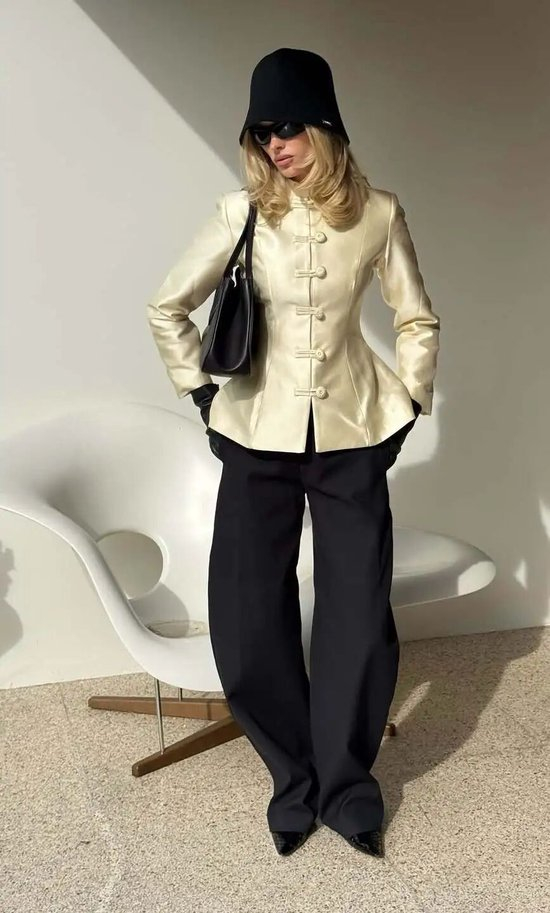
The Tang Jacket’s popularity rests on its versatility. Styling breakdowns cited from Harper’s Bazaar by CCTV note that the Tang Jacket abandons fussy ornament in favor of solid colors such as black and white, favors textured, draping silks and satins, keeps a modest standing collar that flatters most wearers, and cinches the waist to trace a soft line — “elegant or edgy, as you like.” The look of blogger Elsa Hosk — a white Chinese-style jacket over black wide-leg trousers with pointed-toe shoes — has been copied by many. Pairing with jeans is the most common look on social media; an all-white outfit with strappy sandals reads crisp and clean; a black-white-black “Oreo” combination echoes the blank-space aesthetics of Chinese art; sporty Pankou tops with jeans, or colorful Pankou tops with cropped wide-leg trousers, skew more rebellious. On accessories, pearl tassels, silver necklaces and knotted-rope handbags add Eastern flavor, while metal earrings and sunglasses mix in a modern edge without losing the jacket’s restraint.

Amid the hype, arguments over “cultural appropriation” have never stopped. China Daily reported on June 5 that Vanessa Li, a 26-year-old Chinese-Australian content creator, posted a video in January titled “My culture is not a trend,” which had drawn more than 71,000 likes by the time of reporting. She is unhappy that the style is now widely known in the West as the “Mandarin Jacket,” and believes many fashion brands sell the look without acknowledging its cultural source. For her, “there is a fine line between cultural appropriation and cultural appreciation.” She welcomes appreciation but opposes brands profiting without crediting the source or using its real name: “That’s not appreciation — that’s appropriation.” She urges people not to treat Neo-Chinese merely as a trend but as part of thousands of years of Chinese history, craft and cultural meaning, and she supports homegrown Chinese designers.
People’s Daily Online took the discussion to an institutional level on July 12, 2026, in an article titled “Cultural Tracing: A Step International Brands Cannot Skip”. Citing Mexico’s 2022 Federal Law on the Protection of the Cultural Heritage of Indigenous and Afro-Mexican Peoples and Communities, it noted that the law recognizes traditional expressions of indigenous and Afro-Mexican communities as cultural heritage with collective-rights attributes, requiring external parties to obtain community consent and establish fair cooperation mechanisms before commercial use. Zhang Qingren (张青仁), professor at Minzu University of China’s School of Ethnology and Sociology, argued that Mexico’s approach offers an important reference for balancing cultural-heritage protection with commercial use in a globalized context. The article also mentioned that in 2024, a WIPO diplomatic conference adopted a treaty requiring patent applicants to disclose the source of genetic resources and associated traditional knowledge for the first time at the multilateral level. Li Boxuan (李伯轩), associate professor at China University of Political Science and Law’s School of International Law, suggested extending the disclosure principle from patents to trademarks so that public cultural symbols cannot be claimed by any single party. The article concluded: “Peach and plum trees do not speak, yet culture deserves a name. Taking traditional cultural elements from abroad while ignoring their origins — not understanding their meaning, not respecting their source, and not giving back to local artisans — is nothing but cultural misuse or appropriation.”
The Market Behind the Moment: Neo-Chinese by the Numbers
The Tang Jacket’s global run is a snapshot of the broader Neo-Chinese consumer wave. Industry data show that Neo-Chinese womenswear on Tmall has grown more than 200 percent a year, far outpacing the overall womenswear market; according to the China National Garment Association, the Neo-Chinese clothing market will exceed 250 billion yuan in 2026, with the sector still growing at over 78 percent year on year, and more than 60 percent of demand concentrated in everyday settings such as commuting and leisure. Traditional elements — Pankou buttons, standing collars, the structural lines of the Mamianqun — are being reworked through modern design into items overseas shoppers chase, and the cost advantage of “Made in China” is upgrading into the cultural premium of “Created with Chinese elements.” Eastern aesthetics, once the object of the Western gaze, is now writing its own vocabulary — one collar, one button, one pleat at a time.