
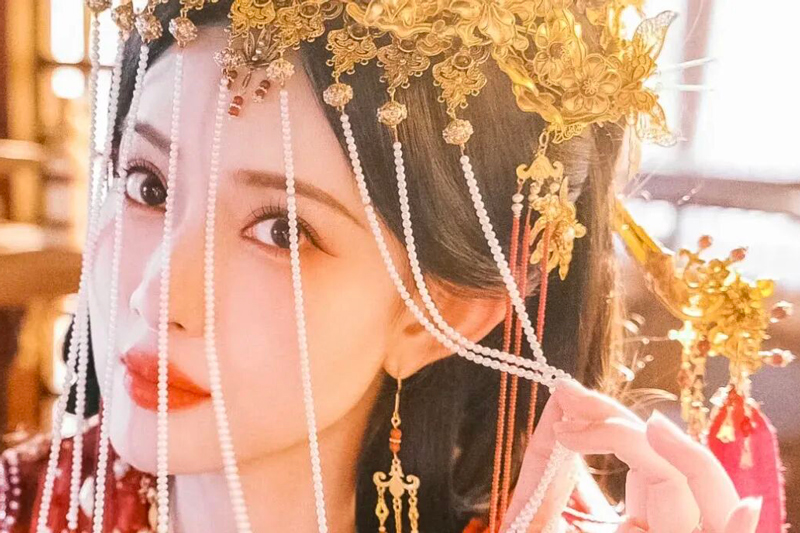
Meng Ziyi (孟子义) recently appeared in a bridal headpiece from the costume drama Blossoms of Power (百花杀) that has sparked considerable debate. The crown features an elaborate forehead veil of dangling tassels, leading many to question its historical accuracy and practical wearability. Did such a design truly exist in ancient China, or is it a modern invention for dramatic effect?
This article traces the origins of this controversial accessory through different dynasties, separating historical fact from theatrical fantasy while examining why contemporary productions remain obsessed with this particular aesthetic.
The Late Qing Anomaly
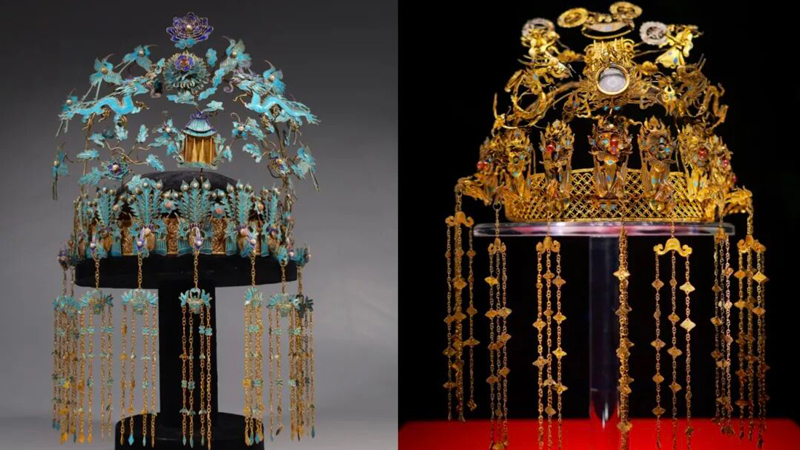
The physical prototype for Meng Ziyi’s crown is not a Tang or Ming dynasty relic as one might expect, but rather a civilian marriage crown from the mid-to-late Qing Dynasty (清朝). Numerous surviving examples of dragon-phoenix crowns from the late Qing period display identical features: multiple phoenix heads at the forehead releasing long tassels that often reached the chin or lower. These objects are preserved in institutions like the Dingzhou Museum (定州博物馆), where they testify to a specific moment in decorative history.
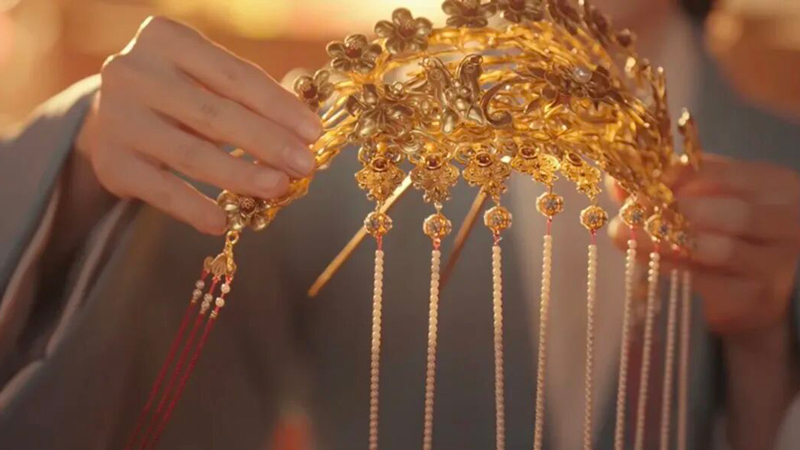
What makes these late Qing crowns distinctive is their hybrid nature. They are not the full, rounded crowns of orthodox tradition but half-crowns—structures that only cover the front portion of the head. This truncated form reveals their folk origin, as they were simplified versions of elite ceremonial headpieces, mass-produced for common brides who could not afford or access the intricate ritual regalia reserved for nobility. The tassels, however, were anything but simple, often arranged in dense rows that created a metallic curtain over the face.
This ornamentation represents an aesthetic departure from earlier dynasties. Scholars such as Yang Zhishui (扬之水), a noted researcher of material culture, have documented these pieces as examples of folk decorative excess, where the desire for grandeur led to the relentless addition of elements regardless of classical proportion. The so-called “face screen” is a symptom of this accumulation, a late Qing peculiarity rather than a timeless tradition.
Mistaken Identity Through Time
The confusion surrounding this crown arises from its superficial resemblance to ancient ceremonial forms. The most obvious parallel is the Liumian (旒冕), the tasseled crown worn by emperors during sacrificial rites. However, that headpiece served an entirely different function, its dangling beads designed to obscure the ruler’s expression and project an aura of divine inscrutability. Moreover, it was exclusively male attire, fundamentally unrelated to bridal fashion.
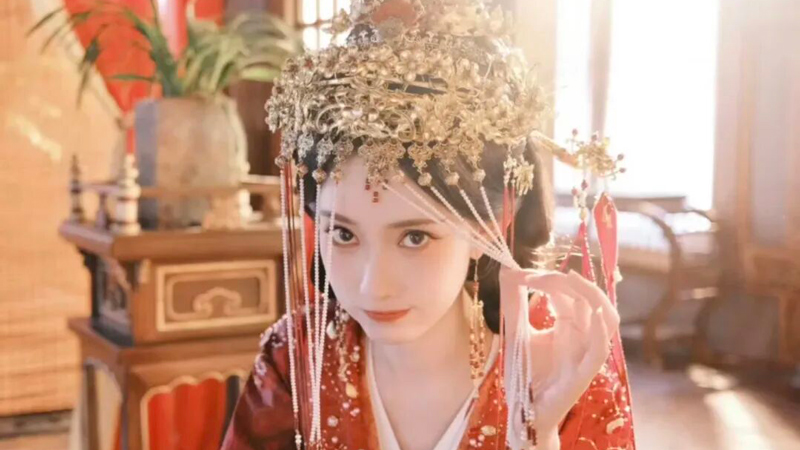
Earlier dynasties did feature front tassels on women’s ornaments, but these were modest in scale. During the Song Dynasty (宋朝), the “curtain comb” featured short pendants that barely dusted the forehead, serving as delicate embellishment rather than facial cover. The Ming Dynasty (明朝) continued this restrained approach with the “surrounding hairpin,” a jewelled piece whose tassels stopped above the eyebrows, preserving unobstructed vision. These designs prioritized harmony and proportion, values completely absent from the late Qing extravagance.
The orthodox Fengguan (凤冠), or phoenix crown, of the Ming and early-to-mid Qing periods rejected any form of full-face screening. These were complete, rounded structures with clean lines, sometimes adorned with lateral dangling ornaments called “picking tags,” but never with the oppressive frontal curtain seen in Meng Ziyi’s headpiece. This historical evidence clarifies that the modern version is not an authentic revival but a caricature of a marginal trend.
Reinventing Tradition for the Screen
The pervasive presence of these crowns in contemporary dramas is largely a consequence of practical staging. Costume departments rely on a convenient supply of late Qing antiques, which remain abundant in private collections and markets. Early television productions adopted them for efficiency, and the association was cemented when horror films exploited their eerie, shadow-casting quality. Consequently, the piece carries a built-in dramatic intensity that appeals to cinematographers and art directors.
Modern stylists often ignore dynastic chronology when applying this accessory, using it indiscriminately for bridal scenes set in the Tang, Song, or any other era. The result is a homogenized visual language where dramatic impact overrides historical credibility. The prolonged tassels, sometimes reaching far below the chin, amplify the emotional weight of wedding sequences while sacrificing authenticity for an intensified aesthetic effect that audiences increasingly read as “ancient.”
The practical function of the late Qing version offers another clue to its evolution. It served as a built-in bridal veil, replacing the traditional red head-covering that shielded the bride’s face. By elongating the tassels, commoners could achieve the same concealment without the separate cloth veil, merging ceremony with adornment. This utilitarian origin explains the extreme length and density, as the crown evolved to fulfil multiple roles within a simplified wedding ritual.
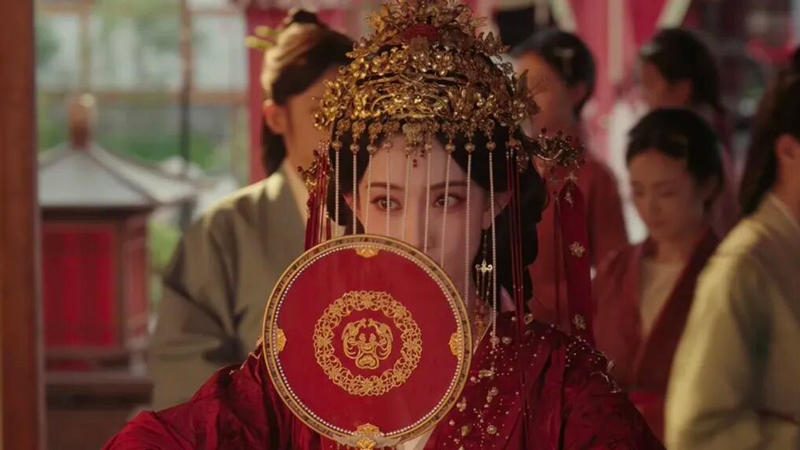
Ultimately, the crown’s unsettling impression stems from decades of cinematic conditioning. Its dense, metallic curtain creates a sensory experience of imprisonment, reflecting the physical constraints placed on women in later feudal society. While recent productions have embraced this design for its visual boldness, they perpetuate a myth of ancient tradition that distorts our understanding of China’s diverse material culture. The controversy surrounding Meng Ziyi’s costume reminds us that the past is not a single costume to be worn but a dialogue to be understood.