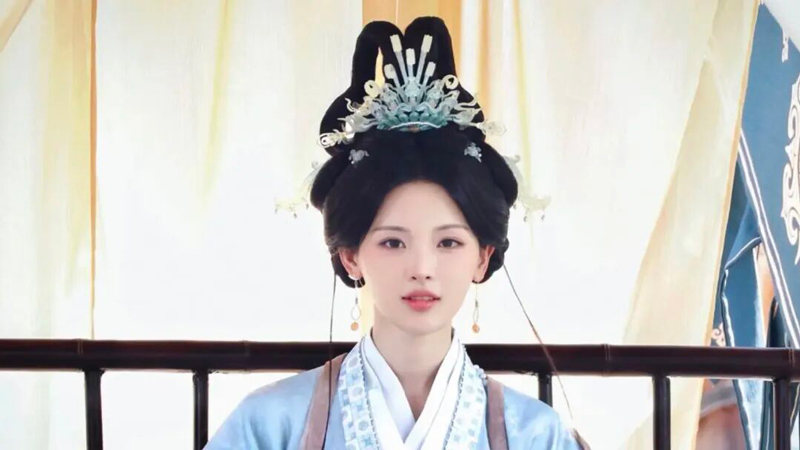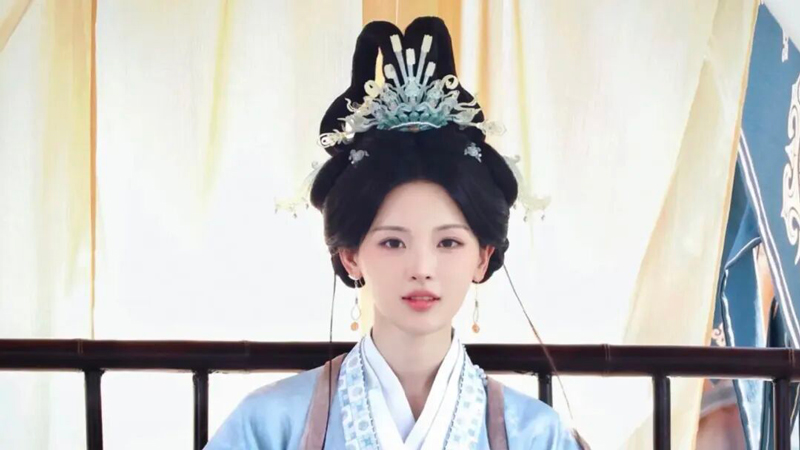
Is Yang Chaoyue (杨超越) finally stepping into her destiny as a historical drama heroine? The recent leaked set photos from the upcoming series Emei (峨眉) have certainly ignited that conversation. Dressed in a flowing Wei-Jin style Ruqun and sporting a Tang Dynasty Shuanghuan Wangxian Ji (双鬟望仙髻), her appearance is not just beautiful—it feels definitive. This isn’t the same ethereal look she’s worn before; it’s a striking blend of classical archaeology and modern aesthetic sensibility.
To understand why this particular styling resonates so deeply, we must look beyond the surface beauty. The secret lies in the rich history of her hairstyle, a narrative of rebellion and grace that spans a thousand years, and a hidden level of ancient engineering that defies gravity itself.
The Hairstyle: A Timeline of Transcendence
Many fans assumed it was a purely Wei-Jin style, but her classic butterfly-shaped loops actually represent a peak of evolution from the late Tang Dynasty. It’s known as the Shuanghuan Wangxian Ji, or the “Double-Ring Hairstyle for Gazing at Immortals.” Its earliest ancestor was the simple Shuanghuan Ji of the Wei-Jin period. However, the iconic shape we see today—with those wide, sweeping loops—didn’t truly emerge until after the High Tang era. It is a testament to how fashion evolves, blending the elegance of one era with the volume of another to create an enduring symbol of ethereal beauty.
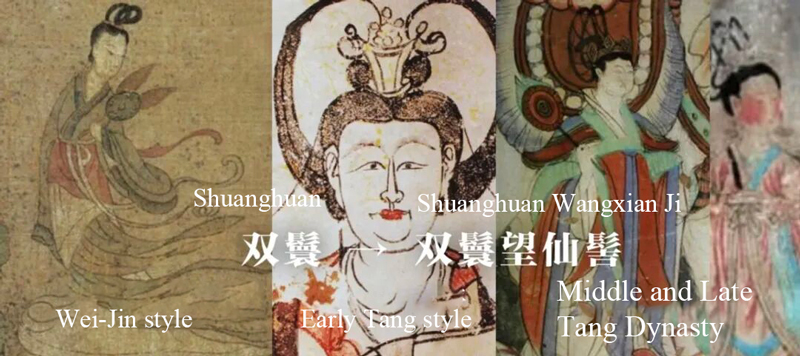
The visual journey is fascinating. During the Wei-Jin and Northern and Southern Dynasties, it was a narrow, high double-ring style, as seen in the art of that time. Moving into the Early Tang, the shape became fuller and rounder, sometimes as long as the face itself. It was a more straightforward, voluminous style. It wasn’t until the zenith of the Tang Empire that the outline began to shift. The rigid circles softened into the dynamic, butterfly-like loops. This final form, famously captured in Wu Daozi’s (吴道子) “Eighty-Seven Immortals,” gave a formerly static hairstyle a sense of movement and whimsy, cementing it as a classic standard for a heavenly being.
The Engineering: A Secret of Ancient Wigs
How did they achieve this gravity-defying look without spending all morning on it? The answer is surprisingly practical. The most common speculation, and the one that makes the most structural sense, is that the two distinctive loops were constructed using pre-styled wigs. These were not crafted with complex magic but with simple tools like gelatinized water and wire. These materials allowed the hairdresser to set the hair into a solid, fixed shape that could be used repeatedly.
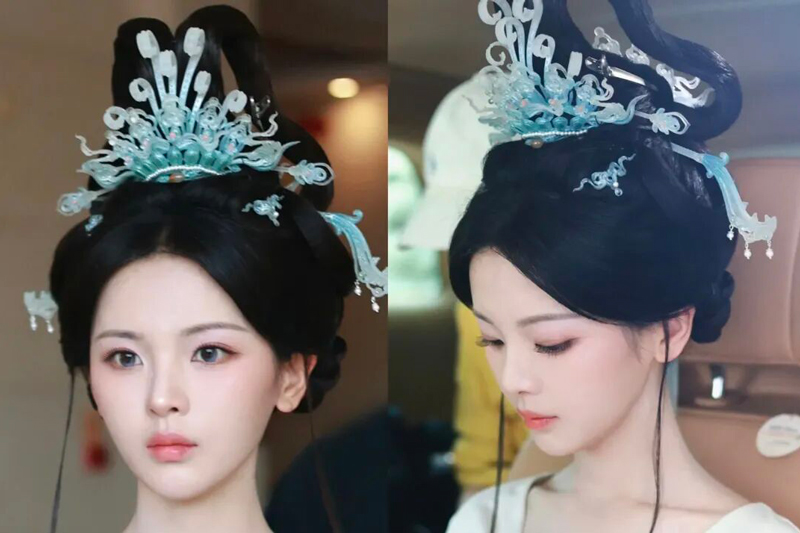
This ancient equivalent of a “clip-in” extension solves a major historical puzzle. The thought of a noblewoman spending hours on her hair every morning is a myth. In reality, they used these ready-made wigs, often called Ji (髻), to simplify the process. She would tie up her natural hair into a simple base bun, then place the pre-styled wig on top, securing it with a single ornate hairpin. This practical approach allowed for extreme versatility. It meant a lady could change her entire style as easily as she could change a piece of jewelry.
The Costume: A Blend of Ruqun and Feathers
Her costume in Emei, a Wei-Jin style Banxiu Ruqun (半袖襦裙), is equally significant. The “Banxiu,” or half-sleeve jacket, is a key component, creating a layered effect over the main garment. However, the genius is in the details. The hems of the sleeves and the skirt feature cascading ruffles. These aren’t just decorative; they are a direct reflection of the Wei-Jin era’s preference for elegant, flowing freedom. The natural, undulating curves of the ruffles harken back to a time when scholars and artists prized a transcendent, unbound spirit.
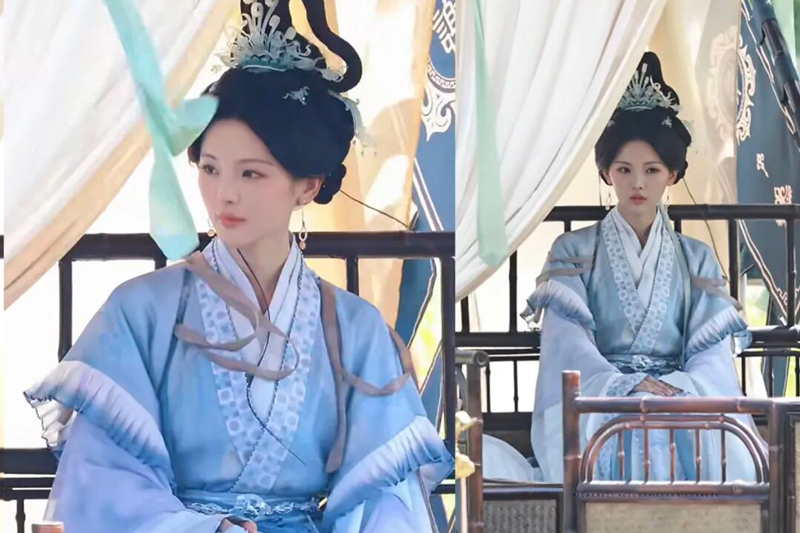
This specific design choice also hints at a forgotten cultural exchange. The layered, feather-like sleeves echo the decoration of the “Western Regions” brought via the Silk Road. They evoke the look of feathers, meant to flutter and move dynamically with the wearer. This borrowing of style wasn’t just about fashion; it was about capturing an ideal. Paired with the helmet-like Buyao (步摇) headpiece—a walking ornament with a tree-like structure that trembles with every step—the entire ensemble creates an aura of airy weightlessness. It’s a perfect synthesis of local tradition and foreign influence.