
Aoqun (袄裙) is the umbrella term for the traditional Chinese women’s ensemble of a jacket (ao, 袄) paired with a long skirt (qun, 裙). While the combination dates back to the Tang dynasty, in modern Hanfu revival contexts the term specifically refers to the Ming-dynasty style — a cross-collar, right-fastening jacket worn over the skirt, typically paired with a Mamianqun (马面裙, horseface pleated skirt). This makes Aoqun the most representative female garment system of Ming-style Hanfu. Below, we trace its historical arc, structural classifications, textile features, and contemporary revival.
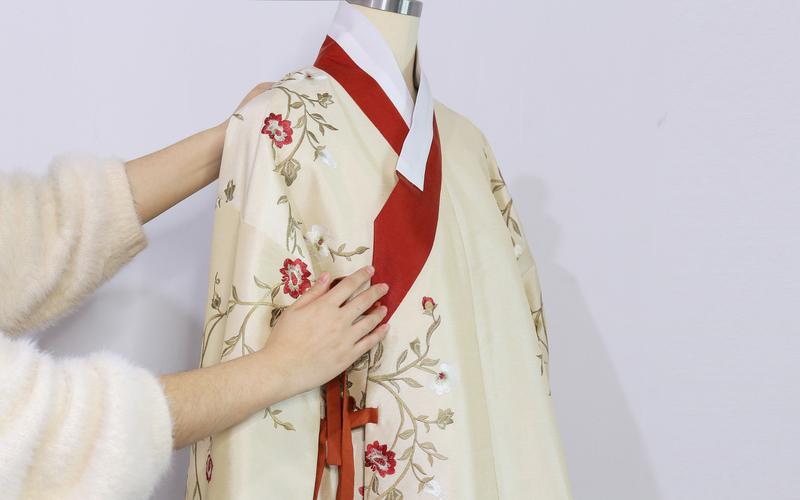
The Evolution of Ao and Skirt
The character “ao” (袄) refers to a lined upper garment. Written records of ao appear in Tang-dynasty clothing inventories, gradually replacing “ru” (襦) as the standard cold-weather daily wear. Across the Song, Ming, and Qing dynasties, ao garments generally retained a long-sleeved, through-cut construction with side slits — typically two side openings. Women’s ao, designed to pair with skirts, almost always carried these side slits.
By length, ao divides into two categories: short ao (短袄, duan’ao) and long ao (长袄, chang’ao), using the same knee-length threshold historically applied to ru. Jackets at or above the knee are short ao; those below are long ao. The Ming dynasty represents the golden age of Aoqun development. Ming-style women’s ao and shan (衫, unlined jacket) are highly distinctive: outer jackets typically feature pipa sleeves (琵琶袖, pipa-shaped sleeves with narrow cuffs), edged cuffs, a protective collar guard (护领, huling), and are paired below with either a Mamianqun or a standard pleated skirt. Women’s ao and shan came in both short and long lengths, with collar types spanning jiaoling (交领, cross-collar), shuling (竖领, standing collar), fangling (方领, square collar), and duijin (对襟, symmetrical front closure).
Many assume that the jacket-over-skirt in Hanfu terminology look existed only in the Ming period, but murals from the Song and pre-Song eras show this styling was already common. Whether the jacket tucks in or hangs out, the two-piece jacket-and-skirt silhouette remained a defining feature distinguishing Han Chinese women’s clothing from that of northern nomadic groups.

Seven Collar Types of Ming Aoqun
Ming-dynasty Aoqun can be classified into seven collar categories: jiaoling dajin (交领大襟, cross-collar with overlapping front), duijin jiaoling (对襟交领, symmetrical cross-collar), yuanling dajin (圆领大襟, round-collar with overlapping front), yuanling duijin (圆领对襟, round-collar symmetrical), shuling dajin (竖领大襟, standing-collar with overlapping front, also called standing-collar slant-front), shuling duijin (竖领对襟, standing-collar symmetrical), and fangling duijin (方领对襟, square-collar symmetrical). Below are the most representative types.
Zhiling (Cross-Collar Overlapping Front)
Predominantly worn in the mid-Ming period and in southern regions during the late Ming. The most famous surviving example is the white ao housed in the Confucius Mansion collection (孔府旧藏), a classic jiaoling dajin ao. The duijin jiaoling variant was popular in the early Ming, inheriting the Song tradition of wearing a symmetrical-front garment as an overlapping-front one.
Shuling (Standing Collar)
Also referred to as liling (立领) or slant-front standing collar, shuling dajin emerged in the mid-Ming as a development of zhiling dajin. Its adoption followed a top-down diffusion pattern — from the upper class to the lower. By the late Ming, the standing collar had replaced the cross-collar as the mainstream in northern China, while the south continued favoring zhiling. The symmetrical standing collar (shuling duijin) appeared concurrently during this period.
Yuanling (Round Collar) and Fangling (Square Collar)
Yuanling dajin evolved into the “厂-shaped placket” (厂字襟) during the Qing dynasty, though its earliest antecedents can be traced to the Northern and Southern dynasties (386–589 CE). Fangling duijin ao was confirmed through archaeological excavation: between 1956 and 1957, Chinese archaeologists working at the Dingling (定陵) — the Ming imperial tomb of the Wanli Emperor — unearthed a fangling ao, providing physical evidence of this collar type in Ming court attire.

Mamianqun: The Essential Skirt
The skirt half of Ming Aoqun centers on the Mamianqun. “Mamianqun” is a modern academic term. In Ming secular fiction such as Jin Ping Mei (金瓶梅), the same skirt was simply called “qun” (skirt); those with horizontal bands were called “lan qun” (襕裙, banded skirt), and those with vertical bands “yuanzhuan qun” (缘襈裙, bordered skirt). The formal adoption of “Mamianqun” as a costume-studies term came in the modern era — in 1999, Huang Nengfu (黄能馥) and Chen Juanjuan (陈娟娟) defined it in Chinese Costume Art Through the Dynasties (中华历代服饰艺术) as: “A skirt with a flat front panel, a flat back panel at the waist, pleats on both sides, and decorative motifs on the front and back panels. It has a waistband and ties.”
The Mamianqun structure comprises four skirt doors (front/back, inner/outer — four total), two skirt leaves (裙联, the fabric panels), pleated zones (裙胁), and a waistband. Ming-dynasty Mamianqun decoration featured a clear tiered band system: early-period skirts typically carried two bands — one at the knee (膝襕, knee band) and one at the hem (底襕, hem band). During the early-to-mid Ming, when short ao and short shan were fashionable, the knee band was wider than the hem band. In the late Ming, when long ao and long shan became popular, the proportions reversed — the hem band widened while the knee band narrowed.
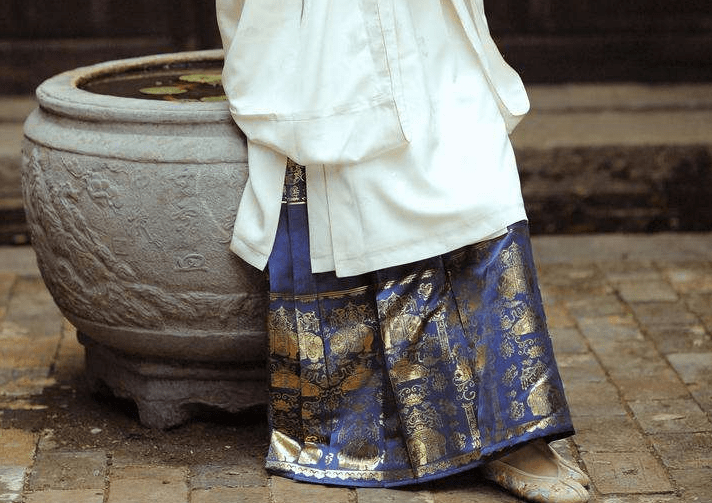
The Ming also had a special skirt exclusively for titled ladies — the yuanzhun qun (缘襈裙), featuring vertical decorative bands on both sides of the skirt doors and a horizontal band at the hem. Full pictorial documentation survives in the Illustrated Ritual Garments of the Eastern Palace (中东宫冠服图), and Dingling-excavated skirts include physical specimens of this type.
Ming Aoqun profoundly influenced the court attire of Joseon Korea and other neighboring peoples. Korea adapted Ming Aoqun into its own national style, evolving into the modern Korean hanbok‘s characteristic jeogori-chima silhouette. The garment spread also to the Ryukyu Kingdom, where it became part of local women’s dress.
During the Qing dynasty, Han Chinese women’s clothing broadly preserved this silhouette. By the Republican era (1912–1949), influenced by female students returning from studies in Japan, Aoqun styling grew more streamlined and form-fitting. The short-ao-with-long-skirt combination, valued for its understated elegance, became favored among young female students and was designated a “civilized new dress” — one of the era’s defining dress reform styles. After the 1920s, pleated variants such as the oblique skirt (斜裙), wrap-around skirt (绕膝裙), and hundred-pleat skirt gradually replaced the Mamianqun.
In the contemporary Hanfu revival movement, Aoqun stands as the core female garment of Ming-style Hanfu. Its defining features — the split upper-lower silhouette, pipa-sleeve cuffs, and Mamianqun’s decorative bands — balance historical gravitas with everyday elegance. Modern consumers selecting Aoqun can make informed choices along three dimensions: collar type (jiaoling vs. standing collar), sleeve style (pipa sleeve, straight sleeve, or arrow sleeve), and skirt band distribution (knee band vs. hem band), ensuring that their purchase aligns with authentic historical prototypes.