
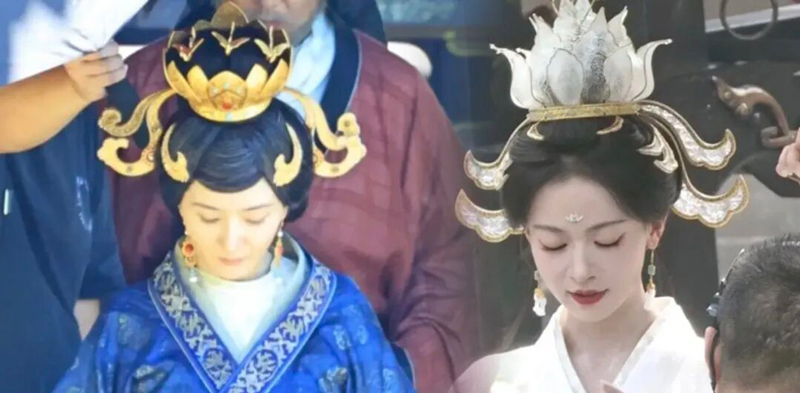
Empress Dowager Feng (冯) of the Northern Wei (北魏) never set foot in Luoyang (洛阳). She died in 490 AD in the ancient capital of Pingcheng (平城), yet the lotus crown she wears in the new television series Jiangshan Datong (江山大同) has sparked a fierce debate among costume drama fans. Is it historically accurate? And why does it look so different from the one worn by actress Wu Jinyan (吴谨言) in the drama Feng Bu Qi (凤不栖)?
To understand the answer is to unlock a hidden chapter of cultural transformation, where a queen’s faith and a dynasty’s political survival merged into a single, stunning piece of jewelry.
Origin: A Native Invention
Many viewers automatically assume the lotus crown was imported from ancient India or the Western Regions along with Buddhism. This is a common misconception. In the early Yungang Grottoes (云冈石窟) during the Pingcheng period, bodhisattvas wear triangular or disc-shaped crowns with scattered lotus petals as mere secondary decorations. These were essentially the three-sided crowns of Central Asian origin, with the lotus serving only as an auxiliary motif—a far cry from the full blossom we recognize today.
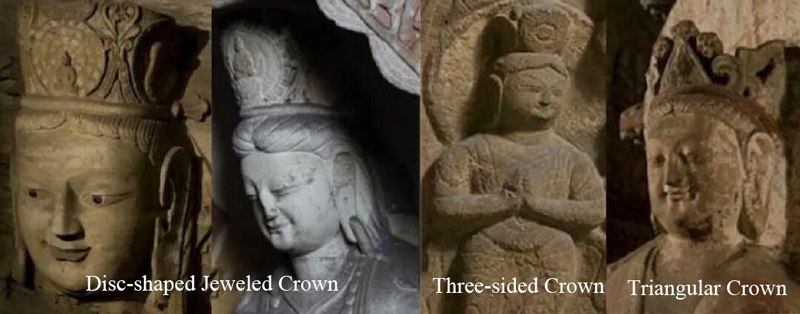
It was precisely during the Taihe (太和) era, when Empress Dowager Feng (冯) ruled as regent for the second time, that the lotus crown truly took shape. A devout Buddhist, she commissioned numerous temples and grottoes in Pingcheng, skillfully using the religion as a political tool to stabilize the court and ease tensions between the nomadic Xianbei (鲜卑) and the Han Chinese. The lotus, symbolizing purity and spiritual transcendence, was thus woven into the aristocratic ceremonial system. This was a uniquely Northern Wei cultural creation; as scholar Yang Zhishui (扬之水) notes in her essay on the subject, neither Indian nor Central Asian Buddhist traditions have any such secular headwear for women.
Two Eras, Two Silhouettes
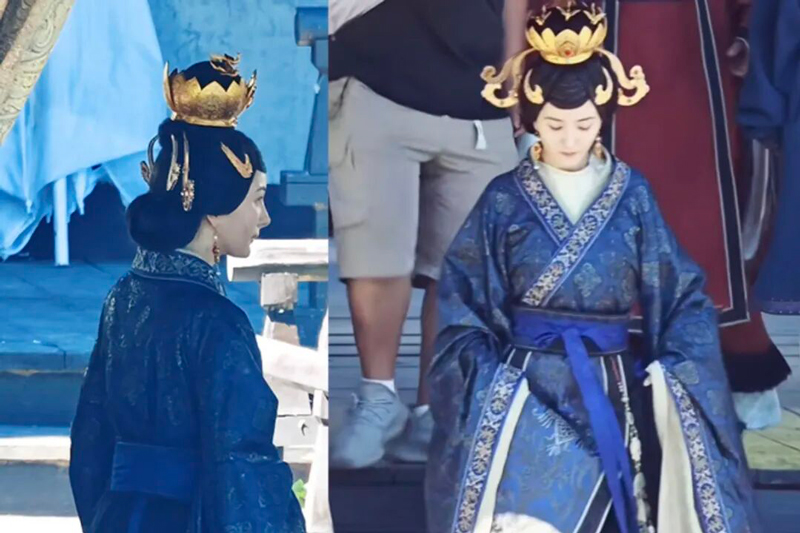
The crowns worn by Yang Mi and Wu Jinyan represent two distinct evolutionary stages. Yang Mi’s crown in Jiangshan Datong reflects the transitional form of the Pingcheng period. Its lotus petals are slender and elongated, favoring a single layer that aligns with the era’s aesthetic of “clear bones and gaunt images”. The gold work is heavier, with inlaid agate and gold leaf, and long pendant ribbons hang from the sides. This style is a tangible blend of Xianbei love for heavy metalwork and the Buddhist ceremonial system that was becoming dominant.
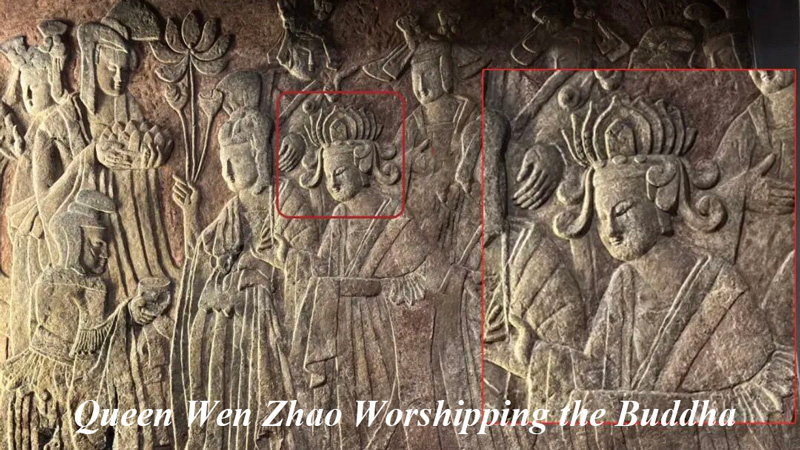
In stark contrast, Wu Jinyan’s crown in Feng Bu Qi, which is set later, represents the mature style that developed after the capital was moved to Luoyang in 494 AD. This second-phase crown is fuller, with more layers of petals, appearing more expansive and lighter. It is a direct descendant of the full-blown lotus crowns seen in the famous Queen Wen Zhao Worshipping the Buddha (文昭皇后礼佛图) relief sculpture at the Longmen Grottoes (龙门石窟). The difference is not just stylistic; it is a visual marker of time, distinguishing the heavy, hybrid aesthetic of the steppe frontier from the more refined, sinicized elegance of the new southern capital.
Faith, Politics, and Distinction
The rapid adoption of the lotus crown among the upper classes was a top-down phenomenon driven by the sinicization reforms of 484 AD. Prior to this, noblewomen typically wore traditional Xianbei gold step-shakes and pearl-topped caps. The new regulations were clear: a woman wore her traditional Xianbei gold crown for banquets and court, but had to change into the lotus crown specifically for Buddhist ceremonies. It became an iconic distinction between secular life and sacred ritual, a symbol of respect for the faith that was quickly emulated by empresses, princesses, and the wives of high officials.
Its political significance cannot be overstated. The lotus, pure and rising from the mud, symbolized the noblewoman’s adherence to precepts, but it also served the rulers’ purpose of educating the populace and dissolving ethnic barriers. By the time the capital moved to Luoyang, the lotus crown had become ubiquitous. Reliefs from Longmen and the Gongyi Grottoes (巩义石窟) depict women from the empress’s retinue to the families of ordinary officials all wearing it, marking its transition from royal ornament to standard ceremonial headwear.
This also clarifies a common point of confusion regarding Taoist headwear. During the Northern Wei period, the distinction was clear and absolute. Taoism of that time only used lotus motifs as simple hairpin decorations; the fully formed lotus crown belonged exclusively to Buddhist ritual. It was not until the Sui and Tang dynasties that Taoism fully adapted this form, renaming it the “Hibiscus Crown” for use by high-ranking clergy—a completely separate lineage.