

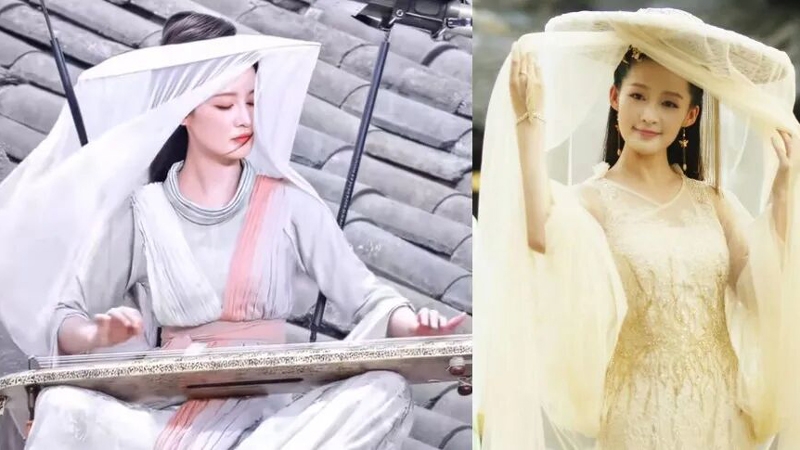
Li Qin (李沁) wears a wide-brimmed white veil hat in her new drama Xian Yu Fei Sheng (咸鱼飞升). It’s a look that immediately sent viewers back in time. They call it a flashback. They say it recalls her role as Princess Yuan Chun (元淳) in Princess Agents (楚乔传). In that historical epic, she wore a strikingly similar headpiece. So, what is this hat? Did the costume designers just make it up? Or did they pull it from the pages of history?
The truth lies in the past. The production teams for both dramas based their designs on the Weimao (帷帽), a “veiled hat” from the Tang Dynasty. The actual historical accessory was made of woven rattan, bamboo strips, or felt. It was then covered with silk and had a long gauze veil hanging from the brim. But in the dramas, the shape and veil length are modified for visual effect. This creative choice blends history with artistry. It turns an ancient garment into a visual trigger for the audience. It’s a testament to how period dramas can popularize historical trivia.
Evolution of a Veil
To understand the hat, we have to look at its grandmother: the Mili (幂篱). This was the Northern and Southern Dynasties’ version. It was also a wide-brimmed hat. But its gauze veil hung all the way down to the wearer’s feet. It covered the entire body. It was a mobile fortress of fabric, hiding the wearer completely. No one could see her face. It was practical for travel but incredibly restrictive.
In the early Tang Dynasty, women still wore the Mili. But as society became more open during the reign of Emperor Gaozong (高宗), things changed. People found the full-length veil to be cumbersome. It was a hassle. So, they shortened it. The veil was cut to just cover the neck and shoulders. This more convenient version was named the Weimao. It was a sign of the times. It showed women wanted more freedom. They wanted to see the world, and be seen, just a little bit.
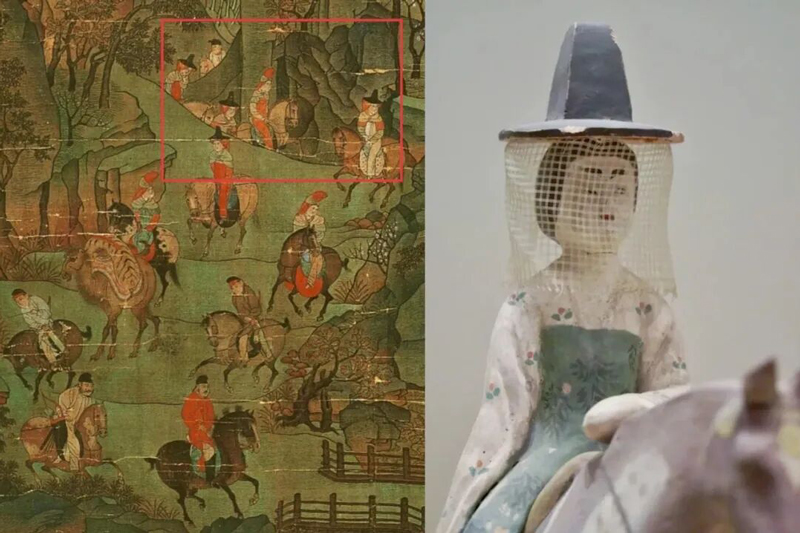
This shift wasn’t just about fashion. It was a social statement. According to the Old Book of Tang (旧唐书), after the Yonghui period, it was common to see women in Weimao. Emperor Gaozong even wrote a decree, the “Edict Prohibiting the Weimao,” to stop it. He thought it was improper. But his words fell on deaf ears. The women, both in the palace and among the commoners, loved it. It became the standard attire for women going out. We can see its popularity in Tang paintings and pottery figurines. The look was here to stay.
A Symbol of Status and Freedom
By the High Tang period, under Emperor Xuanzong (玄宗), society was even more liberal. Many women simply ditched the veil entirely. They wore “barbarian” hats without any covering at all. But the Weimao didn’t vanish. It was made lighter. It remained a top choice for women. Its influence lasted for centuries. Later veiled headwear, like the Song Dynasty’s “Gaitou” (盖头), was a direct descendant of it.

So why did the Weimao win the popularity contest over its predecessor?
First, it was just easier to wear. The Mili was a walking cage. It hampered movement. But the Weimao was breezy. It let you walk, ride a horse, or run errands without the fabric tangling around your legs. It protected you from dust and sun without becoming a nuisance.
Second, it was a perfect match for the times. Ancient women were expected to be discreet. They couldn’t just show their faces. But the Tang Dynasty was an era of prosperity and openness. Women were going to temples and riding horses in public more often. They didn’t want to be shrouded in mystery anymore. The Weimao was the perfect compromise. It showed they were respectable, but also active.

Finally, it was a status symbol. The Weimao started with the imperial court and noble families. They used fine materials and elegant designs. Wearing one was a mark of class. Then, it trickled down. Common women imitated the style. Milliners created different versions for everyone, from the wealthy matriarch to the average girl. It became the universal headwear for all classes. Its evolution tells a story of a society opening up. It’s a story of practicality winning out, all hidden behind a simple piece of gauze.