
On July 15, 2026, Kangping County in Shenyang hosted “Qipao Elegance, Ten Years of Beauty” — the Kangping edition of the 2026 Shenyang Qipao Culture Season. Twenty-two qipao performance teams from Tieling Changtu, Diaobingshan, Faku, and Kangping gathered on Liaoning Street for a joint showcase that brought together performers from four cities across the northern Liaoning region.
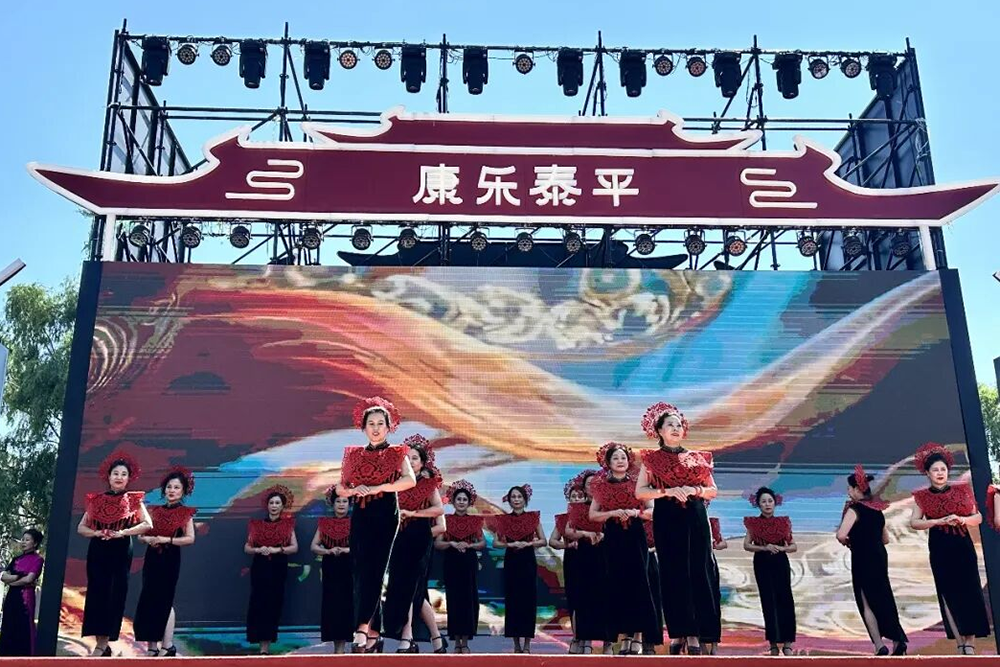
The event opened with a measured qipao parade: participants in elegant traditional qipao walked in synchronized formation along the street, their posture and pace reflecting the formal qipao performance style that emphasizes restrained hand placement, small steps, and vertical spine alignment. Immediately after the parade, the same performers switched costumes and launched a fashion flash mob segment — modern athletic clothing, pop music, energetic group choreography — creating a visual contrast that highlighted how qipao culture can bridge traditional grace and contemporary vitality within a single event format.
The inclusion of teams from Tieling — a neighboring prefecture-level city — marks this event as a cross-regional cultural exchange rather than a local showcase. Liu Yajie, captain of the Diaobingshan Sister Flower Qipao Team, emphasized the social dimension: participation offers both artistic enrichment and physical wellness, while observing other teams’ performances provides learning opportunities. Zhao Yuhua, leader of Kangping’s Jixing Model Art Group, framed the event as a platform for regional cultural networking — using qipao as the shared language through which neighboring counties can build mutual understanding and collaborative programming.
Shenyang Qipao Season: A City-Wide Campaign
Kangping’s showcase is part of the broader 2026 Shenyang Qipao Culture Season, which has already staged events at Jiuwu Cultural City on July 3 with Manchu embroidery displays, qipao fashion shows, and ICH market integration. The season operates across multiple Shenyang districts — Heping, Kangping, and others — each contributing distinct programming that reflects local cultural resources. Kangping’s Liaoning Street venue, a recently developed cultural tourism corridor, gives the qipao season a downtown pedestrian-friendly setting that encourages walk-in attendance rather than ticketed, auditorium-bound audiences.

The “ten years” reference in the event title underscores Kangping’s sustained commitment to qipao cultural programming. Over a decade, the county has built a local qipao community from informal hobby groups into organized performance teams capable of staging synchronized street parades and participating in inter-city exchanges. This long-term development model — slow, community-driven, institutionally supported — offers a contrast to splashy one-off fashion weeks, demonstrating how qipao culture can become embedded in ordinary county-level social life rather than remaining confined to elite urban venues.
Qipao’s Grassroots Growth
Kangping’s ten-year trajectory illustrates a pattern that may be replicable across smaller Chinese cities: local women’s organizations, cultural bureaus, and tourism departments collaborating gradually to build qipao programming that serves both community wellness and heritage preservation. The cross-regional dimension adds a networking effect — each county’s qipao community gains exposure to different performance styles and organizational methods, accelerating learning while maintaining local distinctiveness. For qipao culture nationally, these grassroots events may matter more than high-profile runway shows, because they are where ordinary women actually learn, practice, and sustain the craft of wearing qipao with skill and confidence.