
In July 2026, the Yuanmingyuan (Old Summer Palace) Heritage Park launched a cultural event series titled “A Brocade Rendezvous,” weaving together Qing dynasty art, Songjin craftsmanship, and hands-on heritage workshops. Twelve performers dressed as the women depicted in the famous “Twelve Beauties of Emperor Yongzheng” scroll painting walked along the lotus pond, each carrying Songjin tuan shan (round fans) and accessories patterned after actual ceramic tile motifs excavated from the Yuanmingyuan site.
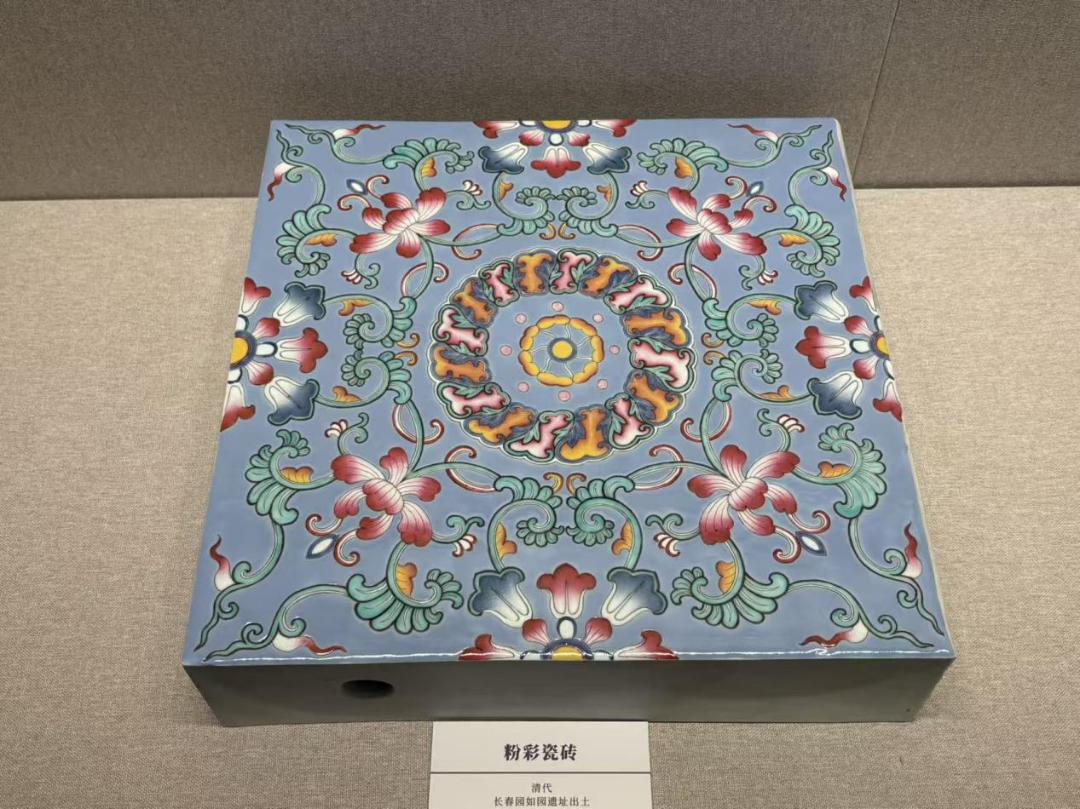
The event’s core innovation lies in its material sourcing. Designers digitally extracted floral patterns from two artifact groups: pink-glazed porcelain tiles recovered from the Ruyuan (Like Garden) ruins within Yuanmingyuan, and Western lotus patterns carved into the Western Mansions’ stone architecture. These patterns — originally rendered in ceramic glaze and stone relief — were then translated into Songjin weaving diagrams, preserving the curves and proportions of the 18th-century originals while adapting them for silk thread execution.
Songjin Production Method: Machine-Woven Base, Hand-Finished Detail
The resulting Songjin fabrics use a hybrid production model the organizers describe as “machine-woven skeleton, hand-finished soul.” Pattern design and jacquard card programming are completed manually by Songjin artisans, while the base weaving is machine-set for consistency. Final detail adjustments — color shifts at pattern boundaries, thread tension tuning for three-dimensional texture — are executed by hand. This approach maintains Songjin’s characteristic interlocking warp-and-weft color display while scaling production enough to support a full range of accessories, fans, and decorative items for retail sale.

Visitors can participate in three workshop formats: making a Songjin brooch by folding and stitching small fabric panels, creating a mother-of-pearl lotus incense holder inspired by the tile patterns, and crafting a Songjin butterfly ornament using the traditional folding-and-pressing technique. Each workshop is designed for completion within 30–45 minutes, making them accessible to casual park visitors rather than committed craft students. The workshops deliberately avoid requiring specialized tools or prior weaving knowledge — the goal is mass accessibility, not artisan training.
The event also produces a line of Songjin textile products that embed Yuanmingyuan archaeological patterns directly into wearable and portable formats. Items include fans, bag accessories, decorative panels, and wearable brooches — all featuring the same digitally-extracted patterns used in the live performance. The merchandise strategy positions Songjin not as a museum exhibit but as a daily-use material: something visitors can carry home, attach to a bag, or wear on a jacket, keeping the Qing-era pattern in physical contact with contemporary life rather than sealed behind glass.
Songjin — literally “Song dynasty brocade” — has struggled with market visibility despite its national ICH designation. Unlike Yunjin (Nanjing brocade), which benefits from imperial palace associations, or Shujin (Sichuan brocade), which links to regional fashion brands, Songjin lacks a single compelling cultural anchor. By tying Songjin directly to Yuanmingyuan — one of China’s most emotionally resonant heritage sites — the event gives Songjin a narrative context that connects imperial art, archaeological recovery, and contemporary design in a single story arc. The approach may prove replicable for other heritage textiles that need stronger cultural branding to reach consumer audiences.