
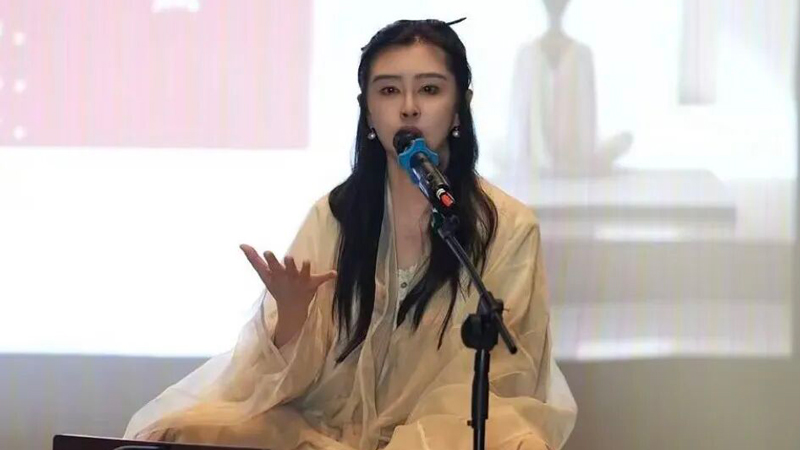
After 22 years away from the spotlight, Joey Wong (王祖贤) stepped back into public view at a recent event in Canada. At 59, she did not appear in the glamorous gowns typical of modern celebrity culture. Instead, she wore a translucent, flowing gauze shirt over a simple inner layer. The look was so ethereal that the internet immediately erupted, with many commenting that she looked like she had stepped straight out of a fantasy epic. But the outfit was not a costume designer’s fancy. Its roots lay in the everyday fashion of the Northern Song Dynasty, a period known for its refined and understated aesthetic. With a single, simple garment, Wong evoked a millennium of cultural memory, proving that true style is indeed timeless.
The Ghost Who Became a Legend
When people saw Wong in that flowing shirt, they did not just see a 59-year-old woman; they saw A Chinese Ghost Story (倩女幽魂). Her portrayal of Nie Xiaoqian (聂小倩) in the late 1980s was a cultural earthquake. She was the ghost who craved innocent love, a spirit trapped in a world of demons who radiated more purity than any mortal. Her eyes held a mesmerizing mix of seduction and sincerity. She was the embodiment of the poet Pu Songling’s (蒲松龄) famous line: “There is no such beauty in the human world; she must be a ghost or a fox.” She was not just playing a role; she was creating an archetype.

Following that iconic performance, she continued to build a legacy with roles in films like Green Snake (青蛇) and The East Is Red (东方不败), becoming the defining beauty of her generation. But just as she reached the pinnacle of her fame, she vanished. She moved to Canada to live a quiet life, far from the flashing lights. The writer Han Songluo (韩松落) once lamented, “Across the land, generations of stars are born. But in this world, there will never be another Xiaoqian.” For decades, she remained a memory, a perfect image frozen in time.
Now, approaching 60, she has reappeared, not as a star chasing relevance, but as a woman owning her age. The internet, of course, is full of critique—the inevitable judgment of an aging beauty. But her presence speaks to a deeper truth: she gave her best years to the screen, and the remaining time is hers to live authentically. Her appearance now is not about defiance but about acceptance. She looks like a person who has found peace, and that, perhaps, is the most beautiful thing of all.
A Shirt Woven from History
The shirt Wong wore is not a modern invention. It is a direct descendant of artifacts discovered in tombs and depicted in ancient murals. Her particular style—a long, airy robe with wide sleeves that fall to around 160 centimeters in length—matches the specifications of garments from the Song Dynasty, like those found in the Iron Crutch Song Tomb in Anhui province. In historical paintings, like those at the Kaihua Temple (开化寺) in Shanxi, women are often seen wearing these nearly transparent outer robes over a short jacket and a long skirt, known as a Baidie Skirt (百迭裙). Wong’s modern styling was just a variation on an ancient theme.

This style isn’t just about form; it’s also about function. Ancient people were not just romantics; they were practical. These shirts were made from a specific type of fabric called Luo (罗) or Sha (纱)—a type of gossamer silk woven with a delicate open grid. The technique creates a fabric that is both sheer and structured, providing a mysterious, hazy coverage. It was the perfect garment for the hot summer months, allowing air to flow freely while adding a tasteful layer of modesty and elegance. The Song people understood something about summer wear that we often forget: less is sometimes more.
If you want a modern analogy, consider Lu You’s (陆游) account from his Notes of the Laoxue Studio (老学庵笔记), where he writes about a fine gauze: “Lift it and it feels like nothing; cut it and it looks like smoke.” This is the fabric Wong was wearing. It is light, almost weightless, and possesses an inherent ‘bones’ that prevents it from sagging. The transparent weave creates a dreamlike visual, a blend of the ethereal and the grounded. It’s a material that invites the imagination.
The Art of Effortless Style
One of the most beautiful takeaways from Wong’s appearance is the relevance of this thousand-year-old garment in our contemporary world. Her look was not a stiff, museum-piece reconstruction. It was a practical, modern outfit: a simple long camisole layered under the open, flowing gauze shirt. This is the same structure seen in the Song Dynasty murals, proving that a good outfit formula never goes out of style. It offers the perfect solution to the dilemma of wearing traditional Hanfu: you do not need to wear the entire set. One piece can elevate a daily look without feeling like a costume.
For anyone inspired to try this style, the advice from historical styling is clear: keep it simple. The beauty of this garment lies in its material and shape, not in elaborate embellishments. Avoid loud prints or heavy embroidery. The most authentic choices are solid colors with subtle, tonal woven patterns. Think of colors like moon-white, light apricot, or a hazy grey, the Song Dynasty’s equivalent of a modern neutral palette. These low-saturation shades are incredibly versatile and exude a quiet sophistication that loud colors simply cannot match.

However, caution is needed when sourcing these pieces. The market is flooded with cheap synthetic meshes that are not only uncomfortable and irritating to the skin but also have a harsh, shiny finish that completely lacks the garment’s inherent grace. High-quality fabrics like silk organza or a silk-blend crepe are essential. Furthermore, a practical adjustment is to shorten the hem to just below the knee. This simple change prevents the long fabric from trailing on the ground or overwhelming a shorter frame, making it perfect for walking, commuting, and even surviving a chilly office air conditioner. It proves the Song people were not just artists; they were practical geniuses.