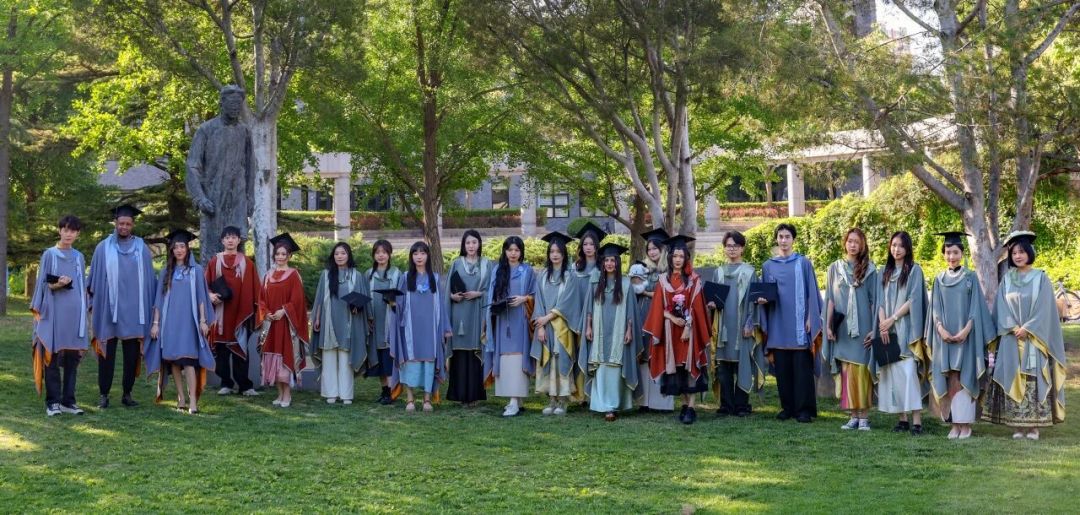
On June 24, 2026, the Central Academy of Fine Arts (CAFA) held its graduation ceremony — and the gowns stole the show. Graduates wore modified shenyi robes (深衣) with auspicious cloud shoulder capes (云肩) replacing the Western triangular hood, while the square academic cap was reimagined as a Ming-dynasty sifang pingding jin (四方平定巾), a headpiece symbolizing scholarly achievement and stability. Four days later, on June 29, the Jiangnan Times published a full-page editorial titled “Wen Mai Zai Shen, Feng Gu Zi Cheng” (文脉在身,风骨自成 — “Culture in Your Attire, Character Forged Within”), syndicated by The Paper, arguing that China’s 32-year-old Western-style academic dress system is overdue for reform.

Three Universities, Three Approaches
The article highlights three leading universities that have developed distinct Chinese-style degree gowns, each rooted in their institutional identity.
Beijing Normal University (BNU) adopted a modified straight-cut Chinese robe, using three traditional colors to distinguish degree levels: jinyu qing (瑾瑜青, a deep jade-green) for bachelor’s, youzi (油紫, an oil-purple) for master’s, and shunsheng hong (顺圣红, a ceremonial red) for doctoral degrees — symbolizing “uncut jade becoming refined,” “deep scholarly cultivation,” and “the fruition of learning.” The collar replicates the window-lattice pattern of the original Imperial University of Peking (京师大学堂) building, and the cuffs are embroidered with calligraphy from the century-old institution’s plaques.
Beijing University of Chinese Medicine (BUCM) chose a Chinese standing collar with a single-line pankou knot button, reflecting the medical principle of zhongzheng pinghe (中正平和, balance and harmony). The graduation cap tassel was redesigned as a gourd-shaped ornament (葫芦穗), referencing the traditional symbol of the wandering physician — xuanhu jishi (悬壶济世, “hanging a gourd to heal the world”).
Central Academy of Fine Arts (CAFA) traced its design to the pre-Qin shenyi deep-robe form, substituting the Western hood with a yunjian cloud shoulder cape. The mortarboard cap was replaced with the Ming-era sifang pingding jin, conveying the wish that graduates achieve “academic success and bring stability to all directions.” CAFA’s signature gray serves as the base color, with three distinct cloud-cape colors marking degree levels.

A 32-Year Monopoly Under Scrutiny
China’s current academic dress system was standardized in 1994 and derives directly from medieval European clerical robes. The tassel, hood, and gown carry explicit Western religious and academic symbolism, with no reference to China’s millennia-old scholarly tradition. Every year, over ten million Chinese graduates wear these Western robes for their most significant academic rite of passage — a fact the Jiangnan Times editorial calls a missed opportunity for cultural education at scale.
The article does not call for abolishing Western academic dress but proposes a dual-track system: retain Western-style gowns as an option while promoting the three universities’ Chinese designs as fully accredited alternatives. This mirrors the approach taken at APEC summits — in 2001 and 2014, China dressed world leaders in tailored new Chinese formalwear (新中装) featuring Song brocade and ocean-and-cliff motifs, proving that Chinese formal attire holds its own on the world’s biggest diplomatic stages.
Author Guan Yunlin concludes: “Let robes carry our cultural lineage, let garments transmit our national spirit — so that every formal ceremony and every dignified appearance becomes a living practice of Chinese cultural confidence.”