
The 10th Textile Intangible Cultural Heritage Conference concluded on June 25 in Dalang (大朗), Dongguan (东莞), bringing together heritage artisans, industry leaders, and scholars under the theme “ICH Coexistence · Weaving the Future.” Co-hosted by the China National Textile and Apparel Council (CNTAC) and the Dalang Town Government, the two-day event was designated a key activity of the 2026 Consumer Brands National Tour and set a new benchmark for weaving intangible heritage into modern knitwear manufacturing.

Three Global Events Merge for the First Time
This year’s conference shared the stage with the 23rd China (Dalang) Knitwear Trade Fair and the 95th International Wool Textile Conference — the first time these three major industry gatherings have run concurrently. The twin themes “Smart Weaving the Future — Wool, Health and Digital Life” and “Weaving Aesthetics · Intelligence Leading Fashion” guided a programme of keynote speeches, expert forums, fashion showcases, and business matchmaking that drew more than 30,000 visitors and buyers from around the world.
Dongguan’s textile and garment sector is one of the city’s deepest manufacturing roots. Dalang, recognised as the nation’s first “China Wool Sweater Town,” produces roughly 900 million sweaters annually — meaning one in every five sweaters sold globally comes from Dalang. In 2025 the full supply-chain transaction volume surpassed 72 billion yuan, supported by some 30,000 knitwear business entities and over 200,000 workers across the chain.
The centrepiece of the conference was the “ICH Coexistence · Weaving the Future” heritage fashion show, staged at the opening ceremony. Fashion designer Wang Dong (王冬) collaborated with multiple leading Dalang-based enterprises and master artisan Wan Gongxue (万贡学) — a “Mountain Flower Award” recipient and ICH inheritor — to create 36 original knitwear outfits. The designs drew on the Qilin (麒麟) motif, a signature Lingnan heritage symbol, rendered in two thematic palettes: “Qilin Blue” and “Auspicious Red.” Three runway chapters — “Morning Life,” “Urban Commute,” and “Evening Gala” — paired Qilin-inspired handcrafted headpieces with three-dimensional knit accessories, translating centuries-old iconography into contemporary wearable style.

Immersive ICH Exhibition Spaces
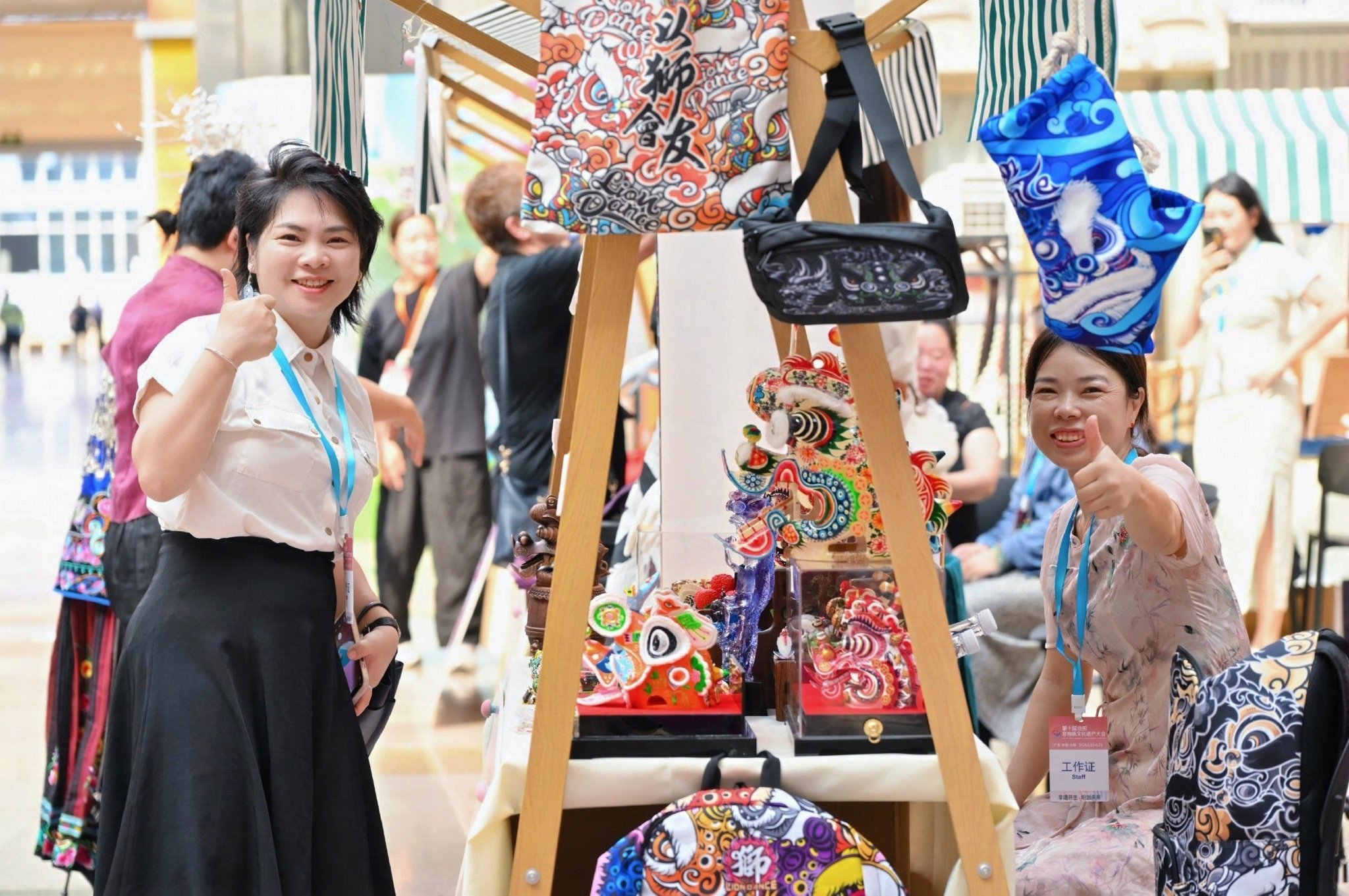
Ten dedicated textile ICH display projects turned the venue into an immersive cultural experience. In the “Weave · Core” zone, a high-precision robotic arm from local firm Bolante (伯朗特) performed alongside a knitwear lion-head sculpture, while a 3D vision-guided voice-interactive claw machine let visitors experience the “AI + ICH” concept through play. The “Weave · Soul” zone featured a “Seven-Colour Auspicious Cloud Dragon” assembled from Dongguan dragon-dance frames and Dalang yarn patchwork, illustrating the symbiosis of local folklore and industrial craft.
Delegates also visited the Caibian Fudetang (蔡边福德堂) for hands-on heritage workshops, experiencing Dalang’s Qilin and lion-dance traditions up close — confirming that intangible heritage is no longer a glass-case exhibit but a tangible, participatory encounter.
Two major outcomes were released during the conference. The 2025/2026 China Textile ICH Development Report reviewed the year’s core achievements and traced the conference’s decade-long journey since its founding in 2017. Meanwhile, the “ICH · Source Creation — China ICH Youth Design Support Project” was officially launched, partnering with Beijing Fashion Week to give emerging designers and heritage inheritors a professional showcase platform.
Five heavyweight signings were completed on stage, spanning ICH standard co-development, industry-innovation integration, quality-system upgrading, brand supply-demand coordination, and carrier-investment entry. Among them, the “Textile ICH Standards and Certification Cooperation” agreement — signed by Hua Shan (华珊), director of CNTAC’s ICH Office, and Zhu Guoquan (朱国权), general manager of China United Quality Inspection (Beijing) Technology Group’s Dongguan branch — marked the first authoritative industry standard framework for textile ICH protection, a prerequisite for heritage products to enter global markets.
Salon Dialogues Bridge Tradition and Commerce
The closing “2026 CNTAC ICH · Dalang Salon” split into two panels: “Commercial Conversion Pathways for Textile ICH” and “Design Innovation Empowering Textile ICH’s Future.” Chen Cheng (陈诚), technical director of the Nanjing Brocade Museum, shared how Yunjin (云锦) is being revitalised in modern design; Chaozhou embroidery inheritor She Xulei (佘旭垒) outlined fusion strategies for Chao Embroidery (潮绣) with contemporary fashion; and Douyin ICH project manager Ge Liang (葛亮) presented Zhuang Brocade (壮锦) commercial-success case studies. Wang Dong, also a Top Ten Chinese Fashion Designer, mapped the three-stage design narrative — “Qilin Awakens,” “Qilin Walks,” “Qilin Shines” — that shaped the heritage runway.
Since its inception in 2017, the Textile ICH Conference has rotated through Zhejiang, Beijing, Yunnan, Liaoning, Guizhou, Hebei, and Sichuan, steadily advancing the industrialisation, marketisation, and everyday integration of textile heritage. CNTAC president Sun Ruizhe (孙瑞哲) noted in his keynote that systematic transformation is reshaping the industry: consumers now prioritise health, self-expression, and emotional connection. Converting technological innovation into product experience, cultural resources into brand value, and industrial strengths into city appeal is the formula for winning the next development cycle — moving heritage from “passing the torch” to “everlasting vitality.”

Dalang party secretary Dong Tie (董铁) highlighted that staging the three events together concentrates global resources and opens a new pathway for heritage-industry fusion. Looking ahead, Dalang will accelerate the “Dalang Weave Valley · Greater Bay Area Wool Textile Reception Room” project, forging a core window for display, exchange, and commerce in the world’s knitwear capital.