
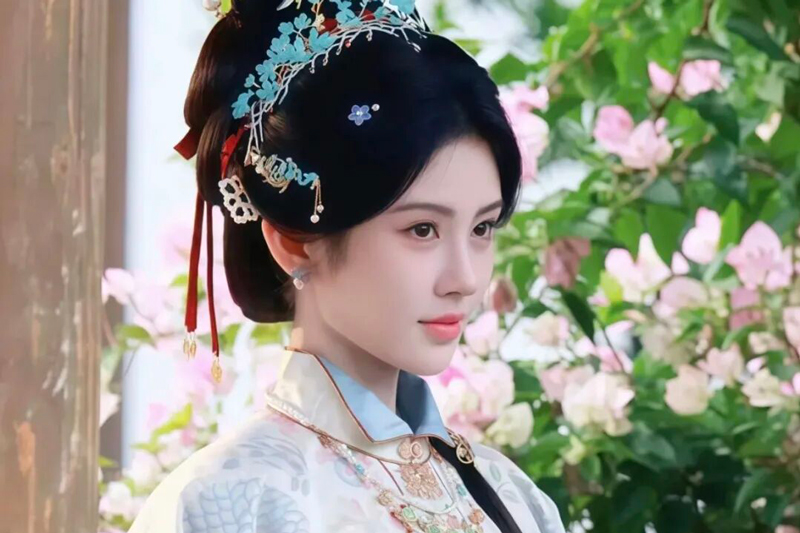
Ju Jingyi’s (鞠婧祎) costume in the upcoming series Wanhua Shijie (万花世界) has sparked a curious online debate: why is her collar flipped outward? Does this trending Ming Dynasty (1368–1644) style actually make her face look smaller, or is it just a modern aesthetic trick?
Historical Roots
To answer the question directly: yes, this folded collar, known as a Zhe Ling (折领) or turned-down collar, was a legitimate and fairly common styling choice in the late Ming Dynasty. It wasn’t a costumer’s invention. You can find it frequently in ancient portraiture. The logic behind it is surprisingly simple yet clever. Many modern viewers immediately compare it to a polo shirt, and they’re not entirely wrong. The mechanical principle of folding a structured collar down to create a new visual line is strikingly similar.

However, to understand the style, we must first look at its parent garment: the standing collar or Shu Ling (竖领). This was the standard for formal and everyday wear in the mid-to-late Ming period. The innovation, which is what we see on screen, was to fold the top edge of this standing collar outward. By turning it down, the wearer would expose the inner lining—often a stark, clean white—creating a visual effect akin to a “white border.” This touch of contrast gave the neckline a layered, architectural feel.
This wasn’t just a random choice. Archaeological evidence supports this practice, such as a short-sleeved standing-collar garment excavated from a Ming tomb in the southern regions of China. The discovery of such items confirms that the “white edge” frequently seen in paintings wasn’t just artistic license; it was the result of layering two garments. The inner layer, a shorter jacket, would have its collar flipped over the outer robe’s standing collar, creating that signature crisp white line. The folded collar was thus a feature of both structural layering and daily practicality.
Two Styles
The historical records and surviving artworks show that the folded collar generally manifested in two primary ways. The first is the direct fold. Here, the standing collar of the outer garment itself is turned down, as seen in Ju Jingyi’s costume. When folded, the fabric forms a broad triangle, displaying a contrasting color (like a vibrant blue) to frame the neck. This creates a wider visual base that cleverly contrasts with the slender line of the neck, giving the illusion of a smaller, more delicate face. It’s a masterstroke of optical design.

The second method is the inner fold. In this version, the outer garment keeps its standing collar pristine and upright around the neck. It is the collar of the inner garment (the base layer) that is flipped outward. This only reveals a subtle white trim along the top edge. This method was more subtle, adding a hint of refined texture to the outfit without altering the structured silhouette of the outer robe. It functioned more as a graceful accent than a dramatic style statement.

Additionally, depending on the occasion and social status, men of the era would adjust the sharpness of the fold. There was the “large turnover” (turning down half the collar), the “folded corner” (a minimal, precise fold), and the “standard fold” (a neat, uniform collar suitable for formal gatherings). However, historians note a crucial distinction: in settings of absolute formality, such as ancestral sacrifices or imperial audiences, collars were never folded. In those contexts, the standing collar had to remain fully upright, emphasizing completeness and propriety.
Ancient Logic
While the aesthetic appeal is undeniable, the ingenuity of the folded collar wasn’t solely about looking good. It had a highly practical purpose tied to geography and climate. In the hot and humid regions south of the Yangtze River, particularly in Lingnan (岭南), wearing a stiff, high standing collar could be stifling. Folding the collar down allowed for better air circulation around the neck. It acted as a natural ventilation system for the heavy robes typical of the Ming era, a simple yet effective solution to the subtropical heat. This is why many portraits featuring this specific fold are linked to figures from these southern areas.
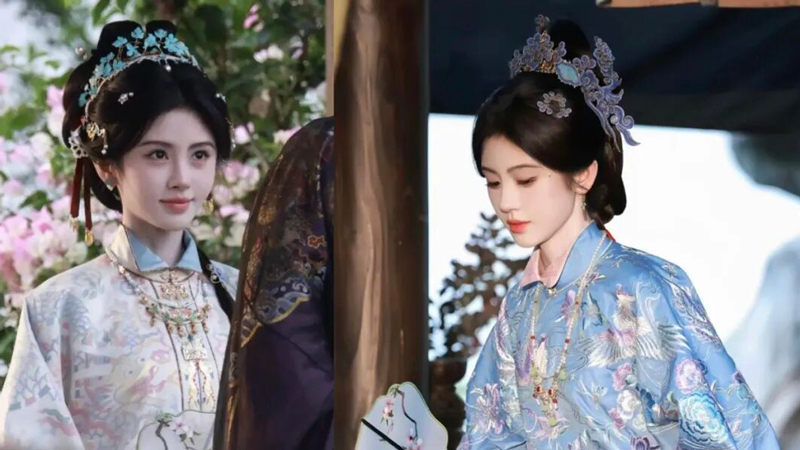
This bring us back to the modern screen. Producers of historical dramas like Wanhua Shijie are increasingly using traditional elements to enhance visual appeal. By making the folded collar smoother and the turnover proportion larger, costume designers visually shorten the neck and emphasize the jawline, a technique well-known in fashion. They are, in essence, adapting ancient wisdom for modern beauty standards. This adaptation serves a dual purpose: it meets the contemporary demand for “face-shrinking” aesthetics while simultaneously reviving and disseminating traditional clothing knowledge.
In this sense, the costume drama is becoming a powerful medium for cultural transmission. By putting historically inspired designs on popular stars, the shows introduce ancient craftsmanship to a mass audience in a digestible, contemporary way. The folded collar is no longer just a piece of history; it is a bridge connecting the practical wisdom of Ming dynasty tailors with the visual preferences of the 21st century. It proves that true style is timeless, and sometimes, the best new trends are the ones borrowed from the past.