
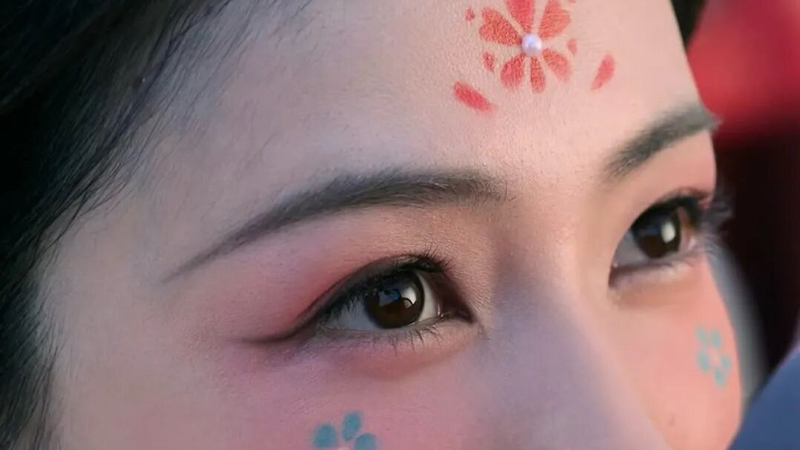
Bai Lu’s recent wedding scene in the historical drama The First Jasmine (莫离) has sparked a heated debate. Instead of the typical glamorous red lips and flawless skin, her character Ye Li (叶璃) appears with a face covered in intricate, colorful patterns. Many viewers were confused, with some even joking that the makeup artist must have had a personal grudge. However, this look is not a modern invention; it is a meticulous recreation of the Five Dynasties era Hua Dian (花钿), or facial adornment.
This practice, known as Mian Ye (面靥), was deeply rooted in the Buddhist culture of the time, where donors and devotees would adorn their faces with jewels and gold foil to mirror the sacred marks of Buddhist icons. It was less about vanity and more about a profound expression of faith and social identity. This article explores the cultural DNA behind this controversial makeup, moving beyond the initial shock to understand why a bride in 10th-century China would choose to look like a living, breathing fresco.
The Divine Blueprint: Faith on the Face
The origins of the Hua Dian in the Five Dynasties are profoundly religious. It is believed to be an emulation of the ūrṇā (白毫相), the white curl of hair between the eyebrows of the Buddha, which was considered a mark of great wisdom. By adorning their faces in this manner, individuals, particularly the devout donors depicted in the Dunhuang (敦煌) murals, sought to embody a fragment of the divine. It was a form of physical devotion, transforming the human face into a canvas for spiritual reverence.
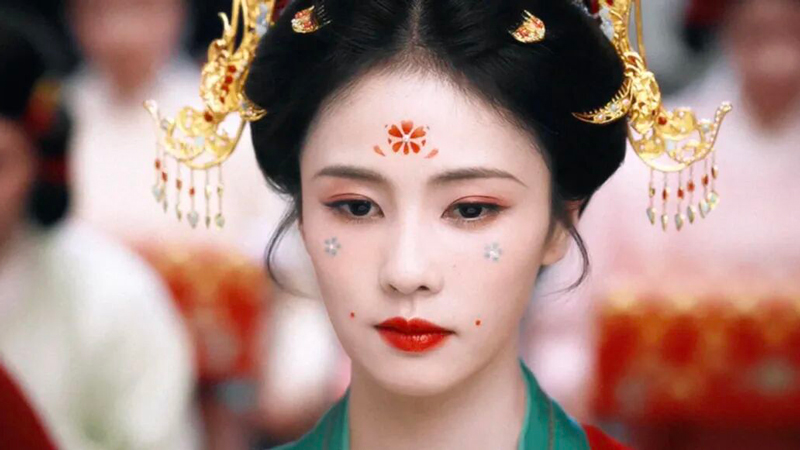
Bai Lu’s character, Ye Li, wears what historians consider a “basic” or classic version of the Five Dynasties Hua Dian. The primary motifs are floral, centered on the forehead and symmetrically distributed across the cheeks. While it appears complex, it follows a strict logic: the main decoration at the center of the brow is the largest, with the size and intricacy of the patterns decreasing as they move towards the jawline and temples. This creates a layered, cascading effect that is opulent yet orderly, a stark contrast to the chaotic impression it might leave on a modern viewer unacquainted with its history.
A Social Ladder Painted in Gold
Beyond faith, the Hua Dian functioned as a visible marker of social hierarchy in the Five Dynasties and the subsequent Guiyi Circuit (归义军) period. It was a non-verbal language of status. The materials used were a direct reflection of one’s rank. Common women might have used a simple, classic cinnabar red, while noblewomen distinguished themselves with opulent materials like pearls, gemstones, kingfisher feathers, and thin gold foil.
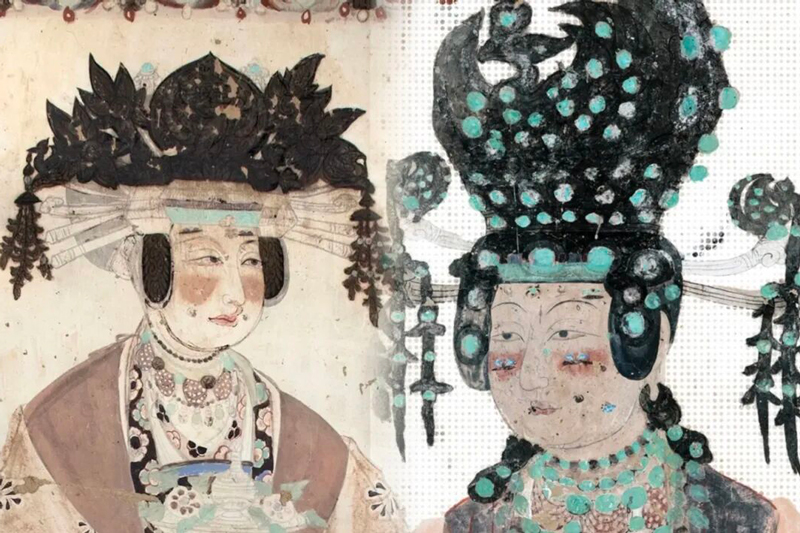
This distinction is evident in the surviving Dunhuang murals. The patterns were not uniform across all cultures, either. Han (汉) Chinese donors typically favored delicate floral motifs, such as the classic five-petal plum blossom on the forehead and small, symmetrical dots on the cheeks, presenting a restrained and elegant aesthetic. In contrast, the noblewomen of the Uyghur and Khotan kingdoms preferred more flamboyant styles. They would often enlarge the cheek adornments to create a stunning, centralized visual impact, incorporating bird-shaped Hua Dian —a signature motif of the era—to broadcast their elite status and cultural influence.
Beyond the Aesthetic: A Window to the Past
The popularity of this makeup style in dramas like The First Jasmine, Sword into Plowshares (太平年), and Moonlit Reunion (子夜归) highlights a growing interest in historical authenticity, but it also presents a challenge. While the intricate designs worn by actors like Bai Lu, Tian Xiwei (田曦薇), and Zhou Yutong (周雨彤) are visually arresting, they often clash with modern beauty standards that favor minimalist, natural looks.
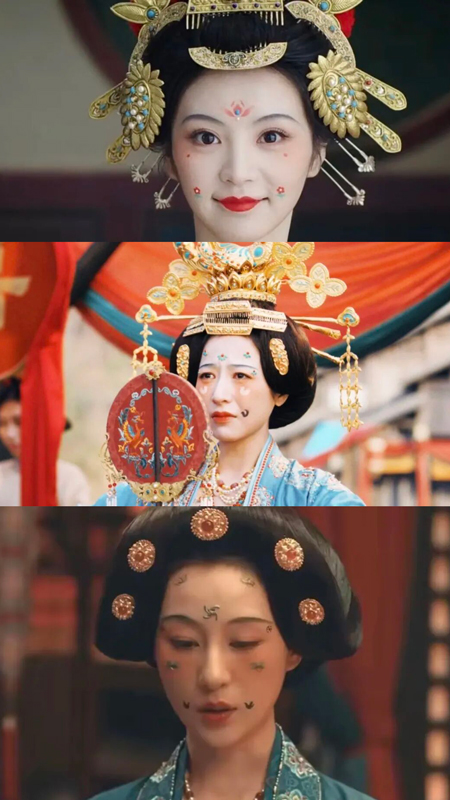
However, dismissing this makeup as simply “ugly” or “over-the-top” means missing the cultural tapestry it represents. The Hua Dian is a testament to a specific moment in history—the Five Dynasties—when Buddhist art, ethnic diversity, and strict social codes merged to create a unique visual language.
Tragically, many of the original murals that depict these intricate details have been vandalized over time. The holes left behind where jewels and gold foil were forcibly removed are a stark reminder of the very real, precious nature of these adornments. This makeup was not just fashion; it was an expensive, tangible display of piety and power. The next time you see a “gaudy” historical costume drama, it might be worth looking closer. The face you see is not just a character; it is a historical document, a mirror reflecting the complex soul of an era long past.