
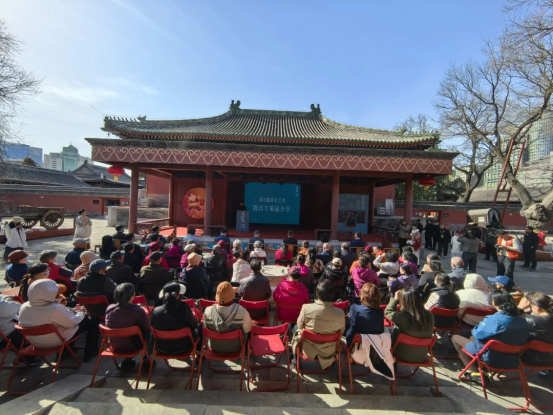
On March 27, 2026, the “Huaxia Yiguan — Liyun Dongyue: Traditional Chinese Costume Exhibition” (华夏衣冠·礼韵东岳——中国传统服饰展) officially opened at the Beijing Folk Museum. Organized by the Beijing Chaoyang District Culture and Tourism Bureau, the exhibition runs through October 10, 2026, offering visitors a rare journey through millennia of Chinese sartorial heritage.
The venue itself is a centerpiece of the experience. The Beijing Folk Museum is housed within Beijing Dongyue Temple (北京东岳庙), a Taoist temple with over 700 years of history dating back to the Yuan dynasty. The exhibition occupies four halls across the temple’s eastern and western side courtyards, merging the ancient architectural space with the ritual elegance of traditional Chinese dress to create a uniquely immersive atmosphere.
Three Thematic Sections Spanning Chinese Costume History
The exhibition is organized into three thematic units: “Historical Costumes by Dynasty”, “Ritual Costumes”, and “Seasonal Costumes”. Together, they present nearly 50 exhibit sets that trace the evolution of Chinese clothing from the pre-Qin era through successive dynasties.
Highlights include the pre-Qin shenyi (深衣), a one-piece robe deeply rooted in Zhou dynasty ritual propriety, and the Han dynasty quju (曲裾), a wrap-style robe recognizable by its spiraling hem. Each garment has been meticulously reconstructed by a professional team specializing in ancient costume research and restoration. Drawing on both archaeological evidence and historical textual records, the team has faithfully reproduced the original forms, patterns, weaving techniques, and wearing methods, offering an academically rigorous yet visually compelling portrait of how ancient Chinese people dressed across different periods.
Beyond clothing as everyday wear, the exhibition explores the profound role of costume in China’s ritual and ceremonial life. The “Ritual Costumes” section examines how clothing functioned within the framework of Confucian ritual music culture, while “Seasonal Costumes” highlights garments tied to traditional festivals and seasonal observances, revealing how attire once marked the rhythm of the lunar calendar.
Seasonal Rotations and Immersive Technology
The exhibition is designed to evolve over its six-month run. Curators will refresh the displays twice — once for the Dragon Boat Festival (Duanwu) and again for the Mid-Autumn Festival — introducing new themed exhibits aligned with each celebration. This dynamic approach rewards repeat visits and deepens the narrative connection between clothing and China’s festival traditions.
Technology plays a starring supporting role. Visitors can try an AI-powered digital photo experience that virtually dresses them in historical Chinese costumes, as well as MR (mixed reality) devices that overlay digital reconstructions onto the physical exhibition space. These interactive features invite guests, particularly younger audiences, to engage with traditional culture through a contemporary lens.
In the exhibition’s later phase, the museum plans a suite of offline public programs, including public lectures, intangible cultural heritage hands-on workshops, and guided tours led by knowledgeable docents. These activities aim to transform the exhibition from a passive viewing experience into an active, community-centered exploration of China’s clothing heritage.
The “Huaxia Yiguan — Liyun Dongyue” exhibition is open to the public at the Beijing Folk Museum from March 27 to October 10, 2026. For those seeking a deeper connection with Chinese history — whether through the quiet elegance of a Han dynasty robe or the playful spark of an AI costume selfie — this exhibition offers a thoughtful and richly layered encounter with the fabric of Chinese civilization.