
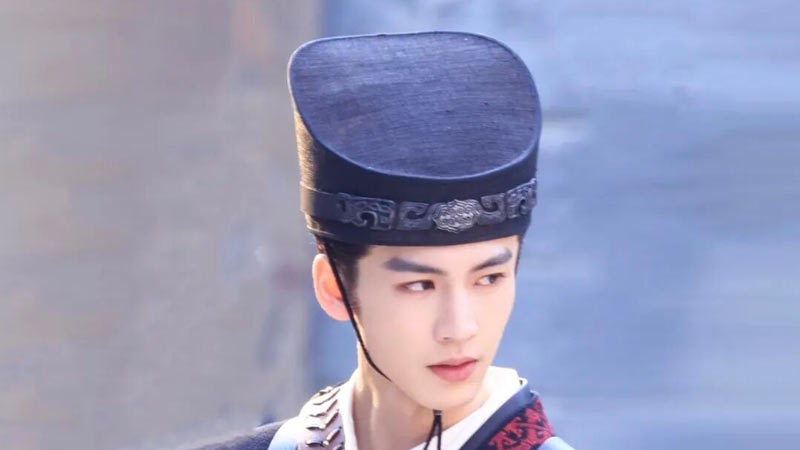
Zhang Linghe’s (张凌赫) black-and-red costume in the period drama The Road to Glory (归鸾) has sparked a wave of confusion. The hat perched on his head appears blocky and anachronistic, clashing violently with the flowing silhouettes usually associated with ancient Chinese court dramas. Viewers are asking: why does this piece feel so out of place, and why haven’t we seen it before on screen? The answer lies not in bad design, but in a fascinating collision between a forgotten historical artifact and the visual expectations shaped by decades of television.
The Historical Headwear
The source of the confusion is the Ping Jin Ze (平巾帻), specifically a type known as the “Ping Shang Ze” (平上帻). This hat originated in the Han and Wei dynasties as the standard headgear for military officers and palace guards. Unlike the towering, winged hats of the Tang dynasty or the sleek black gauze caps of the Ming, this original form is a low, flat-topped cylinder that fits snugly over a topknot. Its design is austere and practical. Historical records, such as the Book of Later Han, state it was the everyday wear for warriors, and it often served as an under-cap for helmets before evolving into a standalone court garment.

During the Wei and Jin periods, it shed its outer crown and became the signature look for military commanders. It was small, compact, and paired with a “Zan Dao” (簪导), a horizontal hairpin that fixed it to the head. However, this style is the antithesis of the fashionable headwear seen in most costume dramas today. Those shows favor the elaborate buns and flamboyant structures of the Song, Tang, and Ming dynasties. He is wearing a piece of history that simply hasn’t been featured in mainstream entertainment. The audience’s immediate feeling of “wrongness” is largely a product of unfamiliarity, a cognitive dissonance from seeing a rare historical artifact on screen.

Visual Distortion
While the Ping Jin Ze is historically accurate, the production team made a critical error in its adaptation for the camera. The original Wei-Jin version was low and compact, hugging the hair tightly. For the drama, it was enlarged significantly. The crown of the hat was raised, and the width was expanded, transforming a close-fitting cap into a large, square block. This pushed the design from the Wei-Jin style towards an earlier, heavier Eastern Han aesthetic. By amplifying its scale, it lost its sleekness and became an ungainly top, disrupting the natural proportions of the actor’s face and creating that top-heavy, clumsy silhouette.

Furthermore, the original Ping Jin Ze was a piece of unadorned practicality, typically made of plain black fabric. Yet, the costume designers added a layer of intricate, delicate trim around the brim. This decorative flourish is historically inappropriate. The simple, martial spirit of the Han and Jin garments relied on stark lines and uncluttered materials. This added ornamentation is a “painting the lily” moment, breaking the ancient atmosphere and pulling the viewer out of the historical setting. It makes the hat look less like authentic armor and more like a fantasy prop gone wrong.
Outfit Integration
The hat does not stand alone; it is part of a complete military ensemble from the Eastern Jin period. It is paired with the “Liangdang Armor” (裲裆甲), a vest of two plates connected by shoulder straps, and “Fuku” (缚裤), narrow-legged trousers tied at the ankles for horseback riding. This is a historically accurate trio. However, this is where the second wave of confusion hits. The audience is conditioned to associate ancient Chinese warriors with long, flowing robes, wide sleeves, and elaborate belts. His costume is a jarring contrast. He is dressed for mobility and combat, not for courtly ceremony.

This stark, minimalist look is almost never featured in martial arts films, which have long favored the more dramatic and visually complex armor of later dynasties. It lacks the “wow” factor of golden scale armor or the elegance of long, embroidered silk. It is a soldier’s uniform, and his no-frills appearance feels more like a historical reenactment than high drama. The production’s choice to use this rare Han-Jin style deserves praise for its ambition, but the oversized, heavily layered black robe worn over the armor further buries the clean lines of the original, making the entire silhouette feel heavy, dark, and lifeless.
A Noble Experiment in Historical Costuming
Ultimately, the strangeness of his attire is a story of two failures: one of popular memory and one of design execution. Half of the problem is that he is wearing a cultural artifact the public has never been taught to appreciate. The other half is the team’s misguided attempt to exaggerate and embellish that artifact until it lost its original essence.
It represents a rare, genuine attempt to depict the military dress of the Han-Jin period on screen, an attempt that is historically rooted but aesthetically clumsy. In trying to bridge the gap between ancient fact and modern visual appeal, the production lost sight of the very simplicity that made the original design great. It is a noble failure, a fascinating footnote in the evolution of period drama costuming.