

The first time many viewers see Dong Xuan (董璇) in the historical drama Jiangshan Datong (江山大同), their initial reaction is often one of confusion. The costume is not conventionally beautiful, lacking the bright filters common to period pieces and the ethereal grace of fantasy epics.
Yet, this “unappealing” aesthetic is precisely what makes it revolutionary. It represents a rare moment in Chinese television where historical accuracy is prioritized over modern beauty standards, marking a significant departure not just for the actress herself, but for the entire genre. To understand why this look feels so alien, we must travel back to the turbulent Wei-Jin period and examine the very real artifacts that inspired it.
The Golden Crown
What many dismiss as a gaudy “golden tree” on her head is actually a meticulously reconstructed Flower-Tree Step-Shaking Crown. This piece is not the product of a prop master’s fantasy but is based on actual artifacts unearthed from Jin Dynasty tombs in Liaoning. Its structure—a frame of gold branches laden with peach-shaped leaves—was a signature accessory for noblewomen of the Xianbei (鲜卑) people, a nomadic tribe that ruled much of northern China at the time.
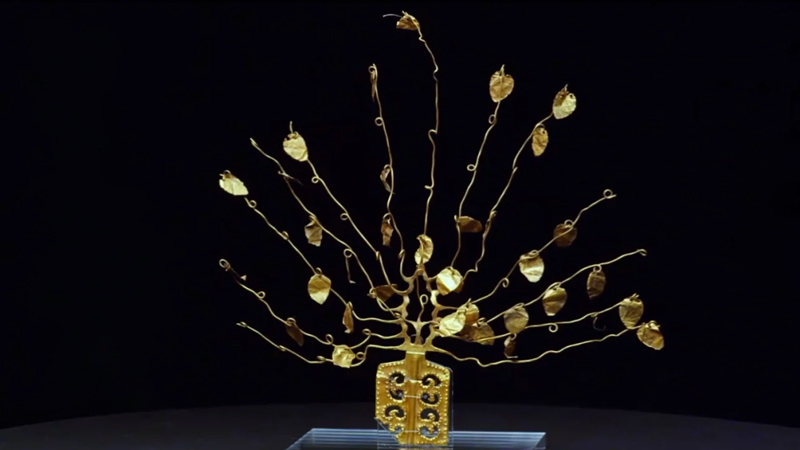
Unlike the gem-encrusted ornaments of later dynasties, this crown carries the rugged elegance of the steppe, a physical testament to the cultural exchange between the nomadic Xianbei and the Han Chinese. When Dong Xuan wears it, the branches tremble with every step, a deliberate effect designed to mirror the historical records that speak of the crown’s “swaying leaves and trembling gold.”
The Cross-Shaped Hair
Beneath the crown sits the Cross-Shaped Bun, an architectural feat of ancient hairstyling. This towering, symmetrical hairdo was the preferred style for aristocratic women of the era, serving both an aesthetic and a practical purpose. Its rigid, cross-like structure provided a stable platform for heavy metal ornaments like the step-shaking crown, ensuring that such elaborate headwear could be worn without collapsing.

In portraying this, Dong Xuan embodies a sense of dignity and formality that is often missing in modern dramas. It removes the illusion of effortless beauty and replaces it with a sense of ritual and status, reminding us that in the Wei-Jin period, a woman’s hair was a statement of power and social standing, not just a canvas for decoration.
The Feathered Sleeves
Her flowing Zaji (杂裾) garment, often referred to as a “feathered” or “layered” skirt, is another masterclass in historical detail. Moving away from the restrictive robes of the Han Dynasty, the Wei-Jin era celebrated a more liberal aesthetic—“broad robes and flowing belts”. This specific design features wide sleeves paired with a skirt adorned with multiple triangular silk panels and long streaming ribbons.
As the wearer moves, these ribbons and panels flutter like the tail of a swallow, creating a visual rhythm directly referenced in Gu Kaizhi’s (顾恺之) famous painting, Nymph of the Luo River (洛神赋图). It’s a design born of a chaotic era that valued spiritual freedom and natural grace. This is a world away from the tightly corseted costumes of the Qing Dynasty or the glittering silks of the Tang; it is a celebration of fluid movement, capturing the philosophical spirit of the age.

This commitment to authenticity, however, creates a jarring contrast with our modern expectations. We are conditioned to associate historical dramas with a specific, polished beauty. The stark simplicity of her makeup, the lack of heavy eyeliner, and the absence of ornate hairpins leave the character feeling almost naked on screen. But this is not a failure of design; it is a refusal to pander.
The costume team anchored her look to a specific historical moment rather than chasing contemporary aesthetics. It makes her character a believable product of the Northern Yan and Northern Wei era, where the roughness of nomadic life met the sophistication of Chinese court culture. The “strangeness” we perceive is actually a signal of the show’s dedication to verisimilitude.
A New Role
This is not the first time Dong Xuan has inhabited a historical or martial arts role, but it is her most striking departure from form. She is beloved for her iconic character Shangguan Yan (上官燕) from Snow Girl (雪花女神龙), a cold and sharp-edged female assassin clad in dark, fitted leather. Then there was her ethereal turn as Lin Chaoying (林朝英) in Return of the Condor Heroes (神雕侠侣), the founder of the Tomb Sect, whose beauty was otherworldly. In The Eight Heroes (八大豪侠), she was the pure and untouchable Su Wen (素问), and in Secrets of the Three Kingdoms (三国机密之潜龙在渊), she played the seductive Diao Chan (任红昌). In each of these roles, her beauty was a powerful, overt tool—a weapon of seduction or a symbol of purity. Her new role in Jiangshan Datong strips all of that away. The glamour is gone, replaced by a quiet, weathered dignity that speaks of a woman who has lived.

This evolution is a testament to her growth as an actress. The youthful sharpness in her eyes has mellowed into a profound sense of calm. She no longer needs to rely on dramatic makeup to convey character; the weight of the historical costume and her own life experience do the work. The way she moves in the layered skirt, the way her gaze holds a story, speaks to a depth her younger self could not have achieved.
In this portrait, we do not see a star playing dress-up; we see a woman embodying history. It is a performance that requires the audience to forget everything they know about period dramas and instead appreciate the quiet beauty of authenticity. This “misunderstood strangeness” is not a flaw, but the very soul of the character.