
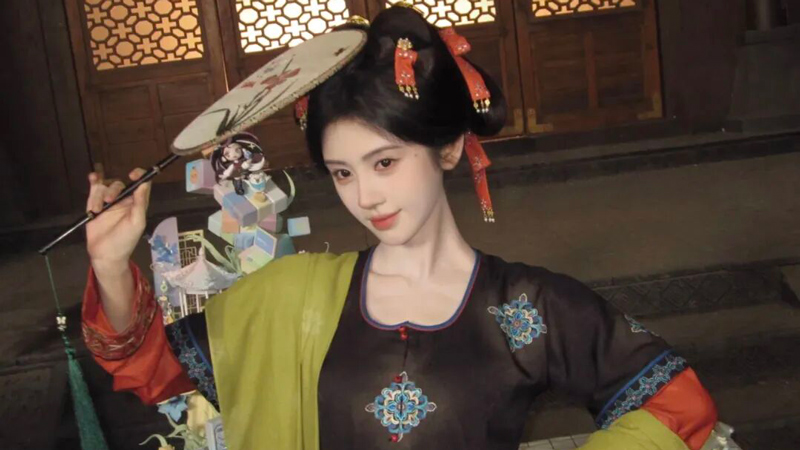
In the latest costume drama Wanhua Shijie (万花世界), actress Ju Jingyi (鞠婧祎) appears in a stunning Tang Dynasty outfit featuring a distinctive pointed neckline. The design has sparked heated debate online, with viewers divided over its purpose. Some argue it’s a practical addition to prevent wardrobe malfunctions, while others see it as a purely decorative flourish. Beneath the surface, however, this small tailoring detail reveals a fascinating story of cultural exchange, aesthetic evolution, and the bold fashion choices of ancient Chinese women.
More Than Just a Modesty Fix
Many commentators have labeled the pointed collar a “modesty piece.” However, this view flips cause and effect. During the early Tang and the reign of Empress Wu Zetian (武则天), women’s fashion celebrated openness and confidence. The most iconic upper garment was the Tan Ling (坦领), a low-cut, U-shaped neckline that displayed the collarbone and upper chest. Rather than concealing the body, this style highlighted a woman’s natural grace. The pointed collar, or the “sweetheart neckline” as it’s commonly known today, didn’t emerge from a desire to cover up but from a harmonious blend of imported fashion and local sensibilities.
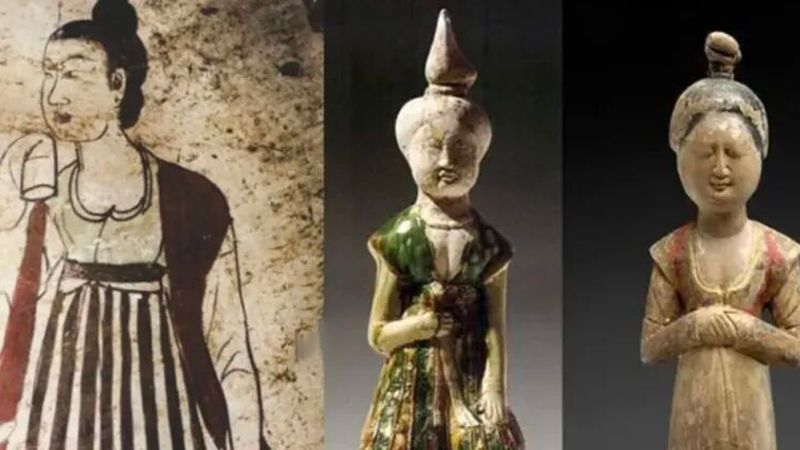
Its journey began along the Silk Road. During the Zhen Guan (贞观) period, Central Asian Hu (胡) clothing entered the Tang capital Chang’an (长安). These foreign garments featured narrow sleeves and open, wide U-shaped necklines. Local nobles and palace entertainers quickly embraced this relaxed silhouette. The sweetheart neckline evolved from this basic Hu influence. Unlike the purely rounded Tan Ling, the new version added a sharp point at the center bottom. This small alteration had a significant practical outcome. When a woman moved, walked, or bent down, the extra fabric at the center naturally drew the lapels together. It provided a subtle sense of security, preventing accidental exposure in everyday settings without sacrificing the aesthetic of openness that defined the era.
Double Duty: Fit and Function
The pointed neckline served a more complex purpose than simple modesty. Layering was a common practice in Tang fashion. A woman might wear a short jacket over a chest wrap, creating a sophisticated ensemble. However, these layers could shift or bunch up throughout the day. The sharp point of the collar acted as an anchor. It visually split the chest area and the upward-pointing angle of the garment provided a gentle counterforce. This clever design kept the inner garment in place, preventing it from sliding down and ensuring the entire outfit remained neat.
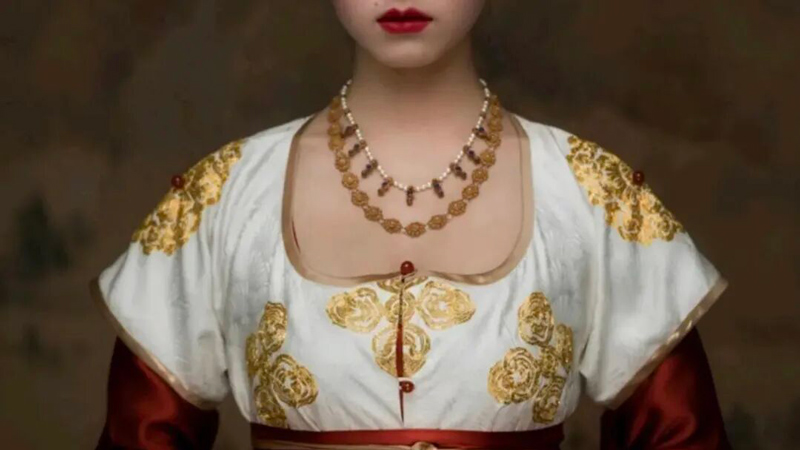
This construction is not about being prudish, but about practicality. It demonstrates an understanding of tailoring that balances aesthetics with the demands of daily life. In essence, the pointed collar was a functional tool for a multi-layered wardrobe, a solution crafted by ancient designers to solve a common clothing dilemma.
Beyond its structural utility, this collar shape delivered a striking visual effect. Tang dynasty aesthetics favored a full, elongated silhouette. The vertical line of the pointed collar cleverly elongated the neck, making it appear slimmer and more graceful. It drew the eye down the center of the body, elongating the torso and minimizing the width of the shoulders. When paired with flowing scarves, beaded necklaces, or ornate Ying Luo (璎珞) jewelry, the collar acted as a beautiful focal point. It framed the décolletage, creating a space where accessories could truly shine.
A Mirror of a Golden Age
The pointed collar’s existence is a perfect symbol of the inclusive and powerful spirit of the High Tang. Before this period, women’s clothing was largely conservative. From the Wei and Jin dynasties, high-necked, cross-collared garments were the standard, reflecting stricter social norms. It was during the Tang, with its immense national strength, that women’s social status rose dramatically. This newfound freedom was reflected in their fashion choices. They embraced bold styles, celebrating their forms.
Yet, this embrace was not a total rejection of tradition. The Tang women skillfully fused the foreign openness of the Hu style with a subtle, inherent sense of modesty. The sweetheart neckline, a hybrid of the open Tan Ling and the structured inner garment, became the physical manifestation of this cultural balance. It was a compromise between the liberated, “Western” influence and the reserved, traditional “Central Plains” aesthetic, all filtered through the confident lens of the empire’s most powerful women.
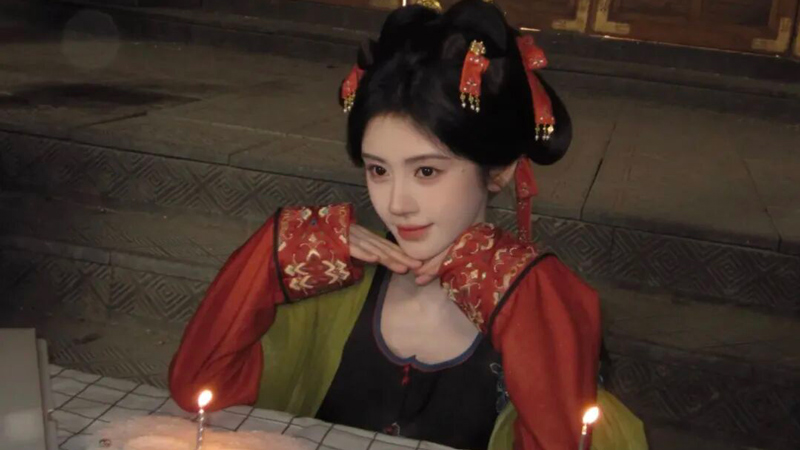
Many modern historical dramas simply copy the surface details of ancient costumes, missing the deeper cultural logic. The costume designers for Wanhua Shijie deserve credit for integrating this specific neckline from the Wu Zetian period. Its popularity, though relatively short-lived, peaked during the High Tang and then faded as fashions tightened in the mid-to-late dynasty. It stands not as a mere safety pin or a decorative frill, but as a testament to a time when fashion was a dialogue between cultures and a declaration of female confidence. It’s a detail that captures an entire civilization’s golden moment in a single, sharp point.