

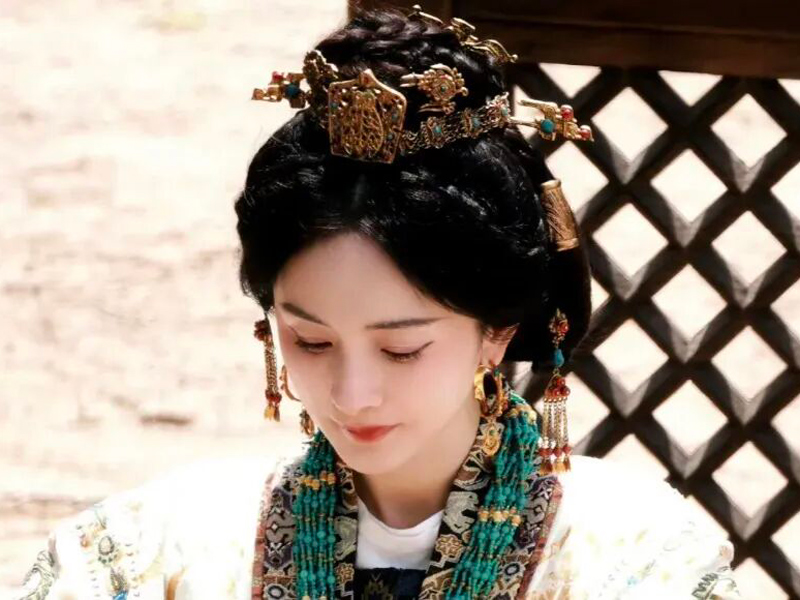
Yang Mi’s latest historical drama, Jiangshan Datong (江山大同), has sparked a fascinating debate. In a promotional still, her character, Empress Dowager Feng of the Northern Wei Dynasty, wears a striking gold, mountain-shaped ornament right at the front of her elaborate headdress. Almost immediately, eagle-eyed history buffs asked: “Isn’t that a men’s ornament?” The question went viral. Many assumed the costume department had made a glaring error, confusing a masculine piece of headgear for a woman’s accessory.
But the reality, as is often the case with history, is far more complex and intriguing. It turns out that the simple answer—”it’s for men”—is a gross oversimplification of how social status, fashion, and political symbolism evolved over a thousand years. What might seem like a major mistake on a multi-million dollar production is, in fact, a very specific and historically accurate detail that reveals the dynamic nature of ancient clothing rituals. The real story behind this single piece of gold is a journey through dynasties, power struggles, and a slow dissolution of strict social boundaries.
The Ornament in Question
The piece in question is known as a Dang (珰). In the Han and Jin dynasties, it was a male-exclusive crown ornament for high-ranking officials, a badge of honor that signified noble birth and bureaucratic rank. For a man to wear it, he had to be a member of the aristocracy; it wasn’t something a commoner could ever hope to possess. The Dang was most often seen on military officers, scholar-officials, and eunuchs.
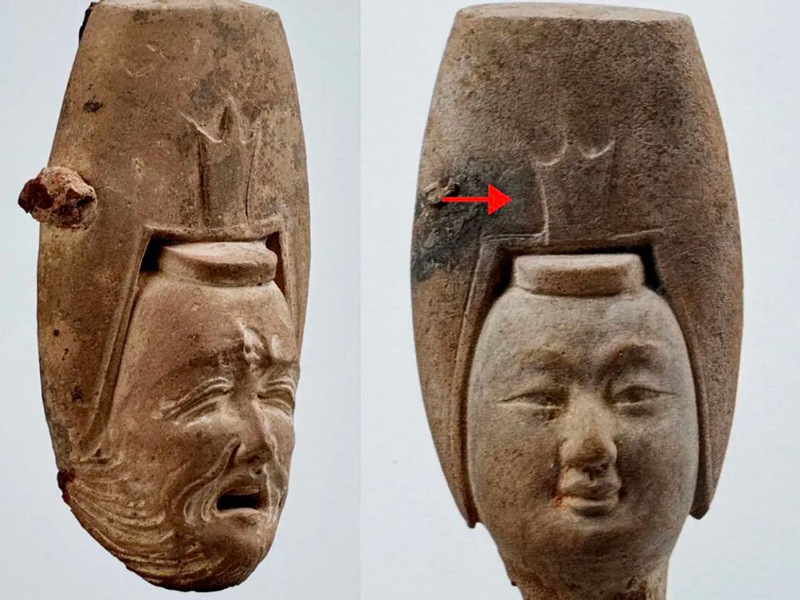
However, by the Wei-Jin period, these rigid rules began to erode. The social turmoil of the era often led to a relaxation of strict Confucian formalities, and with that came a flexibility in fashion. It is the latter period that is most relevant to the Jiangshan Datong costume, as the story is set in the subsequent Northern Wei era. This was a time of cultural fusion between the nomadic Xianbei (鲜卑) people and the Han Chinese, leading to a unique aesthetic that borrowed from both traditions. It is within this context of change that we see the Dang transcend its masculine origins and appear on the heads of influential women.
A Symbol of Power and Purity
The specific shape and decoration on the Dang are also vitally important. The gold plaques were often square or mountain-shaped and heavily featured the openwork design of a cicada. In ancient China, the cicada was not just an insect; it was a potent symbol of purity and high virtue, representing an official who “drank the dew and lived above the dust.” Historical texts from the period, like Cui Bao’s (崔豹) Gu Jin Zhu (古今注), describe the cicada as a symbol of a virtuous official who is humble and wise. This is why a piece of gold with a cicada was placed directly above an official’s forehead—so everyone could see that the wearer was a man of integrity and clarity.
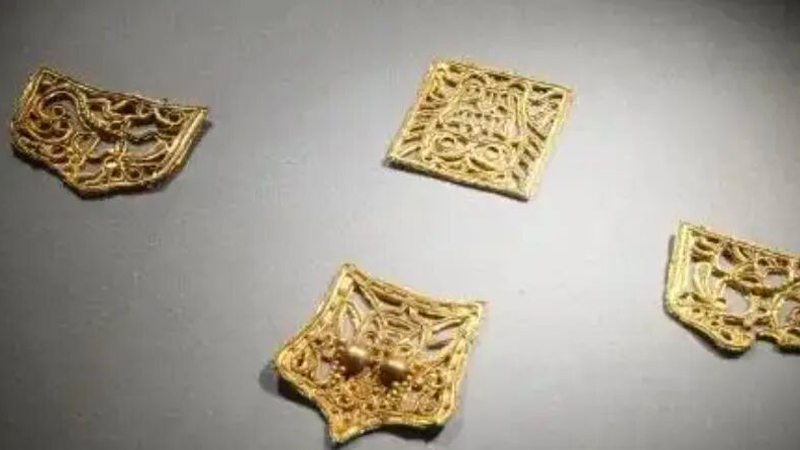
When paired with a marten tail on the side of the cap, it was known as the “Golden Cicada and Marten Tail,” or simply “Marten Cicada”. This was the origin of the term “Diaochan (貂蝉),” which many people mistakenly associate with the famous female beauty. In reality, “Diaochan” was purely a term for a type of male headdress, referring to the combination of a marten fur tail and the cicada gold plaque. The historical beauty was likely given this name as a title or descriptor, but the root of the word is firmly in male court attire.
Breaking the Gender Barrier
So, how did it get from a male-only symbol to the head of a woman? The liberation of the Dang from its gender-specific confines is well documented. During the Wei-Jin period, it wasn’t just the emperor and high ministers who could wear it; female court officials and the wives of high-ranking bureaucrats were also granted the privilege. Historical records, such as the Book of Jin (晋书), detail that female “imperial secretaries” would adorn themselves with the cicada ornament. Furthermore, archaeological evidence, like the discovery of such ornaments in the tomb of a noblewoman from the Eastern Jin period, substantiates this gender-bending trend. However, this wasn’t a universally accepted practice.
Conservative critics of the time, as recorded in the History of the Northern Dynasties, complained that this was a “monstrous garment”, an inappropriate and chaotic fashion choice. But the Wei-Jin period was a time of “fashion monsters”, where breaking the rules was part of the style. It was an era of remarkable personal expression, where rigid Han-era court etiquette gave way to a more relaxed and experimental attitude towards dress, making a woman like Empress Dowager Feng wearing a “male” ornament entirely plausible and historically rooted.
More Than Just a Headpiece
It is also important to distinguish this head Dang from the ear pendant, or Er Dang (耳珰). While the mountain-shaped plaque on Yang Mi’s forehead signifies political power and status, the ear Dang was a widely used, often inexpensive, accessory. A famous line from the Han Dynasty poem Peacock Flies Southeast (孔雀东南飞) mentions “wearing bright moon Er Dangs.” Unlike its cousin on the forehead, the ear Dang was worn by women of all classes.
However, its method of wear is often misunderstood. Han Chinese women did not generally pierce their ears. Instead, these ornaments were likely hung from a cord that looped over the ear or attached to a hairpin. The fact that the production of Jiangshan Datong chose the forehead Dang over the more common earring is a deliberate choice to depict the Empress Dowager’s supreme authority.
The authenticity of this small detail is a testament to the show’s commitment to research, as very few dramas set in the Northern Wei period exist, making this a brave and laudable artistic choice. It shows that true classical beauty isn’t about blindly recreating a “vintage” look, but about accurately presenting the nuanced, and sometimes surprising, evolution of cultural heritage.