

Every Dragon Boat Festival, families across China gather around tables to wrap Zong Zi (粽子, Chinese sticky rice dumplings), and the perennial debate over sweet versus savory fillings heats up once again. Many assume that ancient Zong Zi were predominantly sweet, stuffed with red dates or candied fruits, and that meat-filled versions emerged much later. But a remarkable artifact—buried underground for nine centuries—has completely overturned that assumption. In 2014, archaeologists in Anhui Province unearthed a pair of Zong Zi from a Northern Song Dynasty tomb.
After careful testing, they confirmed that the fillings were unequivocally meat-based. Yes, pork. It seems that our ancestors were already team savory back in the 12th century, though some netizens jokingly quipped: “Maybe they only buried the savory ones because they’d already eaten all the sweet ones!” We’ll leave that debate for now, but one thing is certain: this discovery rewrites the history of a beloved festival food.
The Tomb Discovery
These national treasures came to light in 2014 from the Xu (徐) family tomb complex at Tie Guai Cun (铁拐村), Nanling (南陵) County, Anhui. Based on the coins and funerary banners found alongside, the burial date was calculated to be no later than 1113 AD, during the Northern Song Dynasty—over nine hundred years ago. That makes them the earliest complete four-cornered Zong Zi ever found in Chinese archaeology, now preserved at the Nanling County Museum. The tomb belonged to the mother of a high-ranking official, a noblewoman of considerable status, and the family followed the ancient ritual of “serving the dead as if they were living,” placing seasonal Dragon Boat treats in her burial chamber. Thanks to that devotion, we can now glimpse a Song Dynasty festive table.
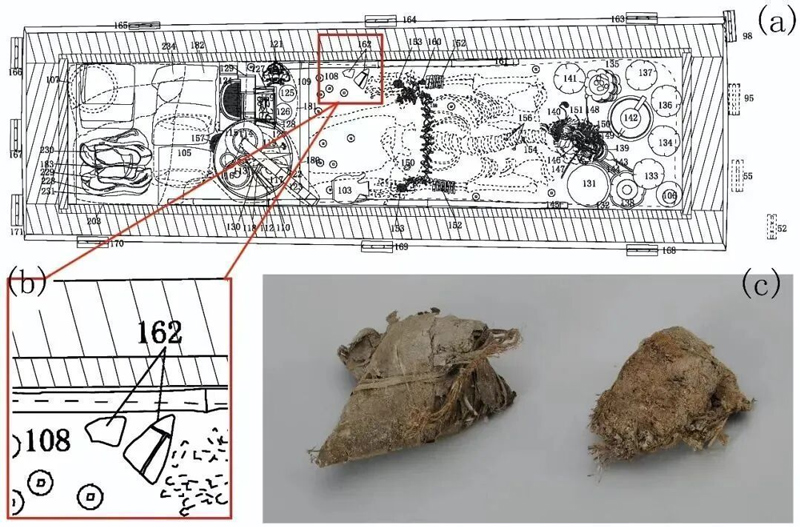
Two dumplings rested peacefully in the tomb’s storage area, one remarkably intact and the other partially decayed. The better-preserved specimen still had its bamboo leaves tightly wrapped; the outer leaves of the other had mostly fallen away, exposing the inner structure. Their shape is the familiar triangular pyramid with four sharp corners, virtually identical to the Zong Zi you’d buy at a wet market today. Even the leaf wrapping and binding cords show little difference from modern techniques. The outer layer used locally grown wild bamboo leaves, folded layer upon layer, then tightly secured with thin, tough plant-fiber twine. The winding patterns and knotting methods closely match those still used by home cooks during the festival.
Using microscopic analysis, the research team compared the thousand-year-old bamboo leaves with contemporary ones. The fibrous structures and venation patterns were almost indistinguishable, proving that the raw materials and fundamental techniques for Zong Zi-making had already become standardized and continuously transmitted by the Song era. This continuity of craft is itself a quiet testament to culinary heritage—a hand-to-hand tradition surviving dynastic changes, wars, and social upheavals.
The Scientific Test
Naturally, the first question everyone asks is: how could experts determine the filling after nearly a millennium of decomposition? Instead of unwrapping the artifacts, archaeologists employed non-destructive CT scanning to peer inside. They found no traces of date pits or fruit seeds, which would have been expected in sweet versions. Instead, the scans revealed dense, blocky organic matter. Subsequent micro-sampling and biochemical analysis identified orderly arrangements of animal muscle protein fibers, ruling out nuts, grains, or preserved fruits. The evidence was clear: the core filling was meat. The results, when first released, surprised many—suddenly, the sweet-versus-savory war had an ancient winner, and it was savory.
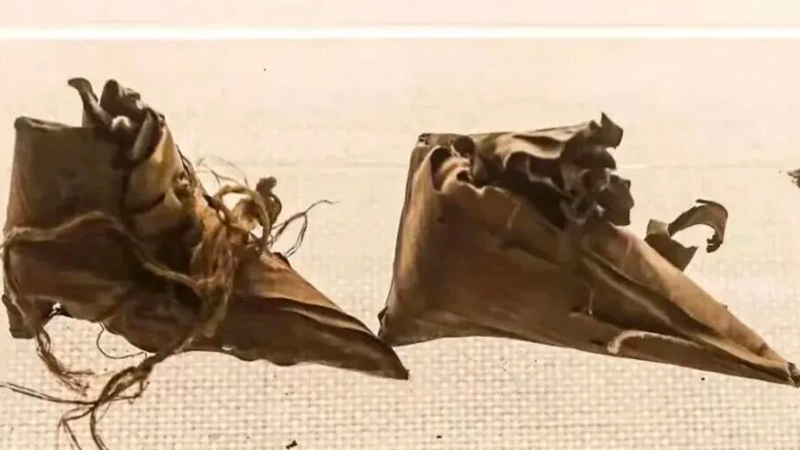
Some may recall another famous discovery: the Southern Song Zong Zi from Jiangxi’s (江西) De’an (德安) County, unearthed in 1988. Those two miniature triangular dumplings, buried in 1274, are about 750 years old—still ancient, but over a century younger than the Anhui specimens. They measure only 6 cm long and 3 cm wide, cute bite-sized treats. However, their internal organic material had completely decayed, making filling identification impossible; only the leaf wrapping and ties could be studied. So while the De’an Zong Zi are valuable, they cannot settle the flavor debate. The Nanling meat Zong Zi, with their detectable protein, offer concrete evidence that savory fillings were already established well before the Southern Song.
This scientific detective work underscores how modern technology can breathe life into ancient crumbs. CT scans and micro-spectroscopy are not just for medical or industrial use—they have become essential tools for food archaeology, allowing us to interrogate the past without destroying its fragile remnants. And what they revealed was a direct challenge to our preconceived notions about historical diets.
A Culinary Revolution
Tracing the history of Zong Zi, we see that the Song Dynasty was a golden age for this treat. Originally called “Jiao Shu” (角黍) in pre-Qin times, it was made solely with millet and offered in ancestral rituals. By the Wei and Jin periods, the Dragon Boat custom of eating Zong Zi took shape, still with plain millet. In the Tang Dynasty, sticky glutinous rice replaced coarse millet, and varieties slowly multiplied. But it was the prosperous, market-driven Song Dynasty that turned Zong Zi into a national snack. Historical records list fillings like chestnut, walnut, ginger-cinnamon, and even bayberry-fruit versions. The poet Su Dongpo (苏东坡) once wrote about enjoying fruit-stuffed Zong Zi. Both sweet and savory styles coexisted; there is no evidence that ancient people exclusively preferred sweet ones.

Conventional wisdom had held that fresh pork Zong Zi were a Ming-Qing innovation from the Jiangnan region. These two Northern Song meat dumplings have now filled a conspicuous gap in culinary history. In the Huaihe-Yangtze region, domestic poultry and pork were relatively accessible to common households, so meat Zong Zi were not exclusive to the elite. Their rare survival in aristocratic burials—where organic remains are better preserved—misled us into thinking savory Zong Zi appeared late. The noblewoman, who came from a wealthy lineage, likely enjoyed meat Zong Zi regularly, proving that by the Northern Song, this flavor had already made its way to everyday festive tables. And she clearly loved them enough to take them to the afterlife.
Nine hundred years later, the combination of bamboo-leaf fragrance, sticky rice, and rich meat flavor remains a festive favorite. The carbonized, seemingly withered dumplings in the museum case are not mere curiosities; they are messengers of folk custom spanning a millennium. They not only demonstrate the unbroken transmission of the four-cornered wrapping technique but also shatter stereotypes about ancient taste preferences. Every Dragon Boat Festival today, as we bite into our savory Zong Zi, we are sharing the same festive warmth and flavor as Northern Song commoners. Sweet or savory, there is no superior choice—both traditions have persisted from the Song to the present, embodying our enduring ritual of the season. And this thousand-year-old dumpling has preserved that culinary romance across time, inviting us to pick our side with a newfound respect for history.